Capital Gains Tax on Home Sale: Complete Guide to Primary Residence Exclusion
Complete guide to capital gains tax on home sales. Learn Section 121 exclusion rules, how to calculate your gain, partial exclusions, and strategies to reduce tax when selling your primary residence.

🏡 Capital Gains Tax on Home Sale: The Complete Picture
Selling your home is one of the biggest financial decisions you will ever make, and understanding the capital gains tax implications is crucial to keeping as much of your profit as possible. The good news is that the IRS provides a generous tax break for homeowners through the Section 121 exclusion, which allows you to exclude a significant portion of your gain from taxation. The bad news is that many homeowners do not understand the rules and end up paying more tax than they should.
When you sell your home for more than you paid for it, the difference between the sale price and your adjusted cost basis is your capital gain. Your cost basis includes the original purchase price plus closing costs, improvements, and additions. It does not include routine maintenance, repairs, or decorations. The larger your cost basis, the smaller your gain, and the less tax you owe. This is why keeping good records of every home improvement project is so important. Every dollar you add to your basis is a dollar you do not pay tax on when you sell.
The capital gains tax on a home sale is not automatic. Whether you owe tax and how much depends on several factors including your filing status, how long you lived in the home, whether you used it for business purposes, and how much gain you realized. Understanding capital gains tax when selling your home requires knowing the specific rules and exceptions that apply to primary residences.
📊 Section 121 Exclusion: How It Works
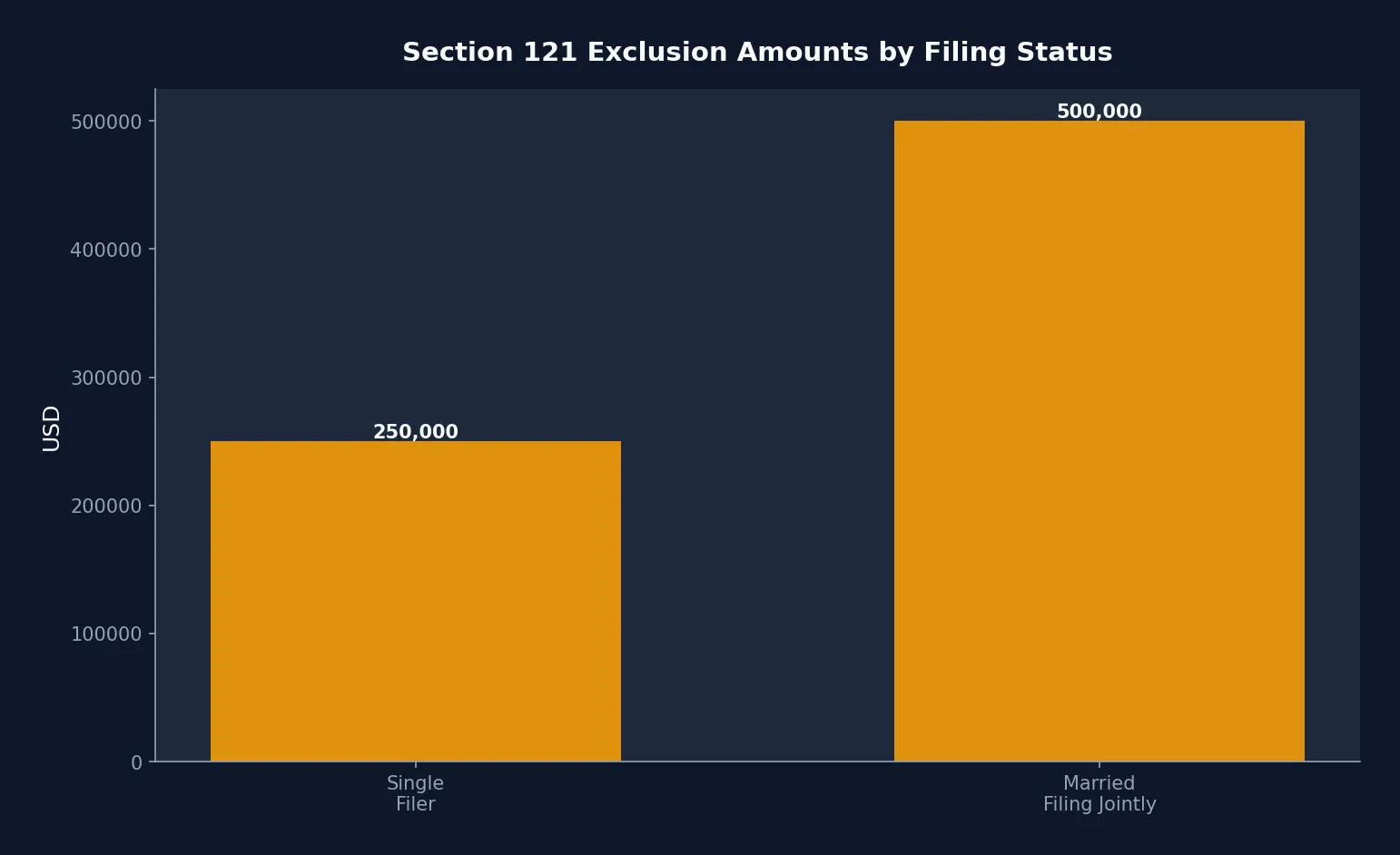
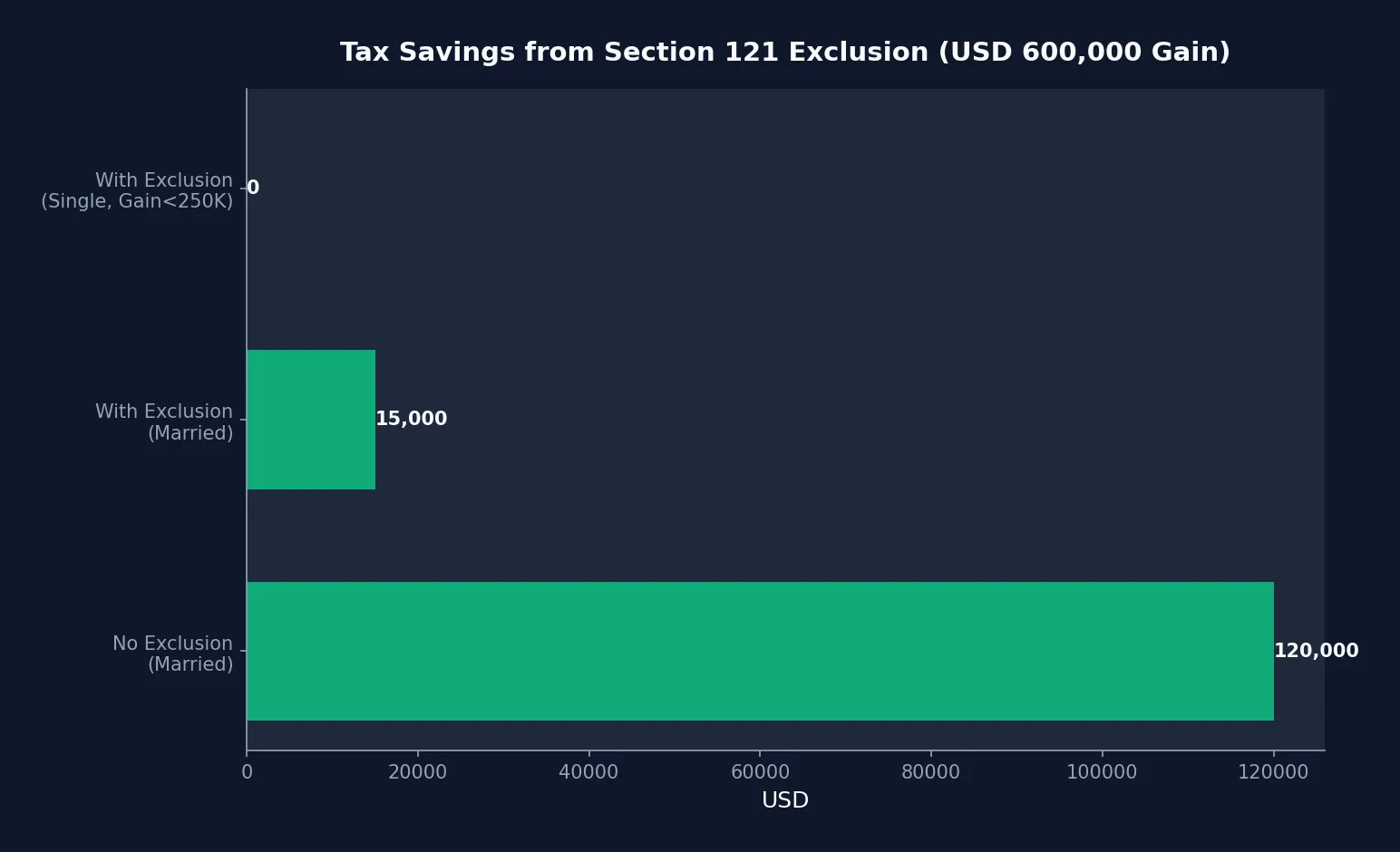
The Section 121 exclusion is the single most important tax provision for homeowners. It allows you to exclude up to USD 250,000 of gain from the sale of your primary residence if you are a single filer, or up to USD 500,000 if you are married filing jointly. This exclusion is not a deduction that reduces your taxable income. It is an outright exclusion, which means the excluded amount is never taxed at all.
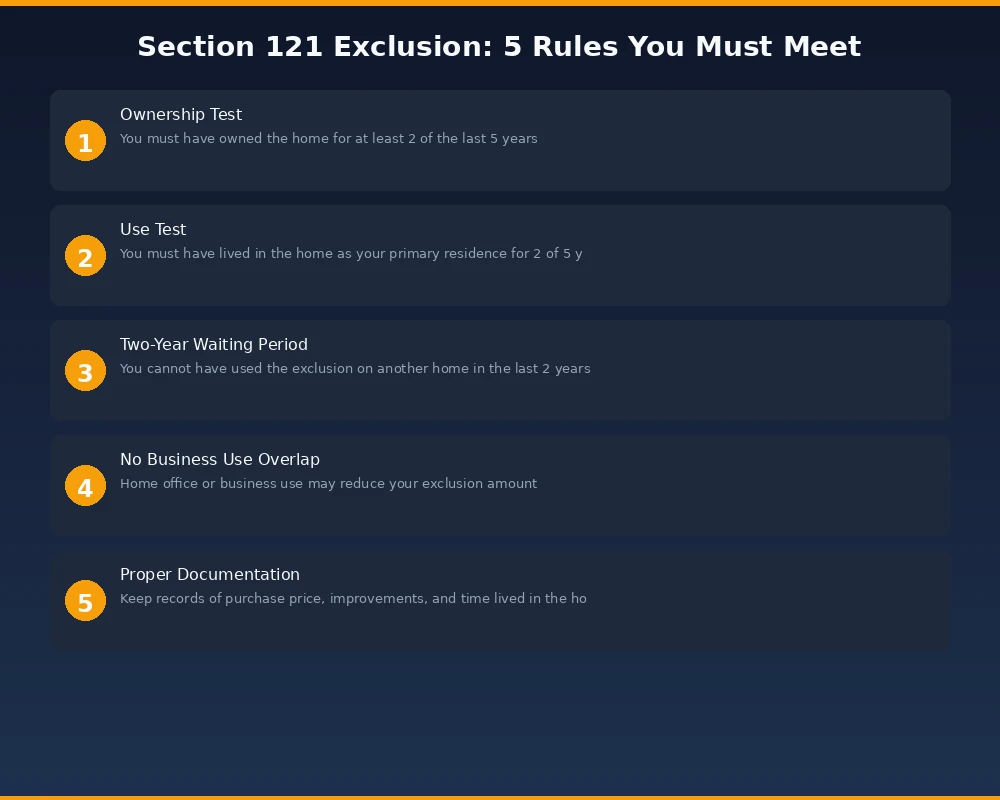
To qualify for the full exclusion, you must meet three tests. First, the ownership test: you must have owned the home for at least two of the five years ending on the date of sale. Second, the use test: you must have lived in the home as your primary residence for at least two of the five years ending on the date of sale. Third, the waiting period test: you must not have used the exclusion on the sale of another home during the two-year period ending on the date of sale.
The two years of ownership and use do not have to be consecutive. You could live in the home for one year, rent it out for two years, move back in for another year, and then sell. As long as you totaled at least 24 months of ownership and 24 months of primary residence use during the five-year period, you qualify. This flexibility is especially helpful for homeowners who are transferred for work or who need to temporarily relocate for other reasons.
✅ Who Qualifies for the Primary Residence Exclusion?
Not everyone who sells a home qualifies for the Section 121 exclusion. The IRS is specific about who can claim it and under what circumstances. The most common qualifying scenario is a homeowner who has lived in their home for at least two years and is selling it for the first time in at least two years. But there are several less common situations that also qualify, and some that do not.
If you are married and filing jointly, you can claim the USD 500,000 exclusion even if only one spouse owned the home, as long as both spouses lived in it as their primary residence for at least two of the five years before the sale. This is a significant benefit for couples where one spouse owned the home before the marriage. However, if either spouse used the exclusion on another home sale within the past two years, the exclusion is reduced to USD 250,000.
Surviving spouses get a special two-year grace period. If your spouse dies and you sell the home within two years of their death, you can still claim the full USD 500,000 exclusion as long as you meet the other requirements. After two years, you are limited to the USD 250,000 single-filer exclusion. Our article on capital gains tax planning for seniors and retirees covers this and other rules that affect older homeowners.
🧮 How to Calculate Your Home Sale Capital Gain
Calculating your capital gain on a home sale is more involved than simply subtracting what you paid from what you sold it for. The IRS allows you to include several expenses in your cost basis that many homeowners overlook. These include the purchase price, closing costs at the time of purchase, the cost of improvements and additions, and special assessments for local improvements. They do not include routine maintenance, repairs, or decorating costs.
On the sale side, you can reduce your gain by subtracting selling costs from your proceeds. These include real estate commissions, transfer taxes, advertising fees, legal fees, and any repairs you made specifically to sell the home. The difference between your adjusted cost basis and your net sale proceeds is your capital gain. If that gain is less than your exclusion amount, you owe no federal capital gains tax at all.
Here is an example. You bought a home for USD 300,000 and paid USD 5,000 in closing costs. Over the years, you added a USD 30,000 kitchen renovation, a USD 15,000 bathroom remodel, and a USD 10,000 deck. Your adjusted cost basis is USD 360,000. You sell the home for USD 650,000 and pay USD 39,000 in commissions and USD 3,000 in closing costs. Your net proceeds are USD 608,000. Your capital gain is USD 608,000 minus USD 360,000, which equals USD 248,000. If you are single, the entire gain is excluded under Section 121. If you are married, the entire gain is excluded as well, since it is well below USD 500,000. For a detailed calculator, see our guide on capital gains tax calculator to estimate what you owe.
⚠️ What Happens When Your Gain Exceeds the Exclusion
If your capital gain exceeds the Section 121 exclusion amount, the excess is taxed as a long-term capital gain at the regular rates of 0, 15, or 20 percent, depending on your taxable income. For example, if you are single and your gain is USD 350,000, the first USD 250,000 is excluded and the remaining USD 100,000 is taxable. If you are in the 15 percent long-term capital gains bracket, you would owe USD 15,000 in federal tax on the excess.
This is where good record keeping becomes critical. Many homeowners fail to document their improvements, which means they cannot add them to their cost basis. If you spent USD 50,000 on a new roof, HVAC system, and kitchen renovation but have no receipts or records, the IRS will not let you include those costs in your basis. That USD 50,000 omission could cost you an extra USD 7,500 to USD 10,000 in capital gains tax.
High-gain home sales are becoming more common in markets like California, New York, and Seattle, where home values have appreciated dramatically over the past decade. Homeowners in these areas may find that their gains far exceed the Section 121 exclusion, especially if they have owned their homes for many years. Understanding capital gains tax thresholds and income limits can help you plan for the tax impact of a large gain.
🔄 Partial Exclusion and Special Circumstances
If you do not meet the full two-year ownership and use test, you may still qualify for a partial exclusion if the sale was due to a change in employment, health reasons, or unforeseen circumstances. The partial exclusion is prorated based on the fraction of the two-year period that you did meet the requirements. For example, if you lived in the home for one year before being transferred for work, you would qualify for half of the full exclusion, or USD 125,000 if you are single and USD 250,000 if you are married.
Unforeseen circumstances include events like the death of a spouse, divorce or legal separation, multiple births from the same pregnancy, natural or man-made disasters, and acts of war or terrorism. The IRS also considers involuntary conversions, such as when your home is condemned or destroyed, as qualifying events. If you think you might qualify for a partial exclusion, consult a tax professional to make sure you meet all the requirements.
Military service members get special treatment under the Military Family Tax Relief Act. If you are on qualified official extended duty, the five-year period for the ownership and use test can be suspended for up to 10 years. This means you could live in your home for two years, serve on military duty for several years, and still qualify for the full exclusion when you sell, even if more than five years have passed since you moved out.
🗺️ Home Sale Capital Gains and State Taxes
While the Section 121 exclusion is a federal provision, most states also offer some form of capital gains exclusion on home sales. However, the amounts and rules vary significantly from state to state. Some states conform fully to the federal exclusion, while others have their own rules or no exclusion at all. California, for example, does not offer a separate state-level exclusion, but it does follow the federal Section 121 rules for state tax purposes.
States with no income tax, such as Texas, Florida, and Washington, do not tax capital gains on home sales at all. This is one of the reasons these states are attractive to retirees and high-income homeowners who are planning to sell a highly appreciated property. For a complete comparison of all 50 states, see our guide on state capital gains tax rates across the country.
🛡️ Strategies to Reduce Home Sale Capital Gains Tax
Even if your gain exceeds the Section 121 exclusion, there are strategies you can use to reduce your tax bill. The most important one is to maximize your cost basis by documenting every improvement you have made to the home. This includes major renovations like kitchen and bathroom remodels, room additions, new roofs, HVAC systems, and landscaping. It also includes less obvious costs like the installation of a security system, a new driveway, or built-in appliances.
Another strategy is to time your sale carefully. If you are close to the two-year ownership or use mark, waiting a few extra months to sell could qualify you for the full exclusion. If you are married and only one spouse has lived in the home, having both spouses live there for the required period can double your exclusion from USD 250,000 to USD 500,000.
If you have a very large gain that far exceeds the exclusion, consider converting the property to a rental first and then doing a 1031 exchange. This strategy allows you to defer the tax on the entire gain, not just the excluded portion. However, you must rent the property for a legitimate period before selling, and the IRS may challenge exchanges that appear to be primarily tax-motivated. Read about 1031 exchange rules to defer capital gains tax to understand the requirements and timeline.
You can also offset your home sale gain with capital losses from other investments. If you have losses in your stock portfolio, selling those positions in the same year as your home sale can reduce the taxable portion of your gain. The tax loss harvesting strategies for investment losses can help you generate losses to offset your home sale gain if you do not already have them.
❌ Common Mistakes Home Sellers Make
The most common mistake home sellers make is failing to document their improvements. Without receipts, contracts, and other records, you cannot add these costs to your basis, and your gain will be larger than it should be. Keep a file for every home improvement project, no matter how small. Take photos before and after, save the contractor invoices, and keep the canceled checks or credit card statements.
Another mistake is selling too soon. If you have lived in the home for 22 months and you are considering selling, waiting just two more months could save you thousands of dollars in capital gains tax. The difference between qualifying for the exclusion and not qualifying is the difference between paying zero tax and paying 15 or 20 percent on your entire gain.
A third mistake is forgetting about depreciation recapture. If you used part of your home for business or rented it out at any point, you may have claimed depreciation on that portion. When you sell, you will need to pay recapture tax on the depreciated portion, which reduces the benefit of the Section 121 exclusion. Understanding depreciation recapture tax when selling investment property is essential if you ever used your home for business purposes.
✅ Key Takeaways for Home Sellers
Selling your home is a major financial event, and the tax consequences can be significant if you do not plan properly. The Section 121 exclusion is your most powerful tool, but it only works if you meet the ownership and use tests. Document every improvement, time your sale carefully, and consider all available strategies to reduce your gain before you list the property.
For most homeowners, the Section 121 exclusion will eliminate their entire capital gains tax liability. But for those with significant gains, especially in high-appreciation markets, the excess can result in a substantial tax bill. Planning ahead, understanding the rules, and keeping good records are the three keys to minimizing your tax and keeping more of your hard-earned profit. For more information on related topics, explore our guides on Section 121 exclusion when selling your home and short-term versus long-term capital gains tax rates.
Fact-Checked & Reviewed
This article was written by David Chen (JD, LLM in Taxation (New York University)) and reviewed for accuracy by Sarah Mitchell (CPA, MST (Master of Science in Taxation)). Published by Wasim Akram, Founder & Lead Researcher at TaxGainsCalc. All tax rates, thresholds, and rules referenced are based on IRS publications and current tax law as of the date published. Tax laws change frequently — always consult a qualified tax professional for advice specific to your situation.
Tax Attorney & Legal Editor
David Chen is a tax attorney with a Juris Doctor and a Master of Laws in Taxation from New York University School of Law. With over 10 years of legal practice, he specializes in 1031 exchanges, capital gains tax law, and IRS dispute resolution. David...
Certified Public Accountant (CPA)
Sarah Mitchell is a Certified Public Accountant with over 15 years of experience in individual and business taxation. She holds a Master of Science in Taxation from Golden Gate University and specializes in capital gains tax planning, investment tax ...

Founder & Lead Researcher, TaxGainsCalc
Wasim Akram is an independent web publisher and digital entrepreneur based in India. Since 2018, he has been building custom CMS platforms, WordPress plugins, niche websites, and AI-powered digital products with over 8 years of real-world experience....
Disclaimer: This article is for informational purposes only and does not constitute tax, legal, or financial advice. Tax laws and regulations change frequently, and the information presented here may not reflect the most current updates. You should consult with a qualified CPA, tax attorney, or financial advisor before making any tax-related decisions. TaxGainsCalc is not responsible for any actions taken based on the information provided in this article.