Section 121 Exclusion: How to Exclude Up to $500,000 When Selling Your Home
Complete guide to the Section 121 exclusion for home sellers. Learn who qualifies, how to calculate your exclusion, special rules for married couples, and when the exclusion may be reduced or denied by the IRS.
When you sell your primary residence, the profit you make could be substantial. Home values in many markets have appreciated significantly over the past decade, and a homeowner who purchased a property for $300,000 might easily sell it for $600,000 or more today. Without the Section 121 exclusion, that $300,000 gain would be subject to capital gains tax, potentially costing you tens of thousands of dollars. Fortunately, the IRS provides a powerful tax break that allows most homeowners to exclude a significant portion of that gain entirely.
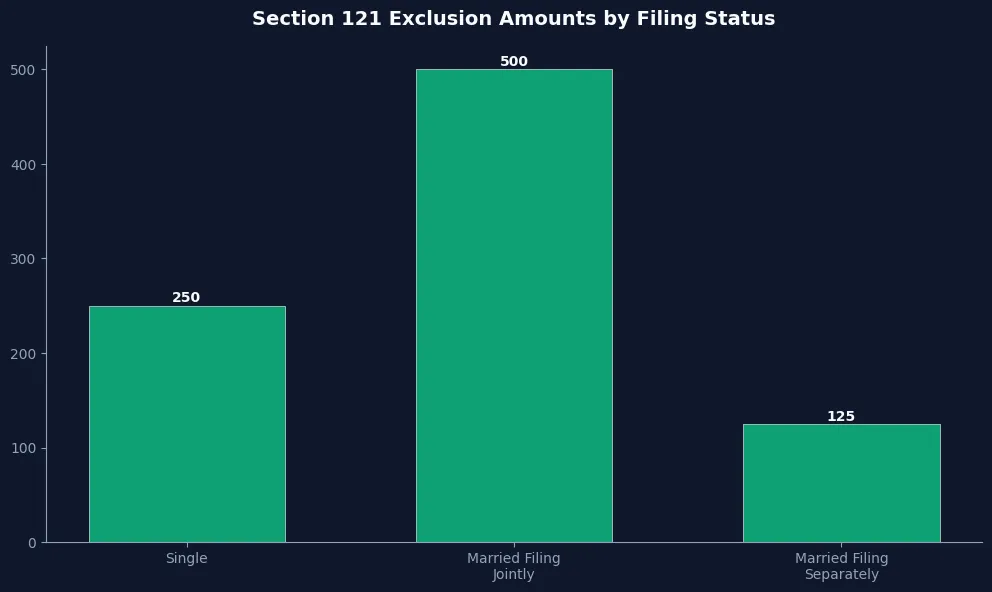
The Section 121 exclusion is one of the most valuable tax benefits available to American homeowners. It allows you to exclude up to $250,000 of capital gain from the sale of your primary residence if you file as a single taxpayer, or up to $500,000 if you file a joint return with your spouse. This exclusion can mean the difference between owing nothing on your home sale and facing a tax bill that could exceed $75,000.
Understanding how this exclusion works, who qualifies, and what the limitations are can save you a significant amount of money. This guide covers every aspect of the Section 121 exclusion in detail, including the ownership and use tests, how to calculate your exclusion, special rules for married couples, and the situations where the exclusion might be reduced or denied.
What Is the Section 121 Exclusion
The Section 121 exclusion, named after Section 121 of the Internal Revenue Code, allows taxpayers to exclude gain from the sale of a principal residence. This provision has been part of the tax code since 1997, when it replaced the old rollover provision that required sellers to purchase a more expensive home to defer taxes. The current rule is much simpler and more generous: if you meet the requirements, you simply exclude the gain from your income.
Before the 1997 Taxpayer Relief Act, homeowners could only defer capital gains tax by rolling the proceeds into a more expensive home. The old rule meant that many elderly homeowners were effectively trapped in large homes they could no longer maintain, because selling would trigger a massive tax bill. Section 121 changed all that by providing a true exclusion rather than a deferral. You do not have to reinvest the money. You can use the proceeds for anything you want, and the excluded gain is never taxed.
The exclusion applies only to your principal residence, not to vacation homes, rental properties, or investment properties. If you own multiple homes, only the one you use as your main home qualifies. The IRS determines your principal residence based on facts such as where you spend most of your time, where you are registered to vote, and the address on your tax returns and driver's license.
Who Qualifies for the Section 121 Exclusion
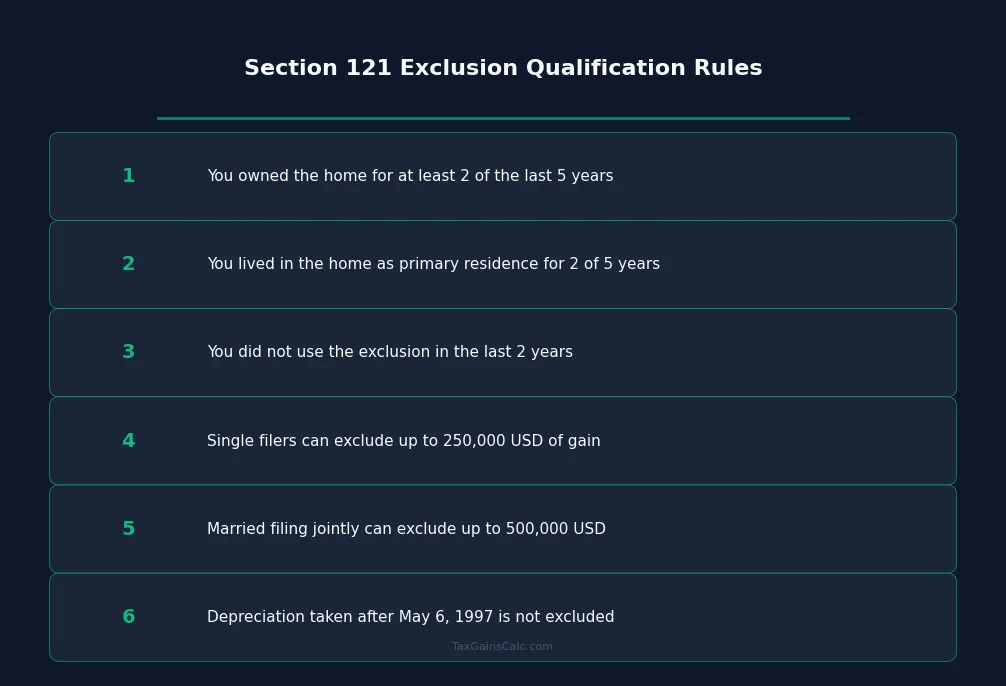
To claim the Section 121 exclusion, you must meet two primary tests: the ownership test and the use test. Both tests must be satisfied for you to qualify. The rules are specific, and understanding them completely is essential before you plan your home sale.
The Ownership Test
You must have owned the home for at least two years out of the five-year period ending on the date of sale. The two years do not need to be consecutive. You could have owned the home for one year, sold it, then bought it back and owned it for another year, and the total two years of ownership would satisfy the test. However, the most common scenario is that you simply owned the home continuously for at least two years before selling.
The ownership period begins on the date you acquire the property, which is typically the closing date of your purchase. If you inherit a home, your ownership period includes the time the deceased person owned the property, which can be a significant advantage if the home was held in the family for many years.
The Use Test
You must have used the home as your principal residence for at least two years out of the five-year period ending on the date of sale. Like the ownership test, the two years do not need to be consecutive. You could live in the home for six months, rent it out for two years, move back in for another eighteen months, and the total two years of use would satisfy the test.
The use test can be satisfied even if you are temporarily absent from the home. Short absences for vacations, business trips, or medical treatment count as periods of use. However, if you rent out the home for an extended period, those months do not count toward the use test unless you are still maintaining the home as your principal residence.
Both Tests Must Be Met
It is important to note that the ownership and use periods do not need to overlap. You could own the home for two years and live in it for two different years within the five-year window, and you would still qualify. The key is that both tests are independently met within the same five-year period ending on the date of sale.
How Much Can You Exclude
The maximum exclusion amount depends on your filing status. If you file as single, head of household, or married filing separately, you can exclude up to $250,000 of gain. If you file a joint return with your spouse, you can exclude up to $500,000 of gain. These amounts are per sale, not per taxpayer, which means you cannot double the exclusion by selling two properties in the same year.
Special Rules for Married Couples
Married couples can claim the full $500,000 exclusion if both spouses meet the use test, even if only one spouse owns the home. This is a common situation when one spouse purchased the home before the marriage. As long as both spouses have lived in the home for at least two years during the five-year period before the sale, and neither spouse has used the exclusion in the past two years, the full $500,000 exclusion is available.
If only one spouse meets the use test, the exclusion is limited to $250,000. This can happen when one spouse moves into the home less than two years before the sale. In community property states, the rules may differ slightly, so consulting a tax professional is always advisable for complex situations.
The Two-Year Waiting Period
You can only use the Section 121 exclusion once every two years. If you sold a home and claimed the exclusion within the past two years, you cannot claim it again on a new sale. However, there is no lifetime limit on the number of times you can use the exclusion. As long as you wait at least two years between sales, you can claim the exclusion each time you sell a qualifying principal residence.
Calculating Your Gain and Exclusion
The gain on the sale of your home is calculated as the selling price minus your adjusted basis. Your adjusted basis is typically the original purchase price plus the cost of capital improvements minus any depreciation claimed. This is the same calculation used for any capital asset, but there are some special considerations for principal residences.
Determining Your Adjusted Basis
Your basis starts with what you paid for the home, including most closing costs such as title insurance, legal fees, and transfer taxes. Capital improvements, which are additions or renovations that add value to the home or extend its useful life, increase your basis. Examples include adding a room, installing a new roof, or upgrading the electrical system. Routine repairs and maintenance, such as painting or fixing a leaky faucet, do not increase your basis.
If you inherited the home, your basis is generally the fair market value of the property on the date of the previous owner's death, which is known as a step-up in basis. This can significantly reduce your taxable gain because the basis is adjusted to the current market value rather than what the deceased originally paid.
Applying the Exclusion
Once you calculate your total gain, you apply the exclusion to reduce or eliminate the taxable amount. For example, if you are single and your gain is $200,000, the entire amount is excluded because it is below the $250,000 limit. If your gain is $300,000, you exclude $250,000 and pay tax on the remaining $50,000. Understanding the short-term vs long-term capital gains tax rates is important because the taxable portion of your gain is subject to these rates.
When the Exclusion May Be Reduced
There are several situations where the Section 121 exclusion may be reduced or partially unavailable. Understanding these exceptions is critical because they can result in an unexpected tax bill.
Non-Qualified Use Periods
If you used the home for purposes other than as a principal residence after 2008, the exclusion may be reduced. Non-qualified use includes any period when the home was not your principal residence, such as when you rented it out or used it as a vacation home. The reduction is calculated as a fraction: the period of non-qualified use divided by the total period of ownership. This prorated reduction applies only to periods after 2008.
For example, if you owned the home for ten years and rented it out for three of those years after 2008, 30 percent of your gain would not be eligible for the exclusion. Only 70 percent of the gain could be excluded. This rule was introduced to prevent taxpayers from converting vacation homes or rental properties into principal residences just before selling.
Depreciation Recapture After 1997
Any depreciation you claimed on the home after May 6, 1997, cannot be excluded under Section 121. This most commonly affects taxpayers who used part of their home as a home office or rented out a portion of the property. The depreciation recapture is taxed at a maximum rate of 25 percent, regardless of your other income. This is similar to the depreciation recapture rules for rental property, and it applies even if you would otherwise qualify for the full exclusion.
Partial Exclusions for Unforeseen Circumstances
If you do not meet the two-year ownership and use tests, you may still qualify for a partial exclusion if the sale is due to unforeseen circumstances. The IRS allows a reduced exclusion if the primary reason for the sale is a change in employment, health issues, or other unforeseen circumstances. The partial exclusion is calculated by prorating the maximum exclusion based on the fraction of the two-year period you completed.
Qualifying unforeseen circumstances include the death of a spouse, divorce or legal separation, multiple births from the same pregnancy, natural or man-made disasters, and involuntary conversion of the property. A change in employment that results in a new job location at least 50 miles farther from the home than the old job location also qualifies.
How to Claim the Section 121 Exclusion
Claiming the exclusion is relatively straightforward. You do not need to file any special forms or request IRS approval. Simply report the sale on your tax return, calculate the exclusion, and reduce your gain accordingly. If the entire gain is excluded, you do not even need to report the sale on your return, unless you received a Form 1099-S from the closing agent.
Reporting Requirements
If you receive a Form 1099-S, you must report the sale on your tax return even if the entire gain is excluded. Report the sale on Form 8949 and Schedule D, showing the selling price, basis, and the exclusion amount. If you do not receive a Form 1099-S and the entire gain is excluded, you can skip reporting the sale entirely. However, many taxpayers choose to report it anyway to create a paper trail in case the IRS questions the transaction later.
Documentation to Keep
Even though you do not need to submit documentation with your tax return, you should keep detailed records of your home purchase, improvements, and sale. This includes the closing statement from your purchase, receipts for capital improvements, and the closing statement from the sale. If you ever face an IRS audit, these records will be essential for proving your basis and your eligibility for the exclusion.
Common Mistakes to Avoid
One of the most common mistakes homeowners make is assuming they automatically qualify for the full exclusion without checking the ownership and use tests. If you moved into the home less than two years before selling, you may not qualify for the full exclusion unless an exception applies. Always verify the two-year tests before assuming the exclusion is available.
Another frequent error is failing to account for depreciation recapture on home office deductions. If you claimed a home office deduction in any year after May 6, 1997, the depreciation portion of that deduction must be recaptured at 25 percent, even if the rest of your gain is fully excluded. This surprises many taxpayers who assumed the entire gain was tax-free.
Some homeowners also fail to properly track capital improvements. Without documentation, you cannot add improvements to your basis, which means your taxable gain will be higher than it should be. Keep every receipt and maintain a detailed spreadsheet of improvements made to the property over the years you own it.
Section 121 vs 1031 Exchange
The Section 121 exclusion and the 1031 exchange are both valuable tax tools, but they serve different purposes. Section 121 applies only to principal residences and provides a true exclusion, meaning the excluded gain is never taxed. The 1031 exchange applies to investment and business property and provides a deferral, meaning the tax is postponed but not eliminated.
If you are selling a property that was once your principal residence but is now a rental, you may be able to use both provisions. You could qualify for the Section 121 exclusion on the portion of the gain attributable to your period of principal residence use, and then defer the remaining gain through a 1031 exchange. This combined strategy requires careful planning and professional guidance, but it can result in significant tax savings for sophisticated taxpayers.
Planning Strategies for Maximizing the Exclusion
Timing is the most important factor in maximizing the Section 121 exclusion. If you are close to the two-year ownership or use requirement, it may be worth delaying your sale to ensure you qualify. Even a few months of additional use can make the difference between a full exclusion and a partial one or no exclusion at all.
Consider whether converting a rental property to your principal residence could qualify you for the exclusion. You would need to live in the property for at least two years, and the non-qualified use rules would reduce the exclusion for any rental period after 2008. However, for properties with significant appreciation, even a reduced exclusion can save you thousands of dollars.
For married couples, make sure both spouses meet the use test before selling. If one spouse has not lived in the home for two years, the exclusion is limited to $250,000 instead of $500,000. In some cases, delaying the sale by a few months so that both spouses satisfy the use test can double the exclusion amount.
Impact on State Taxes
While the Section 121 exclusion applies at the federal level, state tax treatment varies. Most states conform to the federal exclusion, but some have different rules or limits. California, for example, follows the federal exclusion but taxes any remaining gain at ordinary income rates. States with no income tax, such as Florida, Texas, and Nevada, do not impose any additional tax on home sale gains. Understanding your state capital gains tax rates is important for accurately estimating your total tax liability.
Key Takeaways
The Section 121 exclusion is one of the most generous tax benefits available to homeowners. It allows you to exclude up to $250,000 of gain if single or $500,000 if married filing jointly, provided you meet the ownership and use tests. The exclusion can be used repeatedly, but only once every two years. Non-qualified use periods after 2008 and depreciation claimed after 1997 can reduce the exclusion. Proper planning and documentation are essential for maximizing this benefit and avoiding unexpected tax bills.
If you are considering selling your home, take the time to verify your eligibility for the Section 121 exclusion before you list the property. The tax savings can be substantial, and with proper planning, you can ensure that you qualify for the maximum benefit available under the law.
Fact-Checked & Reviewed
This article was written by David Chen (JD, LLM in Taxation (New York University)) and reviewed for accuracy by David Chen (JD, LLM (Taxation), EA). Published by Wasim Akram, Founder & Lead Researcher at TaxGainsCalc. All tax rates, thresholds, and rules referenced are based on IRS publications and current tax law as of the date published. Tax laws change frequently — always consult a qualified tax professional for advice specific to your situation.
Tax Attorney & Legal Editor
David Chen is a tax attorney with a Juris Doctor and a Master of Laws in Taxation from New York University School of Law. With over 10 years of legal practice, he specializes in 1031 exchanges, capital gains tax law, and IRS dispute resolution....
Tax Attorney & Enrolled Agent
David Chen is a tax attorney and Enrolled Agent with over 20 years of experience in tax law and IRS dispute resolution. He holds a Juris Doctor from Columbia Law School and a Master of Laws in Taxation from NYU School of Law....

Founder & Lead Researcher, TaxGainsCalc
Wasim Akram is an independent web publisher and digital entrepreneur based in India. Since 2018, he has been building custom CMS platforms, WordPress plugins, niche websites, and AI-powered digital products with over 8 years of real-world experience....
Disclaimer: This article is for informational purposes only and does not constitute tax, legal, or financial advice. Tax laws and regulations change frequently, and the information presented here may not reflect the most current updates. You should consult with a qualified CPA, tax attorney, or financial advisor before making any tax-related decisions. TaxGainsCalc is not responsible for any actions taken based on the information provided in this article.