Capital Gains Tax for Small Business Owners: Selling Your Business or Partnership Interest
Discover how capital gains tax applies when selling a small business or partnership interest. Learn about QSBE exclusion under Section 1202, asset vs entity sales, and tax planning strategies.
Understanding Capital Gains Tax When You Sell a Business
Selling a small business is often the culmination of decades of hard work, sacrifice, and personal investment. After years of building something from the ground up, the last thing you want is to hand over a massive chunk of your proceeds to the IRS. But that is exactly what happens to unprepared business owners who do not understand how capital gains tax applies to the sale of a business or partnership interest.
The tax consequences of selling a business depend on several factors: the legal structure of your business, whether you are selling assets or entity interests, how long you have held the business, and whether you qualify for any exclusions. Each of these factors can dramatically change your tax bill, and understanding them before you sell is the difference between keeping your money and giving it away.
Before we get into the specifics, it helps to have a solid grasp of the complete breakdown of capital gains tax rates so you understand the baseline rates that apply before any exclusions or special treatment. Small business sales have some unique provisions that can reduce or even eliminate capital gains tax, but you need to know the rules to take advantage of them.
✅ Key Takeaway: Small business owners may qualify for the QSBE exclusion under Section 1202, which can exclude up to 100 percent of capital gains from the sale of qualified small business stock. This is one of the most powerful tax breaks in the entire Internal Revenue Code.
Asset Sale vs. Entity Sale: Why It Matters
One of the most consequential decisions in a business sale is whether you are selling the assets of the business or the entity itself. This distinction has enormous tax implications, and it is often the single largest factor in determining how much tax you will owe on the sale.
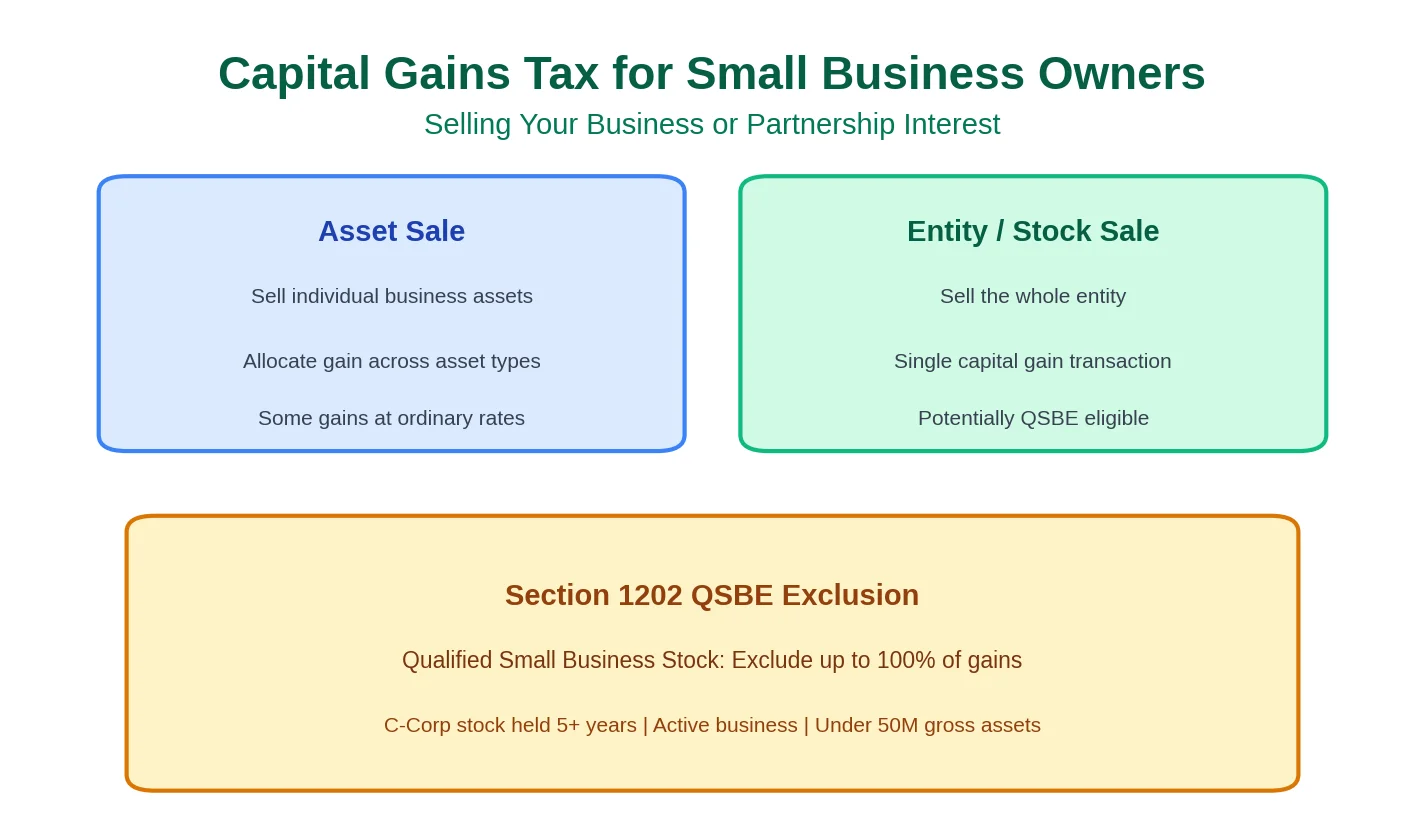
In an asset sale, the buyer purchases the individual assets of the business — equipment, inventory, customer lists, goodwill, and so on. The seller recognizes gain or loss on each asset separately. This means some assets may be taxed at capital gains rates, while others (like inventory and depreciation recapture) are taxed at ordinary income rates. The allocation of purchase price among the various assets is a critical negotiation point, because it directly affects both the buyer's and seller's tax positions.
In an entity sale, the buyer purchases the ownership interest in the business entity itself — shares of a corporation or membership interests in an LLC. The seller recognizes a single capital gain or loss on the difference between the sale price and their basis in the ownership interest. This is generally simpler and often results in a more favorable tax outcome for the seller, because the entire gain is typically treated as a capital gain rather than a mix of capital and ordinary income.
⚠️ Watch Out: Buyers typically prefer asset sales because they get a stepped-up basis in the purchased assets, which increases their future depreciation deductions. Sellers typically prefer entity sales because the entire gain is usually capital gain. This tension is one of the most common negotiation points in any business sale.
How Asset Allocation Affects Your Tax Bill
When you sell business assets, the IRS requires both the buyer and seller to allocate the purchase price among the various asset classes using the residual method under Section 1060. This method establishes a specific order for allocating the purchase price, starting with cash and equivalents, then moving through accounts receivable, inventory, tangible assets, and finally intangible assets like goodwill.
The allocation matters because each asset class is taxed differently. Cash and receivables are generally taxed at ordinary income rates. Inventory is always ordinary income. Tangible assets may involve depreciation recapture at ordinary income rates, with any remaining gain taxed as capital gain. Goodwill and other intangible assets are generally taxed as long-term capital gains, which is the most favorable rate.
This is why understanding the capital gains versus ordinary income tax is so critical for business sellers. The gap between ordinary income rates (up to 37 percent) and long-term capital gains rates (0, 15, or 20 percent) can mean a difference of tens or even hundreds of thousands of dollars in tax on a single transaction.
| Sale Type | Tax Treatment | Seller Preference | Buyer Preference |
|---|---|---|---|
| Asset Sale | Mixed — capital gains + ordinary income | Less favorable | More favorable |
| Entity Sale (C-Corp) | Capital gain on stock | More favorable | Less favorable |
| Entity Sale (S-Corp) | Capital gain on stock | More favorable | Less favorable |
| Partnership Interest | Capital gain (with exceptions) | Favorable | Varies |
Section 1202: The Qualified Small Business Stock Exclusion
Section 1202 of the Internal Revenue Code provides one of the most generous tax breaks available to small business owners and investors. Under this provision, if you sell qualified small business stock (QSBS) that you have held for more than five years, you may be able to exclude up to 100 percent of the gain from federal income tax. This is not a deferral — it is a permanent exclusion. The gain simply disappears from your taxable income.
To qualify for the Section 1202 exclusion, the stock must meet several strict requirements. The business must be a C corporation with gross assets of 50 million dollars or less at all times from August 10, 1993, through the date of the stock issuance. The business must be an active trade or business — not a passive investment vehicle, holding company, or business engaged in certain excluded industries like health care, law, accounting, banking, insurance, farming, or hospitality.
The stock must be acquired at original issuance in exchange for money, property, or services rendered to the corporation. You cannot buy QSBS on the secondary market and claim the exclusion. And you must hold the stock for at least five years before selling to qualify for any exclusion. If you sell before the five-year holding period, the gain is simply a regular capital gain with no special treatment.
💡 Section 1202 Exclusion Amounts: The exclusion percentage depends on when the QSBS was acquired. Stock acquired after September 27, 2010, generally qualifies for a 100 percent exclusion. Stock acquired between February 18, 2009, and September 27, 2010, qualifies for a 75 percent exclusion. Stock acquired before February 18, 2009, qualifies for a 50 percent exclusion. The maximum excludable gain is the greater of 10 million dollars or 10 times the taxpayer's basis in the stock.
Qualified Small Business Stock Checklist
Before you assume your business sale qualifies for the Section 1202 exclusion, go through this checklist carefully. Missing even one requirement can disqualify your entire gain from the exclusion, so it pays to be thorough.
📋 Entity type: The business must be a C corporation. S corporations, partnerships, and LLCs do not qualify. If your business is an S corporation, you would need to convert to a C corporation and wait five years before selling.
📋 Gross assets test: Aggregate gross assets of the corporation must not exceed 50 million dollars at any time before and immediately after the stock issuance.
📋 Active business requirement: At least 80 percent of the corporation's assets must be used in the active conduct of a qualified trade or business during substantially all of the holding period.
📋 Original issuance: The stock must be acquired directly from the corporation at original issuance, not purchased from another shareholder.
📋 Holding period: The stock must be held for more than five years before the sale to qualify for the exclusion.
📋 Excluded industries: The business cannot be in health care, law, engineering, architecture, accounting, actuarial science, performing arts, consulting, athletics, financial services, brokerage services, banking, insurance, financing, leasing, investing, farming, or any business where the principal asset is the reputation or skill of employees.
Selling a Partnership Interest: Tax Rules and Exceptions
Selling a partnership interest is generally treated as a capital transaction. The gain or loss is the difference between the amount realized from the sale and the selling partner's adjusted basis in their partnership interest. For most partners, this results in a capital gain that is taxed at the preferential long-term capital gains rates, assuming the interest was held for more than one year.
However, there is an important exception that can catch partners off guard. Under Section 751, a partner who sells their interest may be treated as having sold their share of certain "hot assets" separately. Hot assets include substantially appreciated inventory and unrealized receivables of the partnership. The gain attributable to these hot assets is taxed as ordinary income, not capital gain, regardless of how long the partner held their interest.
This is a critical distinction that can significantly increase the tax on a partnership interest sale. If a partnership has substantial accounts receivable that have not yet been recognized for tax purposes, or if the partnership holds inventory that has appreciated significantly, a portion of the selling partner's gain will be recharacterized as ordinary income. This is sometimes called the "Section 751 haircut," and it can reduce the expected capital gain treatment by a meaningful amount.
For a broader understanding of how capital gains tax works in different contexts, read our guide on capital gains tax for beginners, which covers the foundational concepts that apply to all types of capital transactions.
Depreciation Recapture and Its Impact on Business Sales
Depreciation recapture is one of the most overlooked tax traps in a business sale. If you have been depreciating business assets over the years — equipment, furniture, vehicles, buildings — the IRS wants some of that depreciation back when you sell. The recapture rules essentially convert what would otherwise be capital gain into ordinary income to the extent of prior depreciation deductions.
Section 1245 property, which includes most personal property like equipment and machinery, requires you to recapture all prior depreciation as ordinary income. Section 1250 property, which includes real property like buildings, requires recapture of certain types of accelerated depreciation as ordinary income, though most straight-line depreciation is not recaptured. The unrecaptured Section 1250 gain is taxed at a maximum rate of 25 percent, which is higher than the standard long-term capital gains rate but lower than ordinary income rates.
The practical impact of recapture can be significant. If you are selling a business with 200,000 dollars of accumulated depreciation on equipment, that 200,000 dollars of gain is taxed as ordinary income rather than capital gain. On a 2 million dollar business sale, the difference between ordinary income and capital gains rates on that 200,000 dollars could be 34,000 dollars or more in additional tax.
⚠️ Depreciation Recapture Alert: Always calculate the recapture impact before agreeing to a sale price. The amount of prior depreciation taken on business assets can significantly increase the ordinary income portion of your gain, and many business owners are surprised by how much recapture they owe.
Tax Planning Strategies for Business Sellers
Selling a business is a once-in-a-lifetime event for most owners, and the tax consequences can be enormous. Fortunately, there are several legitimate strategies that can reduce your capital gains tax liability and help you keep more of your sale proceeds.
1. Installment Sales
An installment sale allows you to spread the capital gain over multiple years by receiving the sale proceeds in payments over time rather than as a lump sum. This can keep you in a lower tax bracket each year and reduce the overall tax rate on the gain. It also provides a steady income stream, which can be useful if you are transitioning into retirement. However, installment sales are not available for inventory sales or for sales of publicly traded securities, and you bear the risk of the buyer defaulting on payments.
2. Like-Kind Exchanges
While the Tax Cuts and Jobs Act of 2017 eliminated like-kind exchanges for most personal property, real property exchanges under Section 1031 remain fully available. If your business sale includes real estate, you may be able to defer the gain by exchanging the property for other qualifying real property. This is a powerful deferral tool, but the rules are strict and the timelines are tight — you must identify replacement property within 45 days and close within 180 days. For more deferral options, see our article on capital gains tax deferral strategies.
3. Qualified Opportunity Zone Investments
If you invest capital gains from a business sale into a Qualified Opportunity Fund within 180 days of the sale, you can defer the gain and potentially reduce it. If you hold the Opportunity Zone investment for at least 10 years, any appreciation in the new investment is permanently excluded from tax. This program has been a game-changer for business sellers looking to reinvest their proceeds in a tax-efficient manner, though the specific benefits depend on the timing of your investment.
4. Charitable Remainder Trusts
Contributing your business interest to a charitable remainder trust before the sale can eliminate capital gains tax on the sale itself. The trust sells the asset tax-free, and you receive an income stream for life or a term of years. When the trust terminates, the remaining assets go to the charity you designated. You also receive an upfront charitable deduction based on the present value of the charity's remainder interest. This strategy works best for owners who have charitable intent and want to create a lasting legacy while reducing their tax burden.
🏆 Pro Tip: Most business sale tax planning needs to happen before the sale is finalized. Once the transaction closes, your options narrow dramatically. Engage a CPA or tax attorney experienced in business transactions at least six months before you plan to sell.
State Tax Considerations for Business Sales
Federal tax is only part of the picture. Most states impose their own capital gains tax, and the rates vary widely. Some states, like California, tax capital gains at the same rate as ordinary income — up to 13.3 percent on top of the federal rate. Other states, like Florida, Texas, and Washington, have no state income tax at all. This can make a difference of hundreds of thousands of dollars on a large business sale.
If you are planning to sell a business, it is worth understanding the state capital gains tax rates that apply in your state. Some business owners even relocate to a no-tax state before selling to reduce their state tax liability, though this strategy requires careful planning to ensure the move is legitimate and not merely a tax avoidance scheme.
Be aware that states are becoming more aggressive about challenging residency changes made in connection with a business sale. If you move to Florida and sell your New York business three months later, New York may argue that you were still a resident at the time of the sale and pursue you for state income tax. Proper documentation of your residency change — including voter registration, driver's license, and the location of your primary home — is essential.
Record Keeping and Basis Documentation
One of the most common problems business owners face when they sell is inadequate documentation of their basis in the business. Your basis includes your original investment, additional capital contributions, and your share of business income minus distributions and losses. If you cannot document your basis, the IRS may assume it is zero, which means your entire sale proceeds are treated as gain.
Good record keeping is not just about keeping your tax bill down — it is about protecting yourself in an audit. The IRS has up to three years to audit a return, and six years if there is a substantial understatement of income. For a large business sale, the risk of audit is real, and having comprehensive documentation of your basis, depreciation schedules, and prior tax returns can make the difference between a smooth audit and a costly one.
Key Takeaways for Small Business Owners
🔑 Section 1202 can eliminate your entire capital gains tax on qualified small business stock if you meet all the requirements. Make sure your business qualifies before you sell.
🔑 Asset sales and entity sales have very different tax consequences. Understand which type of sale you are doing and how it affects your tax liability.
🔑 Depreciation recapture can convert a significant portion of your gain from capital gain to ordinary income. Know how much recapture you face before agreeing to a deal.
🔑 Partnership interest sales may involve Section 751 hot assets that are taxed as ordinary income even though the rest of the gain is capital gain.
🔑 Tax planning strategies like installment sales, Opportunity Zone investments, and charitable remainder trusts can significantly reduce your tax bill, but they must be implemented before the sale closes.
🔑 State taxes can add a substantial layer of tax on top of federal rates. Consider the state tax implications of your sale and whether a residency change makes sense.
Final Thoughts
Selling a business is one of the most significant financial events of your life, and the tax consequences can be enormous. The difference between a well-planned sale and an unplanned one can easily be hundreds of thousands of dollars in tax savings. The key is to start planning early, understand the rules that apply to your specific situation, and work with experienced professionals who can guide you through the process.
Whether you are considering a Section 1202 exclusion, an installment sale, or a charitable planning strategy, the common thread is preparation. The tax code provides significant benefits for business owners who take the time to understand and use them, but it does not reward those who wait until the last minute. Start your planning at least six to twelve months before a planned sale, and you will be in a much stronger position to negotiate the best possible outcome for yourself and your family.
For more strategies on reducing your tax liability, read our comprehensive guide on legal strategies to avoid capital gains tax, which covers the full range of planning techniques available to taxpayers facing significant capital gains.
Fact-Checked & Reviewed
This article was written by Wasim Akram (Independent Web Publisher & Digital Entrepreneur) and reviewed for accuracy by David Chen (JD, LLM in Taxation (New York University)). Published by Wasim Akram, Founder & Lead Researcher at TaxGainsCalc. All tax rates, thresholds, and rules referenced are based on IRS publications and current tax law as of the date published. Tax laws change frequently — always consult a qualified tax professional for advice specific to your situation.

Founder & Lead Researcher, TaxGainsCalc
Wasim Akram is an independent web publisher and digital entrepreneur based in India. Since 2018, he has been building custom CMS platforms, WordPress plugins, niche websites, and AI-powered digital products with over 8 years of real-world experience....
Tax Attorney & Legal Editor
David Chen is a tax attorney with a Juris Doctor and a Master of Laws in Taxation from New York University School of Law. With over 10 years of legal practice, he specializes in 1031 exchanges, capital gains tax law, and IRS dispute resolution. David...
Founder & Lead Researcher, TaxGainsCalc
Wasim Akram is an independent web publisher and digital entrepreneur based in India. Since 2018, he has been building custom CMS platforms, WordPress plugins, niche websites, and AI-powered digital products with over 8 years of real-world experience....
Disclaimer: This article is for informational purposes only and does not constitute tax, legal, or financial advice. Tax laws and regulations change frequently, and the information presented here may not reflect the most current updates. You should consult with a qualified CPA, tax attorney, or financial advisor before making any tax-related decisions. TaxGainsCalc is not responsible for any actions taken based on the information provided in this article.