Capital Gains Tax on Stocks: When You Sell, How Much Goes to the IRS
Complete guide to capital gains tax on stocks. Learn short-term vs long-term rates, how to calculate your tax, cost basis methods, and strategies to reduce what you owe when selling shares.

📊 What Is Capital Gains Tax on Stocks?
When you sell a stock for more than you paid for it, the profit you make is called a capital gain. The IRS wants a piece of that profit, and that piece is the capital gains tax on stocks. It sounds simple enough, but the rules around how much you owe depend on several factors that many investors overlook until tax season arrives and their accountant hands them a bill they did not expect.
Every stock sale you make creates a taxable event. Whether you sold one share of Apple or ten thousand shares of a small-cap biotech company, the IRS requires you to report that transaction and pay tax on any gain. The amount you owe is not a flat percentage. It varies based on how long you held the stock, your total taxable income, and your filing status. Understanding these variables before you hit the sell button can save you thousands of dollars over your investing lifetime.
Many investors mistakenly believe that capital gains tax is just one rate applied to all investment profits. The reality is far more nuanced. Short-term gains and long-term gains are taxed at completely different rates, and your income level determines which bracket you fall into. Before you make any selling decisions, you should understand capital gains tax rates complete breakdown of brackets so you know exactly what rate applies to your situation.
⏱️ Short-Term vs Long-Term Stock Gains: The Critical Difference
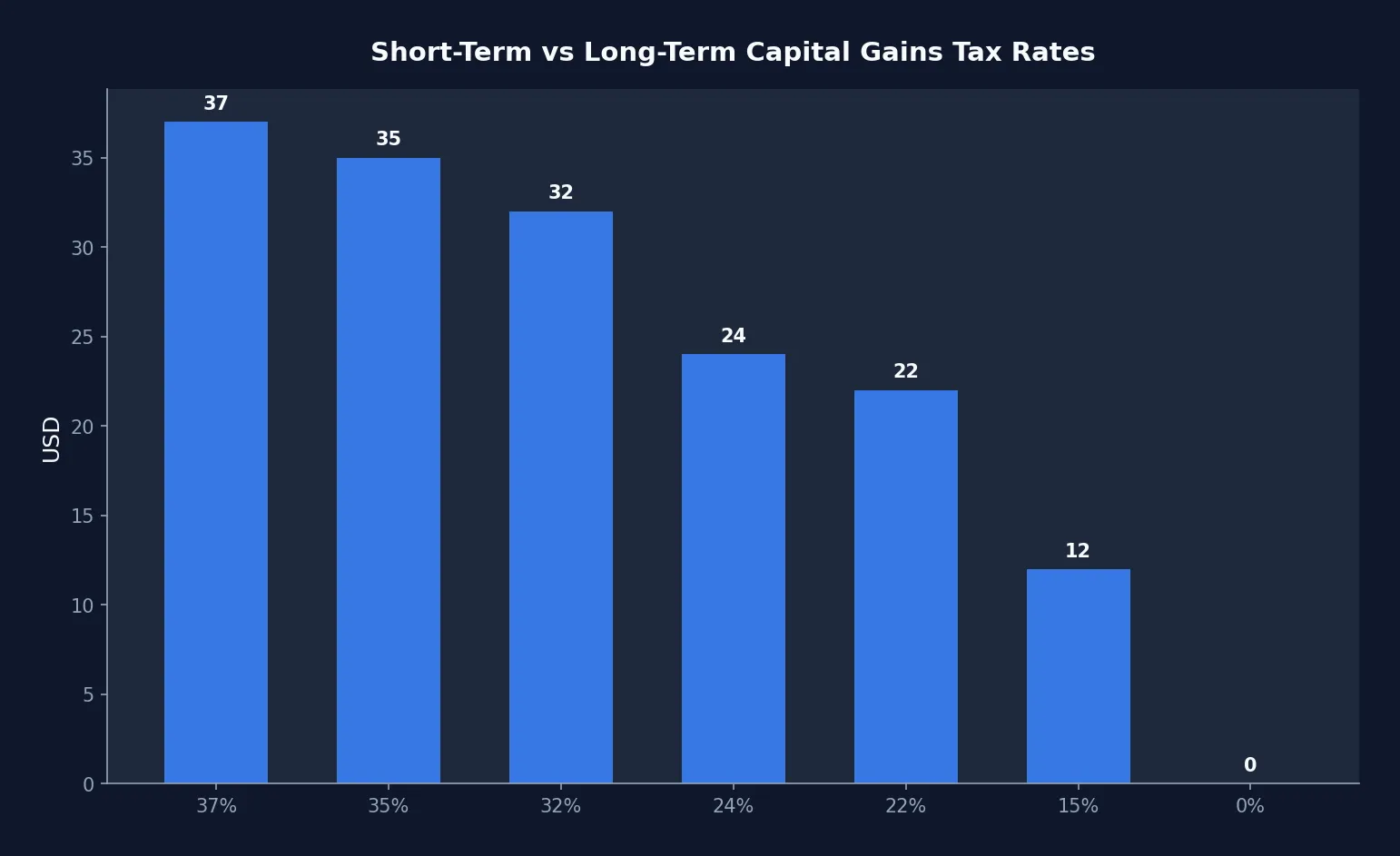
The single most important factor in determining your capital gains tax on stocks is how long you held the shares before selling. The IRS draws a bright line at one year. If you hold a stock for one year or less before selling, your gain is classified as short-term. If you hold it for more than one year, your gain is long-term. This distinction can mean the difference between owing 37 percent on your gain or owing zero percent.
Short-term capital gains are taxed at your ordinary income tax rate, which means they are lumped together with your salary, wages, and other regular income. For high earners, this can mean paying 32, 35, or even 37 percent on stock gains. Long-term capital gains, on the other hand, enjoy preferential rates of zero, 15, or 20 percent, depending on your taxable income. This is why holding periods matter so much, and why understanding short-term versus long-term capital gains tax rates is essential knowledge for every investor.
🧮 How Capital Gains Tax on Stocks Is Calculated
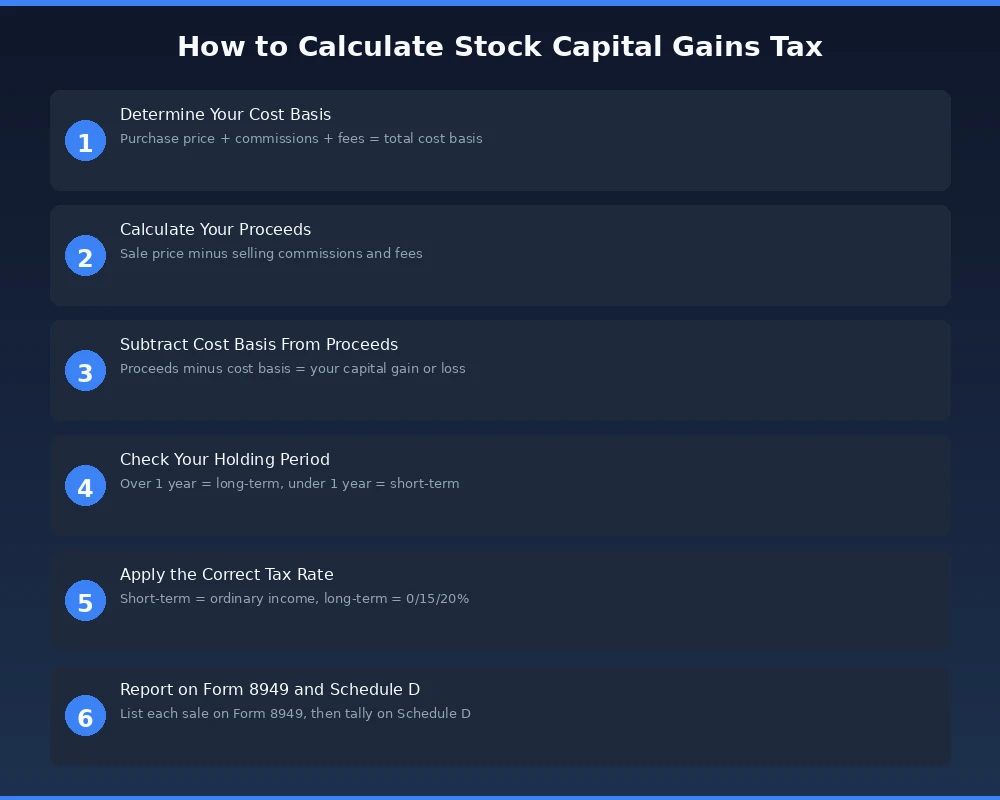
Calculating the capital gains tax on your stock sales follows a straightforward formula, but the details can trip you up if you are not careful. The basic calculation starts with your cost basis, which is what you originally paid for the shares plus any commissions or fees. You then subtract that cost basis from your sale proceeds, which is what you received when you sold minus any selling commissions. The result is your capital gain or loss.
For example, if you bought 100 shares of Microsoft at USD 150 per share and paid a USD 10 commission, your total cost basis would be USD 15,010. If you later sold those shares at USD 250 each with a USD 10 commission, your proceeds would be USD 24,990. Subtracting your cost basis from your proceeds gives you a capital gain of USD 9,980. The tax you owe on that gain depends entirely on how long you held the shares and what your other income looks like.
One area that confuses many investors is the cost basis itself. If you bought shares at different times and different prices, you need to decide which shares you are selling. The IRS allows several methods for this, and the choice can significantly affect your tax bill. Learning about capital gains tax cost basis methods like FIFO and specific ID can help you choose the method that minimizes your tax liability legally.
📉 Capital Gains Tax Brackets for Stock Sales in 2026
Long-term capital gains from stock sales fall into three brackets: zero percent, 15 percent, and 20 percent. Which bracket you land in depends on your taxable income and filing status. For the 2026 tax year, a single filer with taxable income below approximately USD 47,025 pays zero percent on long-term gains. Between USD 47,025 and USD 518,900, the rate is 15 percent. Above USD 518,900, the rate jumps to 20 percent.
For married couples filing jointly, the thresholds are roughly double. The zero percent rate applies up to about USD 94,050 of taxable income. The 15 percent rate covers the range from USD 94,050 to USD 583,750. Anything above that is taxed at 20 percent. These brackets are adjusted annually for inflation, so the exact numbers change slightly each year. It is worth checking the current thresholds to see where you fall, and you can use a capital gains tax calculator to estimate what you owe before you file.
Short-term gains do not get their own brackets. They are simply added to your other ordinary income and taxed at whatever marginal rate applies to your total. This is why a single large short-term gain can push you into a higher tax bracket for all of your income, not just the gain itself. The consequences can be surprisingly expensive if you are not prepared for them.
💰 How Much Tax Do You Actually Pay on Stock Gains?
The actual amount of tax you pay on stock gains depends on a combination of factors: your holding period, your income level, your filing status, and your state tax rate. A single filer in California who makes a USD 100,000 long-term gain could easily owe USD 20,000 in federal tax plus another USD 13,300 in state tax, for a total of USD 33,300. That is one-third of the gain gone to taxes.
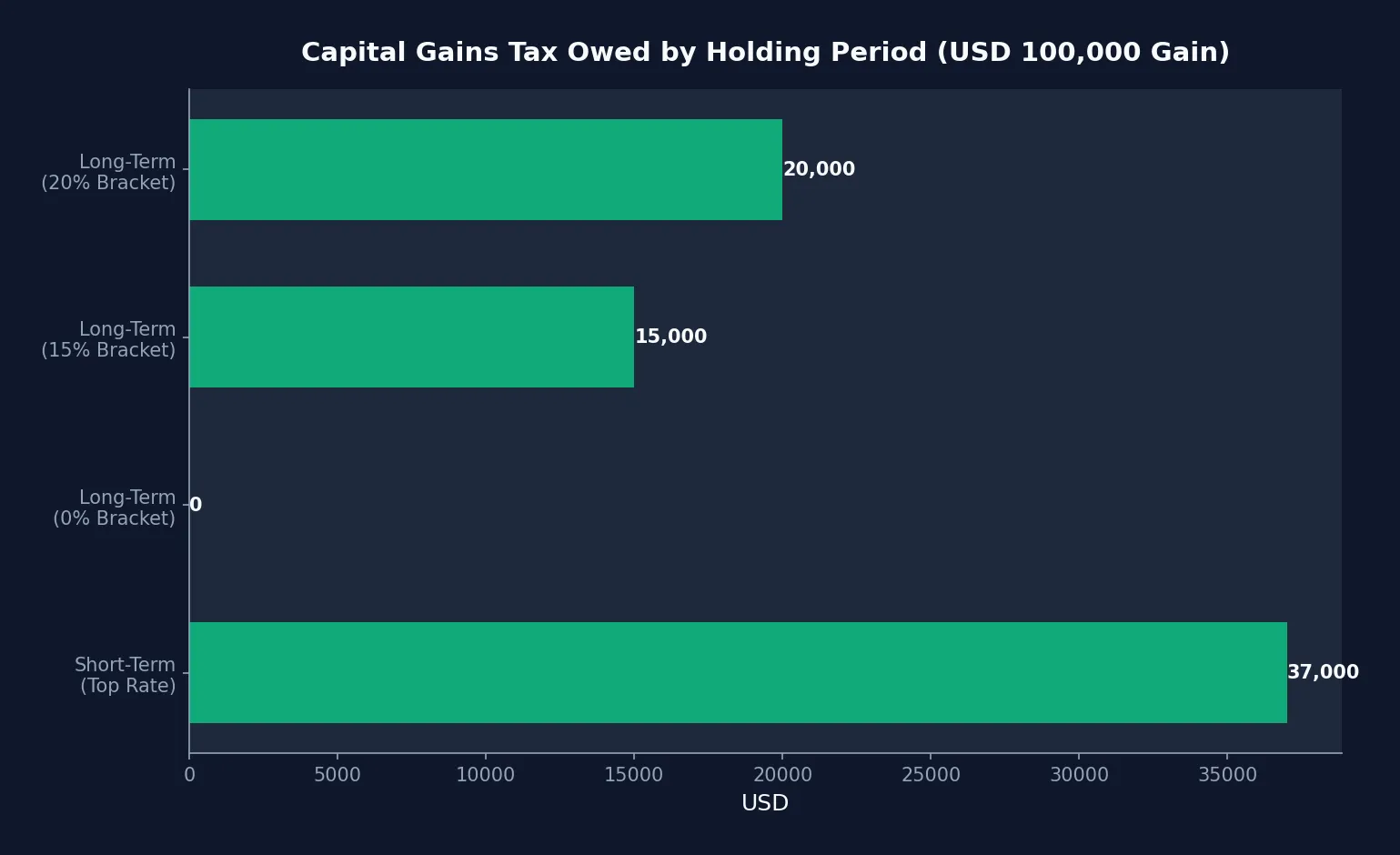
Compare that to the same investor making a USD 100,000 short-term gain. At the top federal rate of 37 percent, the federal tax alone would be USD 37,000. Add the California state tax and you are looking at over USD 50,000 in total taxes on a single stock sale. The difference between holding for one year and one day versus selling one day early can literally cost you tens of thousands of dollars.
There is also the Net Investment Income Tax to consider. If your modified adjusted gross income exceeds USD 200,000 for single filers or USD 250,000 for married couples, you owe an additional 3.8 percent on your investment income, including capital gains. This surtax stacks on top of the regular capital gains rate, which means high earners can effectively pay 23.8 percent on long-term gains or 40.8 percent on short-term gains. Understanding the net investment income tax and the 3.8% surtax is critical if your income is anywhere near these thresholds.
📋 Cost Basis Methods: Which One Saves You the Most?
When you sell shares that you acquired at different times and prices, you need to tell the IRS which specific shares you are selling. The method you choose can have a big impact on your tax bill. The three most common methods are FIFO (First In, First Out), Specific Identification, and Average Cost.
FIFO is the default method used by most brokerages. It assumes you are selling the oldest shares first. This can work against you if your oldest shares have the lowest cost basis, because it maximizes your gain. Specific Identification allows you to choose which shares to sell, which means you can pick the ones with the highest cost basis to minimize your taxable gain. Average Cost is only available for mutual funds, not individual stocks.
The smart move for most investors is to use Specific Identification whenever possible. By selling the shares you bought at the highest price, you reduce your gain and therefore your tax bill. This is perfectly legal and widely recommended by tax professionals. Just make sure you identify the specific shares at the time of the sale, not later when you are preparing your tax return. Your brokerage should provide a cost basis report, but you should always verify it against your own records.
🔄 Tax Loss Harvesting for Stock Investors
One of the most powerful tools available to stock investors is tax loss harvesting. This strategy involves selling losing investments to offset the gains from your winning trades. If you have USD 50,000 in gains and USD 30,000 in losses, you only pay tax on the net gain of USD 20,000. This can dramatically reduce your tax bill, especially in years when you have both big winners and losers in your portfolio.
The key rule to remember is the wash sale rule. If you sell a stock at a loss and buy the same or substantially identical stock within 30 days before or after the sale, the IRS disallows the loss deduction. The loss is not gone forever; it gets added to the cost basis of the new shares. But you lose the immediate tax benefit, which defeats the purpose of harvesting. Before you start selling, make sure you understand tax loss harvesting strategies for investment losses and the wash sale rules that can trip you up.
If your losses exceed your gains in a given year, you can deduct up to USD 3,000 of net capital losses against your ordinary income. Any remaining losses carry forward indefinitely, which means you can use them to offset future gains. This is one of the few areas where the tax code actually works in your favor over the long term. The capital gains tax loss carryover for future years provision ensures that no investment loss goes to waste from a tax perspective.
📝 Reporting Stock Capital Gains on Your Tax Return
Every stock sale must be reported on your tax return, regardless of whether you made a gain or took a loss. The form you use is Form 8949, where you list each individual transaction with the date acquired, date sold, proceeds, cost basis, and gain or loss. The totals from Form 8949 then flow to Schedule D, where you calculate your net capital gain or loss for the year.
Your brokerage should send you a Form 1099-B that summarizes your transactions for the year. Check this form carefully against your own records, because brokerages sometimes make errors in their cost basis reporting, especially for shares that were transferred from another broker or acquired through a stock split or dividend reinvestment plan. If you notice discrepancies, you should correct them on your Form 8949 rather than simply copying the 1099-B numbers.
The reporting process can be tedious if you have many transactions, but it is not optional. The IRS receives a copy of your 1099-B, so they already know about your stock sales. Failing to report them is a quick way to trigger an audit or receive a notice demanding additional tax plus penalties. For a complete walkthrough of the filing process, read our guide on how to report capital gains on your tax return which covers every line and every form you need.
🔍 Special Situations: ESPP, Stock Options, and RSU
Not all stock gains are created equal. If you acquired shares through an Employee Stock Purchase Plan, stock options, or Restricted Stock Units, the tax rules are more complex. With incentive stock options, for example, you may owe the alternative minimum tax in the year you exercise, even if you have not sold the shares yet. With non-qualified stock options, the spread between the exercise price and the market value is taxed as ordinary income at the time of exercise.
ESPP shares have their own holding period rules. If you hold the shares for at least two years from the grant date and one year from the purchase date, some of your gain may qualify for long-term capital gains treatment. Sell too early, and your discount is taxed as ordinary income. The rules are intricate enough that you should consult a tax professional before making any decisions about employee stock. Our detailed guide on capital gains tax on stock options and RSU covers ISO, NSO, and ESPP rules in depth.
🛡️ Strategies to Reduce Capital Gains Tax on Stocks
There are several completely legal strategies that can help you reduce the capital gains tax you owe on stock sales. The most impactful is simply holding your winners for more than one year. The difference between short-term and long-term rates is so significant that it almost always makes sense to wait if you are close to the one-year mark.
Another powerful strategy is donating appreciated shares to charity instead of selling them and donating cash. When you donate shares that have gone up in value, you avoid paying capital gains tax on the appreciation and you still get a charitable deduction for the full market value. This double benefit is one of the most underused tax strategies available to investors who are charitably inclined.
You can also use tax-advantaged accounts to shield your gains. Holding growth stocks in a Roth IRA means you will never pay capital gains tax on the appreciation, because qualified Roth withdrawals are completely tax-free. Even traditional IRAs and 401(k) plans allow you to defer taxes on gains until you withdraw the money in retirement. Learn more about capital gains tax on retirement accounts like 401k and IRA to see how these accounts can protect your investment returns.
Finally, consider the timing of your sales. If you are near the boundary between the zero percent and 15 percent bracket, you might be able to sell enough shares to use up the zero percent bracket without crossing into the 15 percent bracket. This is sometimes called bracket management, and it requires careful planning and a good understanding of your total income picture. For a comprehensive look at all available strategies, read our guide on how to avoid capital gains tax with legal strategies.
🗺️ State Capital Gains Tax on Stock Sales
Do not forget about state taxes. Most states tax capital gains as ordinary income, and a few states have their own capital gains tax rates that are separate from the federal system. California has the highest top rate at 13.3 percent, which means a California resident in the top federal bracket could pay a combined rate of over 33 percent on long-term gains and over 50 percent on short-term gains.
On the other hand, nine states have no state income tax at all: Alaska, Florida, Nevada, New Hampshire, South Dakota, Tennessee, Texas, Washington, and Wyoming. If you live in one of these states, you only need to worry about the federal capital gains tax. For a detailed comparison of all 50 states, see our guide on state capital gains tax rates across the country to find out where your state stands.
✅ Key Takeaways for Stock Investors
Understanding capital gains tax on stocks is not optional for anyone who invests in the market. The difference between holding for one year versus selling one day early can cost you thousands of dollars. The difference between choosing specific identification and FIFO can save you hundreds or thousands more. And the difference between harvesting losses and letting them sit can turn a bad year into a manageable one from a tax perspective.
Always know your holding period before you sell. Always check your cost basis method. Always consider tax loss harvesting before year-end. And always report every transaction on your tax return, because the IRS already knows about your sales. The best investors are not just the ones who pick the right stocks. They are the ones who keep the most of what they earn after taxes.
For a step-by-step calculation guide, visit our page on how to calculate capital gains tax step by step and use our free calculator to estimate your exact tax liability before you sell.
Fact-Checked & Reviewed
This article was written by James Park (EA, CFP (Certified Financial Planner)) and reviewed for accuracy by Sarah Mitchell (CPA, MST (Master of Science in Taxation)). Published by Wasim Akram, Founder & Lead Researcher at TaxGainsCalc. All tax rates, thresholds, and rules referenced are based on IRS publications and current tax law as of the date published. Tax laws change frequently — always consult a qualified tax professional for advice specific to your situation.
Enrolled Agent & Tax Researcher
James Park is an Enrolled Agent licensed by the IRS and a Certified Financial Planner with over 12 years of experience in tax research and financial planning. He specializes in capital gains strategies for real estate investors and cryptocurrency tra...
Certified Public Accountant (CPA)
Sarah Mitchell is a Certified Public Accountant with over 15 years of experience in individual and business taxation. She holds a Master of Science in Taxation from Golden Gate University and specializes in capital gains tax planning, investment tax ...

Founder & Lead Researcher, TaxGainsCalc
Wasim Akram is an independent web publisher and digital entrepreneur based in India. Since 2018, he has been building custom CMS platforms, WordPress plugins, niche websites, and AI-powered digital products with over 8 years of real-world experience....
Disclaimer: This article is for informational purposes only and does not constitute tax, legal, or financial advice. Tax laws and regulations change frequently, and the information presented here may not reflect the most current updates. You should consult with a qualified CPA, tax attorney, or financial advisor before making any tax-related decisions. TaxGainsCalc is not responsible for any actions taken based on the information provided in this article.