Capital Gains Tax Calculator USA 2026
Calculate your short-term and long-term capital gains tax liability instantly. Free online tax estimator for stocks, real estate, crypto, and investment property.
Purchase
Sale
Your income from other sources (excluding this gain)
Every Capital Gains Calculator You Need
Purpose-built calculators for each asset class — all using the same verified 2026 federal engine.
Stocks
Per-share gains, dividends timing & wash sales
Open calculatorCrypto
BTC, ETH, altcoins, NFTs and DeFi disposals
Open calculatorReal Estate
Rental property with 25% depreciation recapture
Open calculatorHome Sale
Section 121: exclude $250K / $500K
Open calculator1031 Exchange
Deferred gains, boot and tax savings
Open calculatorLoss Harvesting
Offset gains, $3,000 rule & carryforwards
Open calculatorShort-Term
Ordinary income rates up to 37%
Open calculatorLong-Term
0%, 15% and 20% bracket stacking
Open calculatorNIIT 3.8%
The $200K/$250K investment surtax
Open calculatorState Rates
All 50 states + DC, ranked and searchable
Open calculatorWhat is Capital Gains Tax?
What Triggers Capital Gains Tax?
Capital gains tax is a fundamental component of the United States tax system that affects millions of investors, homeowners, and businesses each year. When you sell a capital asset for more than you originally paid for it, the profit you realize is considered a capital gain and is subject to taxation by the federal government and, in most cases, state governments as well.
Understanding how capital gains tax works is essential for anyone who invests in stocks, bonds, real estate, or other appreciating assets, as it can significantly impact your after-tax returns and overall financial planning strategy.
Capital Asset Types
The IRS defines a capital asset broadly to include almost everything you own for personal or investment purposes:
Tax Treatment Varies by Holding Period
When you sell one of these assets for a profit, the gain is subject to capital gains tax. However, the tax treatment varies significantly depending on how long you held the asset before selling and your overall income level, making it crucial to understand the rules before making investment decisions.
The U.S. tax code distinguishes between two types of capital gains: short-term and long-term. This distinction is crucial because it directly affects the tax rate you will pay on your investment profits.
A Two-Tiered Tax System
Short-term capital gains, which apply to assets held for one year or less, are taxed at your ordinary income tax rate, which can be as high as 37% for high earners. In contrast, long-term capital gains, which apply to assets held for more than one year, benefit from preferential tax rates of 0%, 15%, or 20%, depending on your taxable income and filing status.
This two-tiered system rewards patient investors who hold their investments for the long term.
Key Takeaway
The rationale behind these preferential long-term rates is to encourage long-term investment and provide tax relief to investors who commit their capital for extended periods. This policy aims to promote economic growth by incentivizing patient, long-term capital allocation rather than short-term speculation. For investors, understanding these rules can lead to significant tax savings over time through strategic investment timing and portfolio management. Our long-term capital gains guide provides more detailed information on how these rates apply to your situation.
Short-Term vs Long-Term Capital Gains: Understanding the Difference
Short-Term Capital Gains
- • Assets held for 1 year or less
- • Taxed at ordinary income rates (10%-37%)
- • No preferential tax treatment
- • Higher tax burden for most investors
- • Common for active traders
Long-Term Capital Gains
- • Assets held for more than 1 year
- • Taxed at preferential rates (0%, 15%, 20%)
- • Significant tax savings potential
- • Encourages long-term investing
- • Best for buy-and-hold investors
The Holding Period Rule
The holding period is the single most important factor in determining whether your capital gains qualify for preferential tax treatment. For the IRS, the holding period begins the day after you acquire the asset and ends on the day you sell it.
This means if you purchase a stock on January 1st and sell it on January 1st of the following year, you have held it for exactly 364 days, which still qualifies as a short-term holding period. To qualify for long-term capital gains treatment, you must hold the asset for more than 365 days.
Real Tax Savings Example
The tax implications of this distinction can be substantial. Consider an investor in the 35% ordinary income tax bracket who realizes a $50,000 capital gain. If this gain is short-term, they would owe approximately $17,500 in federal taxes.
However, if the same gain qualifies as long-term and falls within the 15% capital gains bracket, the tax liability drops to just $7,500—a savings of $10,000 simply by holding the investment for an additional few days or weeks.
This example illustrates why understanding and strategically managing holding periods is a critical component of tax-efficient investing.
2025-2026 Capital Gains Tax Rates
The following tables show the federal capital gains tax rates for the 2025-2026 tax year. Long-term capital gains enjoy preferential rates of 0%, 15%, or 20% based on your taxable income.
Long-Term Capital Gains Tax Rates 2025-2026
| Tax Rate | Single | Married Filing Jointly | Married Filing Separately | Head of Household |
|---|---|---|---|---|
| 0% | Up to $49,450 | Up to $98,900 | Up to $49,450 | Up to $66,200 |
| 15% | $49,451 – $545,500 | $98,901 – $613,700 | $49,451 – $306,850 | $66,201 – $579,600 |
| 20% | Over $545,500 | Over $613,700 | Over $306,850 | Over $579,600 |
Net Investment Income Tax (NIIT) – 3.8%
High-income taxpayers may be subject to an additional 3.8% Net Investment Income Tax on their investment income, including capital gains. The NIIT applies when your modified adjusted gross income exceeds:
- $200,000 for Single filers
- $250,000 for Married Filing Jointly
- $125,000 for Married Filing Separately
- $200,000 for Head of Household
The 0% Rate Opportunity
Understanding these tax brackets is crucial for effective tax planning. The 0% long-term capital gains rate is particularly valuable for retirees and others with lower incomes who may be able to realize gains without paying any federal tax.
For investors in the 15% bracket, long-term capital gains are taxed at less than half the rate of short-term gains for many taxpayers, representing substantial savings that can compound over years of investing.
The Stacking Rule
It is important to note that these thresholds apply to your taxable income, which includes your ordinary income plus your net capital gains. The tax rate is determined by stacking your capital gains on top of your ordinary income.
For example, if you have $40,000 in ordinary income and $20,000 in long-term capital gains as a single filer, your total taxable income would be $60,000, placing your gains in the 15% bracket. This stacking rule means that even small gains can push you into a higher bracket if your ordinary income is already near a threshold.
Quick Tip
If your income is near a bracket threshold, consider timing your asset sales strategically. Realizing gains in a year when your income is lower could qualify you for the 0% or 15% rate instead of the 20% rate. Conversely, deferring gains to a lower-income year can save you thousands in taxes. Use our calculator above to model different scenarios for your situation.
How to Calculate Capital Gains Tax: Step-by-Step Guide
Your Step-by-Step Guide
Calculating your capital gains tax liability involves several steps, but the process becomes straightforward once you understand the key concepts. Here is a comprehensive guide to help you accurately determine your capital gains tax obligation for the 2025-2026 tax year.
Step 1: Determine Your Cost Basis
Your cost basis is the original value of an asset for tax purposes, typically the purchase price plus any additional costs such as commissions, fees, and improvements. For stocks, this includes the purchase price per share multiplied by the number of shares, plus any brokerage commissions. For real estate, the cost basis includes the purchase price, closing costs, and the cost of any improvements made to the property. Understanding your cost basis is essential because it directly determines the amount of your capital gain or loss when you sell.
Step 2: Calculate Your Capital Gain or Loss
Subtract your cost basis from the sale price to determine your capital gain or loss. If the result is positive, you have a capital gain. If negative, you have a capital loss. Capital losses can be used to offset capital gains, and up to $3,000 of net capital losses can be deducted against ordinary income each year. Any remaining losses can be carried forward to future tax years, providing ongoing tax benefits. This is a key strategy in tax loss harvesting.
Step 3: Determine Your Holding Period
The holding period determines whether your gain is classified as short-term or long-term. This classification has significant tax implications. Count the number of days between the day after you acquired the asset and the day you sold it. If the holding period is more than 365 days, your gain qualifies as long-term and benefits from lower tax rates. If it is 365 days or less, it is classified as short-term and taxed at your ordinary income rate.
Step 4: Apply the Appropriate Tax Rate
For long-term gains, determine which bracket your total taxable income falls into based on your filing status. Apply the corresponding 0%, 15%, or 20% rate. For short-term gains, the tax is calculated using the ordinary income tax brackets, which range from 10% to 37%. Remember to account for the 3.8% NIIT if your modified adjusted gross income exceeds the applicable threshold. Use our calculator above to instantly determine your tax liability with all factors considered.
Step 5: Consider State Taxes
In addition to federal capital gains tax, most states also impose their own income tax on capital gains. State tax rates vary widely, from 0% in states like Florida, Texas, and Nevada to over 13% in California. Some states offer special treatment for capital gains or have different brackets. Be sure to factor in your state tax liability when calculating your total tax burden. Visit our capital gains tax rates by state page for detailed information.
Capital Gains Tax by Asset Type
Capital gains tax rules vary depending on the type of asset you are selling. Choose your asset type below for a specialized calculator and detailed tax guidance.
Stocks & ETFs
Calculate capital gains tax on stock sales including employee stock options, dividend reinvestment, and wash sale considerations. Get accurate estimates for your equity trades.
Stock Tax CalculatorReal Estate
Calculate capital gains tax on investment property and primary residence sales. Includes depreciation recapture, 1031 exchange options, and primary residence exclusion.
Real Estate CalculatorCryptocurrency
Calculate crypto capital gains tax including Bitcoin, Ethereum, and altcoins. Covers DeFi, staking rewards, NFTs, and crypto-to-crypto trades.
Crypto Tax CalculatorHow to Reduce Your Capital Gains Tax
Why Tax Strategy Matters
Minimizing your capital gains tax liability is a critical component of any successful investment strategy. By understanding and utilizing the various tax-saving strategies available under current U.S. tax law, you can keep more of your investment returns and build wealth more efficiently over time.
Here are the most effective strategies for reducing your capital gains tax burden in 2025-2026.
Hold Investments Longer
The simplest strategy is to hold investments for more than one year to qualify for long-term capital gains rates. The difference between short-term and long-term rates can be as much as 20 percentage points, potentially saving you thousands of dollars on a single transaction. Even waiting a few extra days past the one-year mark can transform a heavily taxed short-term gain into a more favorably taxed long-term gain.
Tax Loss Harvesting
Sell losing investments to offset your capital gains. You can deduct up to $3,000 in net capital losses against ordinary income per year, with any excess carried forward. This strategy is especially valuable at year-end when you can assess your full portfolio performance. Be aware of the wash sale rule which prevents you from repurchasing the same or substantially identical security within 30 days.
1031 Exchange
Real estate investors can defer capital gains tax by using a 1031 exchange to reinvest proceeds from the sale of an investment property into a like-kind property. This powerful tax deferral strategy has no limit on the number of times it can be used, allowing you to potentially defer taxes indefinitely. Strict timelines apply: you must identify a replacement property within 45 days and close within 180 days.
Home Sale Exclusion
If you sell your primary residence, you may exclude up to $250,000 ($500,000 for married couples) in capital gains from taxation, provided you have owned and lived in the home for at least 2 of the last 5 years. This exclusion can be used once every two years, making it one of the most generous tax benefits available to homeowners.
Capital Gains Tax by State
State Taxes Add Up
State capital gains taxes can significantly increase your total tax burden. While the federal government taxes capital gains at rates of 0%, 15%, or 20% (plus the 3.8% NIIT for high earners), many states impose their own additional tax on top of the federal rate.
Nine states—Alaska, Florida, Nevada, New Hampshire, South Dakota, Tennessee, Texas, Washington, and Wyoming—have no state income tax, making them attractive for investors looking to minimize their tax liability.
High-Tax States
California imposes the highest state capital gains tax rate at 13.3%, which means a California resident in the top federal bracket could pay an effective combined rate of over 37% on long-term capital gains (20% federal + 3.8% NIIT + 13.3% state).
Other high-tax states include New Jersey (10.75%), New York (8.82% plus potential NYC tax), and Oregon (9.9%). Understanding your state tax obligations is crucial for accurate tax planning and making informed decisions about where to establish residency.
Special State Provisions
Some states offer special treatment for capital gains. For example, Arkansas provides a reduced rate for long-term capital gains, and Montana offers a partial exclusion.
View our complete state-by-state capital gains tax rate guide to see the exact rates and rules for your state, along with a calculator that factors in both federal and state taxes for a complete picture of your tax liability.
Latest Tax Guides
Capital Gains Tax Bracket Calculator: Find Your Exact Rate in Seconds
Use our capital gains tax bracket calculator to find your exact rate instantly. Covers 0%, 15%, and 20% long-term brackets plus short-term rates. Updated for 2026 thresholds and income limits.

Capital Gains Tax on ETFs: Distributions, Tracking Error, and Tax-Efficient Choices That Save You Money
Complete guide to capital gains tax on ETFs. Learn how ETF distributions are taxed, why ETFs are more tax-efficient than mutual funds, and strategies to minimize your tax bill on ETF investments.

Capital Gains Tax on Home Sale: Complete Guide to Primary Residence Exclusion
Complete guide to capital gains tax on home sales. Learn Section 121 exclusion rules, how to calculate your gain, partial exclusions, and strategies to reduce tax when selling your primary residence.

Capital Gains Tax on Stocks: When You Sell, How Much Goes to the IRS
Complete guide to capital gains tax on stocks. Learn short-term vs long-term rates, how to calculate your tax, cost basis methods, and strategies to reduce what you owe when selling shares.

Capital Gains Tax on Real Estate: Selling Property Without Losing Your Profit
Complete guide to capital gains tax on real estate. Learn Section 121 exclusion, 1031 exchanges, depreciation recapture, and strategies to minimize tax when selling property.
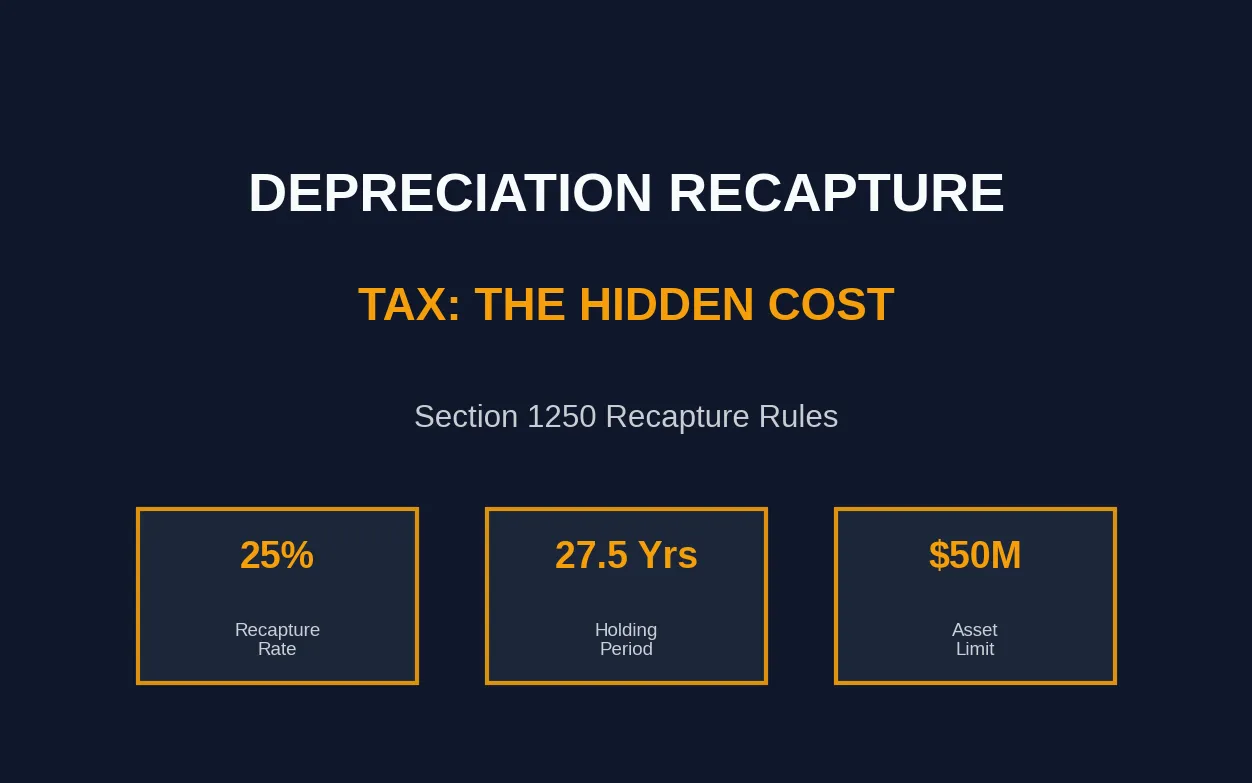
Depreciation Recapture Tax: The Hidden Cost of Selling Investment Property
Depreciation recapture tax can add 25% to your tax bill when selling investment property. Learn how Section 1250 recapture works, how to calculate your tax, and strategies to minimize what you owe when selling depreciated real estate.

1031 Exchange Rules: How to Defer Capital Gains Tax When Swapping Investment Properties
Complete guide to 1031 exchange rules for real estate investors. Learn the 45-day and 180-day deadlines, qualified intermediary requirements, like-kind property rules, and common mistakes that can disqualify your exchange.
Capital Gains Tax Thresholds 2026: Income Limits That Decide Your Rate
Complete breakdown of 2026 capital gains tax thresholds by filing status. Learn the 0%, 15%, and 20% bracket income limits, how the stacking mechanism works, and strategies to stay in the lowest possible bracket.

Section 121 Exclusion: How to Exclude Up to $500,000 When Selling Your Home
Complete guide to the Section 121 exclusion for home sellers. Learn who qualifies, how to calculate your exclusion, special rules for married couples, and when the exclusion may be reduced or denied by the IRS.