Capital Gains Tax on ETFs: Distributions, Tracking Error, and Tax-Efficient Choices That Save You Money
Complete guide to capital gains tax on ETFs. Learn how ETF distributions are taxed, why ETFs are more tax-efficient than mutual funds, and strategies to minimize your tax bill on ETF investments.
📊 How Are ETFs Taxed: The Basics You Need to Know
Exchange-traded funds have earned a reputation as one of the most tax-efficient investment vehicles available to individual investors. But that reputation can be misleading if you do not understand the mechanics behind it. ETFs are not tax-free. They generate capital gains and income distributions just like any other investment, and the IRS expects you to report and pay taxes on those distributions. The difference is that well-structured ETFs tend to generate fewer taxable events than mutual funds, which means you keep more of your returns over time.
When you own an ETF, you face two types of tax events. The first is distributions from the ETF itself, which happen when the fund sells securities inside the portfolio or receives dividends and interest from its holdings. The second is your own capital gain or loss when you sell your ETF shares. These two events are taxed differently, and understanding the distinction is essential for managing your tax bill effectively.
Before diving into the details, it helps to understand the broader context of how capital gains tax on mutual funds and ETFs works. The two fund types share many similarities, but the tax differences between them can be significant enough to change your investment strategy.
📋 ETF Distributions Explained: What You Receive and What You Owe
ETF distributions come in several forms, and each is taxed differently. The most common types are qualified dividends, ordinary dividends, and capital gains distributions. Qualified dividends are taxed at the long-term capital gains rate of zero, fifteen, or twenty percent, depending on your income. Ordinary dividends are taxed at your regular income tax rate. Capital gains distributions occur when the ETF sells securities inside the fund at a profit and passes those gains to shareholders.
Capital gains distributions from ETFs are relatively rare compared to mutual funds, but they do happen. They are most common in actively managed ETFs, sector-specific ETFs that experience high turnover, and international ETFs that need to rebalance frequently due to currency fluctuations or regulatory changes in foreign markets. When an ETF makes a capital gains distribution, you receive a payment that is taxable in the year it is distributed, regardless of whether you reinvest it or take it in cash.
The timing of distributions matters. Most ETFs make their largest distributions in December, which means you need to be careful about buying ETFs late in the year. If you buy shares just before a distribution, you are essentially buying a tax liability. The share price drops by the amount of the distribution, so you are not gaining any economic value, but you owe tax on the distribution. This is sometimes called buying the dividend, and it is one of the most common mistakes new ETF investors make. For a broader understanding of how different investment income is taxed, read our guide on capital gains tax on dividends and the difference between qualified and ordinary.
🔄 Why ETFs Are More Tax-Efficient Than Mutual Funds
The tax advantage of ETFs over mutual funds comes down to one key mechanism: the in-kind creation and redemption process. When investors buy or sell mutual fund shares, the fund manager must buy or sell securities in the portfolio to meet those redemptions. These sales can trigger capital gains inside the fund, which are then distributed to all shareholders. With ETFs, most buying and selling happens between investors on the open market, not between investors and the fund itself.
When an ETF does need to create or redeem shares, it uses an in-kind process. Instead of selling securities for cash, the ETF exchanges a basket of its underlying securities for ETF shares. This exchange is not a taxable event under current IRS rules, so it does not generate capital gains distributions. This is the primary reason why broad-based index ETFs rarely make capital gains distributions, while comparable mutual funds often do.
The tax efficiency gap between ETFs and mutual funds is not just theoretical. Over the past decade, the average actively managed mutual fund has distributed capital gains in seven out of ten years, while the average broad-based index ETF has distributed capital gains in less than one out of ten years. For investors in high tax brackets, this difference can translate into thousands of dollars in avoided taxes over a multi-year holding period. Understanding capital gains tax versus ordinary income tax helps you appreciate why minimizing distributions is so valuable.
💰 Capital Gains Tax When You Sell ETF Shares
When you sell your ETF shares, you realize a capital gain or loss based on the difference between your sale proceeds and your cost basis. The tax rate depends on your holding period. If you held the shares for more than one year, your gain is long-term and qualifies for the preferential rates of zero, fifteen, or twenty percent. If you held them for one year or less, your gain is short-term and is taxed at your ordinary income rate.
Calculating your cost basis for ETF shares can be tricky if you made multiple purchases at different prices. Most brokerages use FIFO (First In, First Out) as the default method, but you can usually choose specific identification or average cost instead. The method you choose can significantly affect your tax bill, especially if you have been dollar-cost averaging into the same ETF over many years. For a detailed explanation of these methods, see our guide on capital gains tax cost basis methods including FIFO and specific identification.
One important thing to remember is that reinvested distributions increase your cost basis. If you received a capital gains distribution and reinvested it, you already paid tax on that distribution in the year it was received. When you eventually sell your shares, you should not pay tax on that amount again. Your cost basis includes the reinvested amount, so make sure your brokerage records reflect this correctly.
🎯 Choosing Tax-Efficient ETFs: What to Look For
Not all ETFs are equally tax-efficient. Some are specifically designed to minimize taxable distributions, while others are structured in ways that virtually guarantee annual capital gains. Here are the key factors to consider when choosing ETFs for a taxable account.
1. Index ETFs over actively managed ETFs. Index funds have lower turnover, which means fewer sales inside the portfolio and fewer capital gains distributions. Actively managed ETFs trade more frequently, which increases the likelihood of taxable distributions.
2. Broad-based ETFs over sector-specific ETFs. Sector ETFs often need to rebalance more frequently as companies move in and out of the sector, which can trigger capital gains. Broad market ETFs like those tracking the S&P 500 or total stock market have much lower turnover.
3. U.S. ETFs over international ETFs for tax efficiency. International ETFs face additional challenges including foreign tax withholding, currency hedging, and regulatory changes that can force rebalancing. While international diversification is important, be aware that international ETFs tend to be less tax-efficient.
4. ETFs with low turnover ratios. You can check an ETF's turnover ratio on its fact sheet. A ratio below ten percent is generally considered tax-efficient. Ratios above fifty percent suggest the fund trades frequently and may generate more distributions.
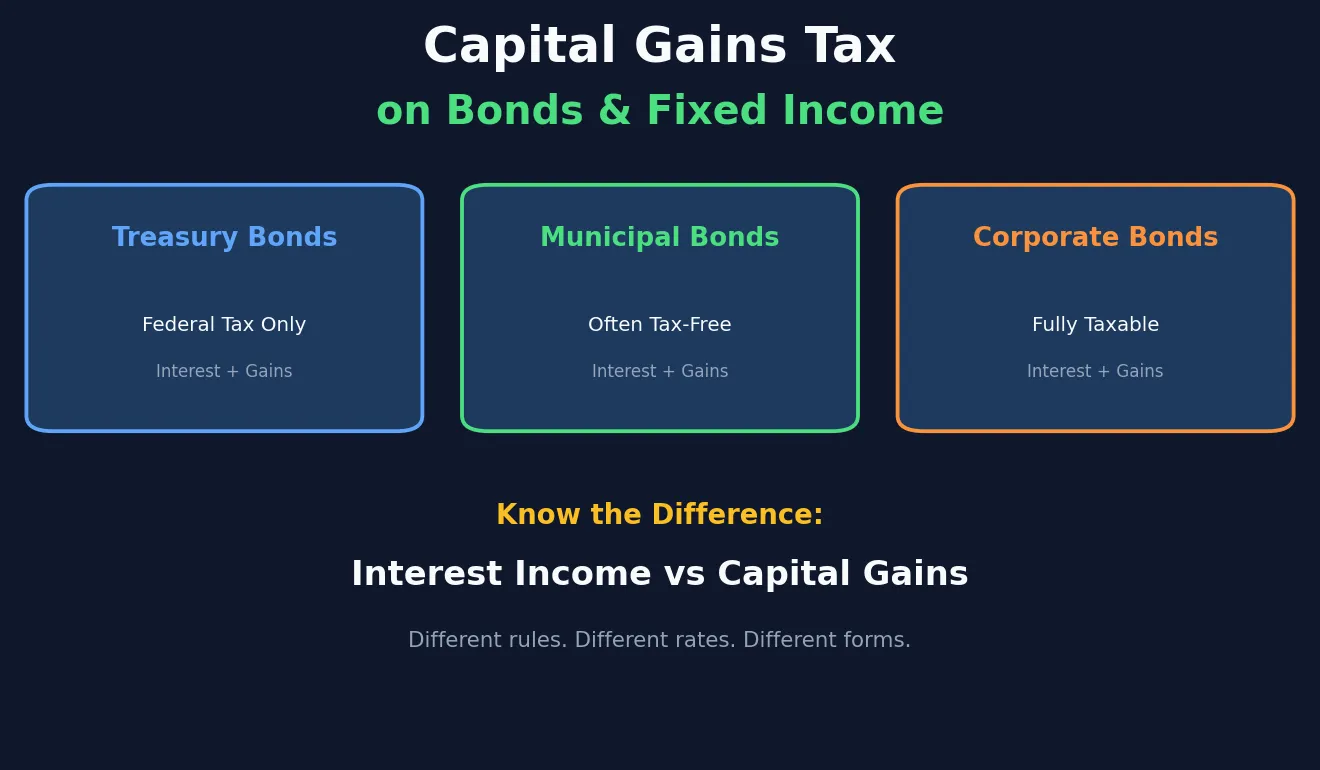
For a broader understanding of how different investment vehicles are taxed, read our guide on capital gains tax on bonds and fixed income investments and our comparison of mutual fund versus ETF tax treatment.
🔄 Tax Loss Harvesting with ETFs: The Swap Strategy
ETFs are ideal vehicles for tax loss harvesting because there are many ETFs that track similar but not identical indexes. This allows you to sell a losing ETF to capture the tax loss and immediately buy a similar ETF to maintain your market exposure, without triggering the wash sale rule. The wash sale rule disallows a loss deduction if you buy the same or substantially identical security within thirty days before or after the sale.
For example, you could sell a Vanguard Total Stock Market ETF at a loss and buy an iShares Core S&P Total U.S. Stock Market ETF the same day. These two ETFs track different indexes and are not considered substantially identical by the IRS, so the wash sale rule does not apply. Yet they both provide broad exposure to the U.S. stock market, so your portfolio stays invested. This is one of the most popular tax loss harvesting strategies used by sophisticated investors and robo-advisors alike.
The key is to make sure the replacement ETF is not substantially identical to the one you sold. Two ETFs from different providers that track the same exact index, like two S&P 500 ETFs, would likely be considered substantially identical. Two ETFs that track different but similar indexes, like a total market ETF and an S&P 500 ETF, are generally considered different enough. For a complete guide to this strategy, read our article on tax loss harvesting and how to turn investment losses into real tax savings.
📝 Reporting ETF Capital Gains on Your Tax Return
Every ETF sale and distribution must be reported on your tax return. Your brokerage will send you a Form 1099-B that summarizes your ETF transactions for the year, including proceeds, cost basis, and holding period. You will also receive a Form 1099-DIV that shows dividend and capital gains distributions from your ETFs.
Capital gains distributions from ETFs are reported on Form 8949 and Schedule D, just like gains from selling individual stocks. The distribution is treated as a long-term capital gain regardless of how long you held the ETF shares, because the gain was generated by the fund's internal transactions, not by your own sale. This is actually beneficial because it means you always get the preferential long-term rate on capital gains distributions, even if you have held the ETF for less than a year.
Make sure to verify your 1099-B against your own records, especially if you transferred ETFs between brokerages or participated in a dividend reinvestment plan. Brokerages sometimes get cost basis wrong for transferred shares, and the IRS will hold you responsible for reporting the correct numbers. For a complete walkthrough of the reporting process, read our guide on how to report capital gains on your tax return with line-by-line instructions.
🏦 ETFs in Tax-Advantaged Accounts: The Best of Both Worlds
One of the smartest things you can do is hold your least tax-efficient ETFs in tax-advantaged accounts like IRAs and 401(k) plans. In a traditional IRA, all gains and distributions are tax-deferred until you withdraw the money in retirement. In a Roth IRA, qualified withdrawals are completely tax-free, which means you never pay capital gains tax on ETF gains inside a Roth. This is particularly valuable for high-turnover ETFs, actively managed ETFs, and international ETFs that tend to generate more distributions.
The general rule of thumb is to hold your most tax-efficient investments in taxable accounts and your least tax-efficient investments in tax-advantaged accounts. This is called asset location, and it can add significant value over a long investing horizon. For a deeper look at how tax-advantaged accounts work, read our guide on capital gains tax on retirement accounts including 401(k), IRA, and Roth.
✅ Key Takeaways for ETF Investors
ETFs are one of the best tools available for tax-conscious investors, but they are not a magic bullet. You still need to pay attention to distributions, holding periods, and cost basis methods. The in-kind creation and redemption process gives ETFs a significant tax advantage over mutual funds, but actively managed and sector-specific ETFs can still generate substantial distributions.
Choose broad-based index ETFs with low turnover for your taxable accounts. Use the ETF swap strategy for tax loss harvesting. Hold your least tax-efficient ETFs in tax-advantaged accounts. And always report every transaction and distribution on your tax return, because the IRS already knows about them from your brokerage.
For a complete picture of how all your investments are taxed, check out our guide on capital gains tax for beginners and our calculator to estimate your capital gains tax liability before you sell.
Fact-Checked & Reviewed
This article was written by James Park (EA, CFP (Certified Financial Planner)) and reviewed for accuracy by Sarah Mitchell (CPA, MST (Master of Science in Taxation)). Published by Wasim Akram, Founder & Lead Researcher at TaxGainsCalc. All tax rates, thresholds, and rules referenced are based on IRS publications and current tax law as of the date published. Tax laws change frequently — always consult a qualified tax professional for advice specific to your situation.
Enrolled Agent & Tax Researcher
James Park is an Enrolled Agent licensed by the IRS and a Certified Financial Planner with over 12 years of experience in tax research and financial planning. He specializes in capital gains strategies for real estate investors and cryptocurrency tra...
Certified Public Accountant (CPA)
Sarah Mitchell is a Certified Public Accountant with over 15 years of experience in individual and business taxation. She holds a Master of Science in Taxation from Golden Gate University and specializes in capital gains tax planning, investment tax ...

Founder & Lead Researcher, TaxGainsCalc
Wasim Akram is an independent web publisher and digital entrepreneur based in India. Since 2018, he has been building custom CMS platforms, WordPress plugins, niche websites, and AI-powered digital products with over 8 years of real-world experience....
Disclaimer: This article is for informational purposes only and does not constitute tax, legal, or financial advice. Tax laws and regulations change frequently, and the information presented here may not reflect the most current updates. You should consult with a qualified CPA, tax attorney, or financial advisor before making any tax-related decisions. TaxGainsCalc is not responsible for any actions taken based on the information provided in this article.