Capital Gains Tax on Rental Property: What Every Landlord Must Know Before Selling
Complete guide to capital gains tax on rental property sales. Learn how to calculate your tax bill, understand depreciation recapture, and discover legal strategies to reduce what you owe when selling investment real estate.
When you sell a rental property, the tax consequences are very different from selling your primary home. Unlike a personal residence, where you can exclude up to $250,000 or $500,000 of gain, rental property sales offer no such exclusion. Every dollar of profit is potentially taxable, and the rules are more complex than most landlords expect.
Understanding capital gains tax on rental property is essential before you list that investment for sale. The IRS treats rental property as a business asset, which means you face both capital gains tax and depreciation recapture when you sell. These two taxes combined can take a significant bite out of your profits, sometimes reaching effective rates of 25 percent or more on portions of your gain.
How Capital Gains Tax Works on Rental Property
Capital gains tax on rental property follows the same basic structure as other investments, but with important differences. The gain is calculated as your selling price minus your adjusted basis. Your adjusted basis includes the original purchase price plus capital improvements minus accumulated depreciation.
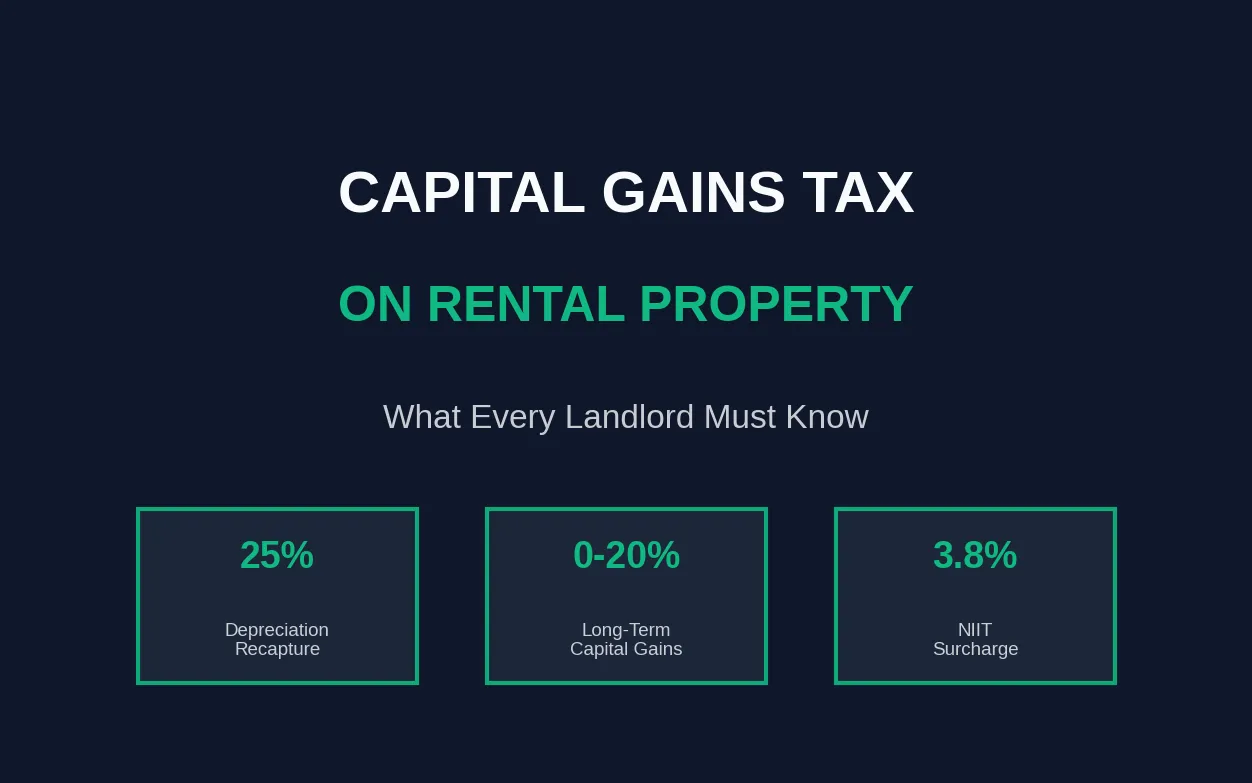
This is where many landlords get surprised. That depreciation you have been claiming year after year reduces your basis, which increases your taxable gain when you sell. The IRS essentially makes you pay back some of the tax benefit you received from depreciation deductions. This is called depreciation recapture, and it is taxed at a flat 25 percent rate, which is higher than the typical long-term capital gains rate.
Short-Term vs Long-Term Capital Gains
The holding period matters enormously for rental property. If you own the property for one year or less before selling, the entire gain is taxed at your ordinary income rate, which can be as high as 37 percent. If you hold it for more than one year, you qualify for the lower long-term capital gains rates of 0 percent, 15 percent, or 20 percent, depending on your taxable income.
For most landlords, the holding period is well over one year, so the long-term rates apply to the capital gain portion. However, the depreciation recapture portion is always taxed at 25 percent regardless of your holding period. This dual-tax structure means you need to calculate both portions separately.
Calculating Your Gain on Rental Property
The calculation starts with determining your adjusted basis. Your original purchase price includes the cost of the property plus closing costs like title insurance, legal fees, and transfer taxes. Capital improvements, such as a new roof, HVAC system, or kitchen renovation, add to your basis. Routine repairs and maintenance do not add to basis.
Accumulated depreciation reduces your basis dollar for dollar. If you claimed $50,000 in depreciation over the years you owned the property, your basis is reduced by that amount. This means your taxable gain is higher than the simple difference between purchase price and selling price.
Example Calculation
Consider a rental property purchased for $300,000 and sold for $500,000 after ten years. You claimed $90,000 in depreciation over the holding period and made $30,000 in capital improvements. Your adjusted basis is $300,000 plus $30,000 minus $90,000, which equals $240,000. Your total gain is $500,000 minus $240,000, which equals $260,000.
Of that $260,000 gain, $90,000 is depreciation recapture (taxed at 25 percent), and the remaining $170,000 is long-term capital gain (taxed at 0, 15, or 20 percent depending on your income). If you are in the 15 percent capital gains bracket, your total federal tax on this sale would be approximately $22,500 on the recapture plus $25,500 on the capital gain, totaling $48,000.
Depreciation Recapture Explained
Depreciation recapture is the IRS mechanism for recovering the tax benefit you received from claiming depreciation deductions. When you sell a rental property for more than its depreciated basis, the IRS requires you to pay tax on the depreciation you claimed at a special 25 percent rate.
This applies even if you did not actually claim depreciation on your tax return. The IRS uses the concept of "allowed or allowable" depreciation, meaning you must recapture depreciation even if you forgot to claim it. This is a harsh rule that catches many landlords off guard, particularly those who managed their own properties without professional tax help.
Section 1250 Recapture Rules
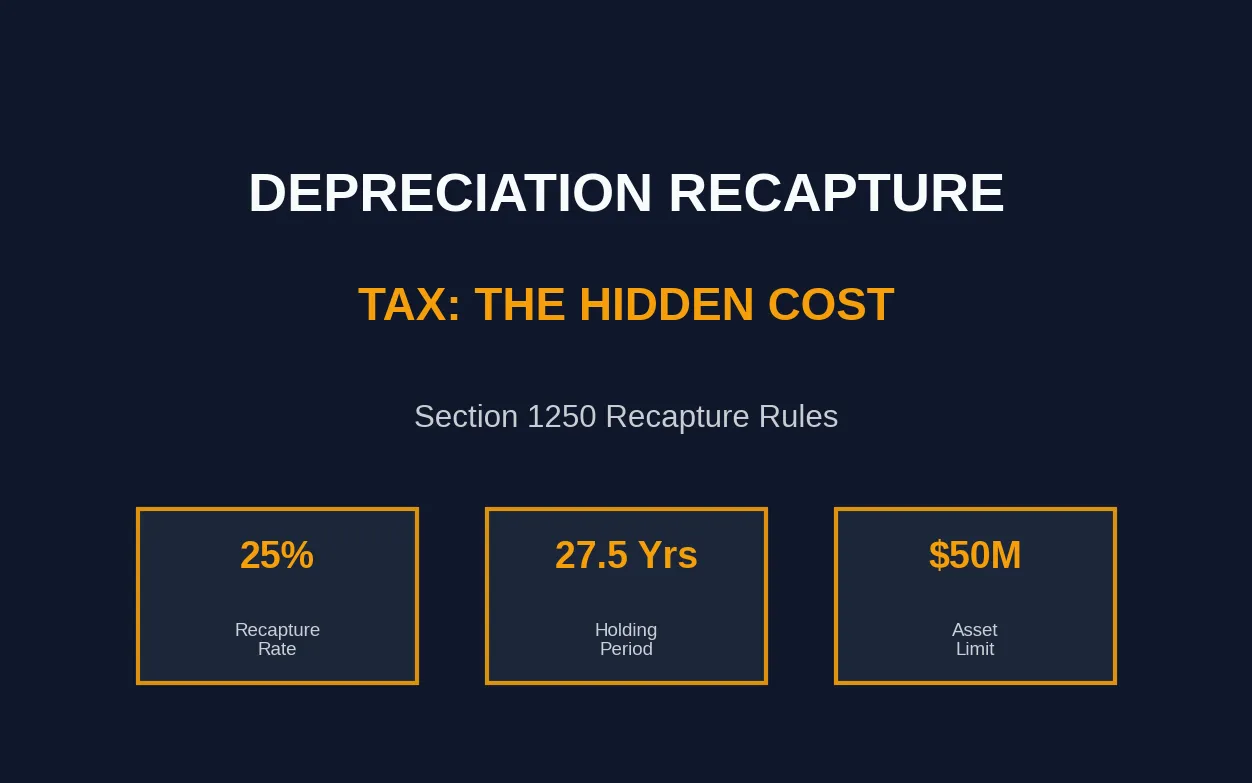
For residential rental property, the depreciation recapture rules under Section 1250 are relatively straightforward. Since residential rental property is depreciated using straight-line methods over 27.5 years, there is no additional recapture beyond the straight-line amount. The entire amount of depreciation claimed is recaptured at the 25 percent rate.
For commercial rental property depreciated over 39 years, the same straight-line rule applies. However, if you used accelerated depreciation methods on older properties, you could face additional recapture taxes above the 25 percent rate. Always consult a tax professional for properties placed in service before 1987.
Strategies to Reduce Capital Gains Tax on Rental Property
Several strategies can help reduce the tax burden when selling rental property. The most powerful is the 1031 exchange, which allows you to defer all capital gains tax by reinvesting the proceeds into another investment property. This is the most common and effective strategy for active real estate investors.
Installment Sale Method
An installment sale spreads the gain over multiple years by receiving payments over time rather than in a lump sum. This can keep you in a lower tax bracket each year and reduce the overall tax burden. However, the depreciation recapture is still taxable in the year of sale, so only the capital gain portion can be spread out.
Converting to Primary Residence
If you move into the rental property and live there as your primary residence for at least two of the five years before selling, you can qualify for the Section 121 exclusion. This allows you to exclude up to $250,000 of gain if single or $500,000 if married filing jointly. However, the depreciation recapture portion is still taxable, and non-qualified use periods after 2008 reduce the exclusion amount.
Tax Loss Harvesting
If you have other investments with unrealized losses, consider selling those investments to offset the rental property gains. Capital losses can offset capital gains dollar for dollar, and up to $3,000 of excess losses can offset ordinary income. This strategy works best when you have significant losses in your stock portfolio that you can realize.
Opportunity Zone Investment
Investing your capital gains into a Qualified Opportunity Fund within 180 days of the sale can defer the capital gains tax. If you hold the opportunity zone investment for at least ten years, any appreciation on the new investment is tax-free. This is a powerful strategy for landlords looking to reinvest in designated opportunity zones.
State Capital Gains Tax Considerations
Most states impose their own capital gains tax in addition to the federal tax. Some states like California tax capital gains at ordinary income rates, which can add 13.3 percent to your tax bill. Other states like Florida, Texas, and Nevada have no state income tax at all. Understanding your state capital gains tax rates is critical for accurately estimating your total tax liability.
The combined federal and state tax rate on rental property gains can be substantial. In high-tax states, the total effective rate can exceed 35 percent on the capital gain portion and 38 percent on the depreciation recapture portion. This makes tax planning strategies even more important for landlords in high-tax states.
Reporting the Sale on Your Tax Return
The sale of rental property is reported on Form 4797, Sales of Business Property, and Schedule D, Capital Gains and Losses. The depreciation recapture is reported on Form 4797 Part III, while the capital gain portion flows to Schedule D. You also need to file Form 8949 to report the sale details.
Many landlords make the mistake of reporting the entire gain on Schedule D as a capital gain. This understates your tax because the depreciation recapture portion should be taxed at 25 percent, not the capital gains rate. Proper reporting ensures you pay the correct amount, which can actually be higher than what a simple capital gains calculation would suggest.
Common Mistakes to Avoid
One of the biggest mistakes landlords make is failing to account for depreciation recapture. They calculate their gain as selling price minus purchase price, ignoring the accumulated depreciation that reduces their basis. This leads to an underestimation of the tax bill and an unpleasant surprise at tax time.
Another common error is not tracking capital improvements properly. Without receipts and documentation, you cannot add improvements to your basis, which means your taxable gain will be higher than it should be. Keep detailed records of every improvement, including the date, cost, and description of the work performed.
Some landlords also fail to consider the net investment income tax of 3.8 percent, which applies to investment income including rental property gains if your modified adjusted gross income exceeds $200,000 for single filers or $250,000 for married filing jointly. This additional tax can add thousands to your bill.
Planning Ahead for the Sale
The best time to plan for capital gains tax on rental property is before you sell. Consider the timing of your sale relative to your income in that year. If you expect lower income in a particular year, selling in that year could qualify you for the 0 percent capital gains rate on some of your gain.
If you are planning to sell multiple properties, consider spacing the sales across different tax years to avoid pushing yourself into higher brackets. Also, consider whether a 1031 exchange might be more beneficial than a taxable sale, especially if you want to continue investing in real estate.
The key takeaway is that selling rental property involves more tax complexity than most landlords expect. The combination of capital gains tax and depreciation recapture can result in a significantly higher tax bill than you might anticipate. Working with a qualified tax professional who specializes in real estate can help you navigate these rules and implement strategies to minimize your tax burden legally.
Fact-Checked & Reviewed
This article was written by Sarah Mitchell (CPA, MST (Master of Science in Taxation)) and reviewed for accuracy by David Chen (JD, LLM in Taxation (New York University)). Published by Wasim Akram, Founder & Lead Researcher at TaxGainsCalc. All tax rates, thresholds, and rules referenced are based on IRS publications and current tax law as of the date published. Tax laws change frequently — always consult a qualified tax professional for advice specific to your situation.
Certified Public Accountant (CPA)
Sarah Mitchell is a Certified Public Accountant with over 15 years of experience in individual and business taxation. She holds a Master of Science in Taxation from Golden Gate University and specializes in capital gains tax planning, investment tax ...
Tax Attorney & Legal Editor
David Chen is a tax attorney with a Juris Doctor and a Master of Laws in Taxation from New York University School of Law. With over 10 years of legal practice, he specializes in 1031 exchanges, capital gains tax law, and IRS dispute resolution. David...

Founder & Lead Researcher, TaxGainsCalc
Wasim Akram is an independent web publisher and digital entrepreneur based in India. Since 2018, he has been building custom CMS platforms, WordPress plugins, niche websites, and AI-powered digital products with over 8 years of real-world experience....
Disclaimer: This article is for informational purposes only and does not constitute tax, legal, or financial advice. Tax laws and regulations change frequently, and the information presented here may not reflect the most current updates. You should consult with a qualified CPA, tax attorney, or financial advisor before making any tax-related decisions. TaxGainsCalc is not responsible for any actions taken based on the information provided in this article.