Depreciation Recapture Tax: The Hidden Cost of Selling Investment Property
Depreciation recapture tax can add 25% to your tax bill when selling investment property. Learn how Section 1250 recapture works, how to calculate your tax, and strategies to minimize what you owe when selling depreciated real estate.
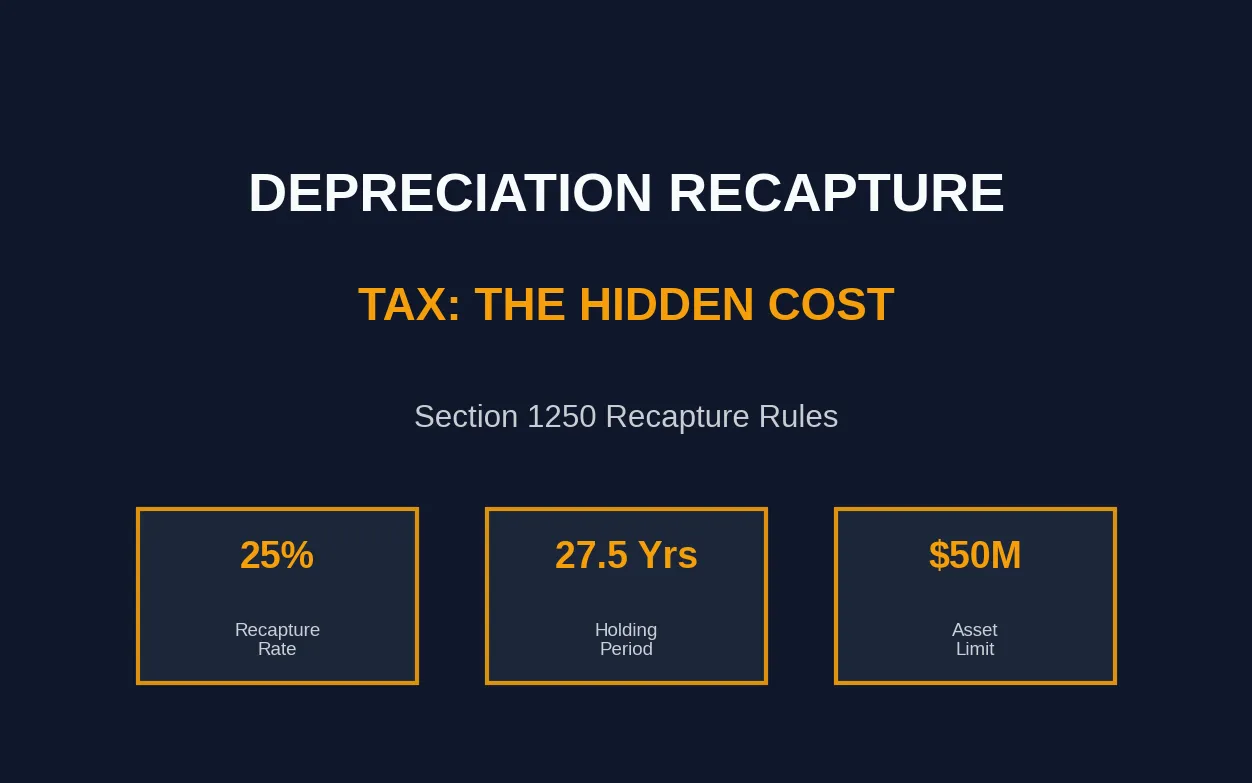
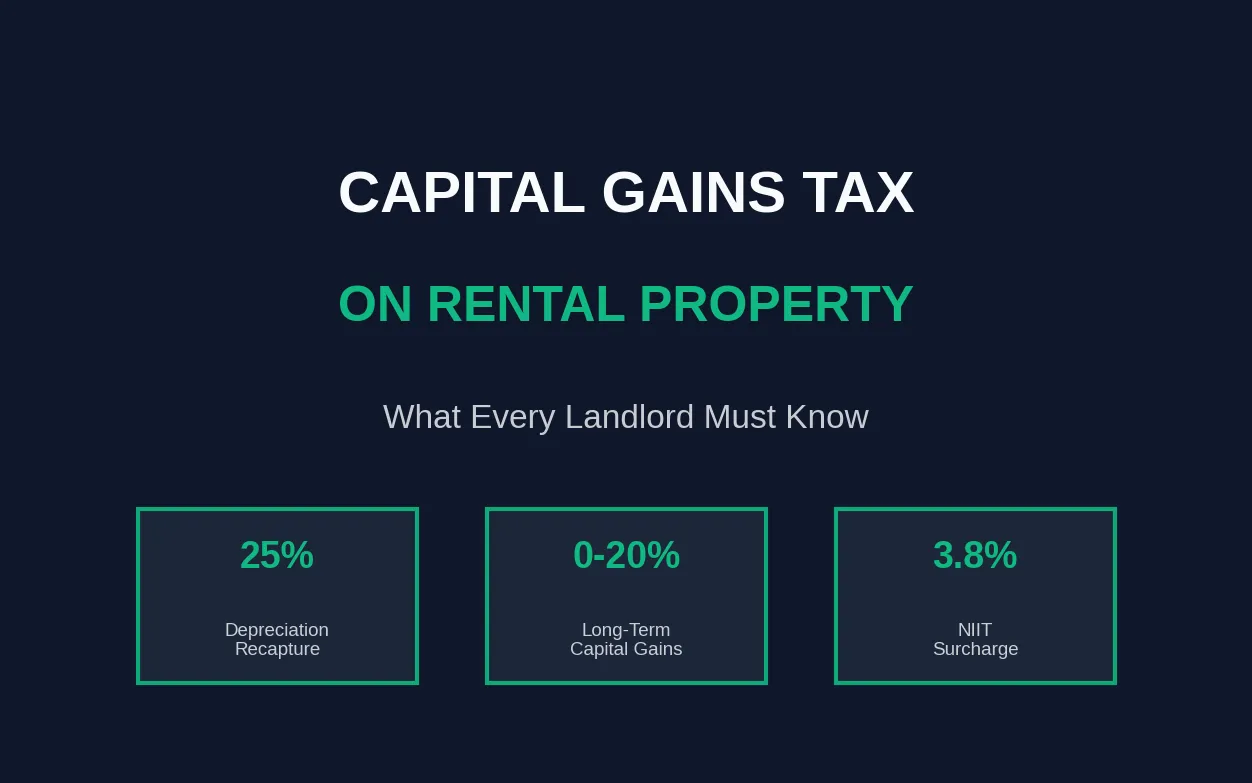
Depreciation recapture is one of the most misunderstood and costly tax provisions that property investors face when selling. Many landlords are shocked to discover that the depreciation deductions they claimed over the years must be repaid when they sell the property. This repayment, known as depreciation recapture, is taxed at a flat 25 percent rate, which is often higher than the long-term capital gains rate.
The concept is straightforward but the execution is complex. When you own investment property, you are required to depreciate it over its useful life, which is 27.5 years for residential rental property and 39 years for commercial property. Each year, you deduct a portion of the property cost as depreciation expense, reducing your taxable rental income. However, when you sell, the IRS wants some of that tax benefit back.
What Is Depreciation Recapture?
Depreciation recapture is the process by which the IRS recovers the tax benefit you received from claiming depreciation deductions on an investment property. When you sell the property for more than its adjusted basis (original cost minus accumulated depreciation), the portion of the gain attributable to depreciation is recaptured and taxed at a special rate.
The recapture amount is limited to the lesser of the accumulated depreciation or the total gain on the sale. If you sell the property at a loss, there is no depreciation recapture because there is no gain to recapture. The recapture only applies to the extent you have a gain.
Why the IRS Requires Recapture
The IRS views depreciation as a loan, not a gift. When you claim depreciation, you are effectively borrowing tax savings from the government. When you sell the property and realize a gain, the IRS wants its loan repaid. The 25 percent recapture rate is designed to partially claw back the tax benefit you received, particularly if you were in a higher tax bracket when you claimed the deductions.
This system prevents taxpayers from double-dipping by claiming depreciation deductions to reduce ordinary income and then paying only the lower capital gains rate when they sell. Without recapture, you could deduct depreciation at your 37 percent rate and pay only 15 percent on the gain, effectively creating a 22 percent tax arbitrage.
Section 1250 Recapture Rules
Section 1250 of the Internal Revenue Code governs depreciation recapture on real property. For residential rental property depreciated under the straight-line method over 27.5 years, the recapture is relatively simple. The entire amount of depreciation claimed is recaptured at the 25 percent rate.
For commercial property depreciated over 39 years using the straight-line method, the same rule applies. The straight-line depreciation is recaptured at the 25 percent rate. However, if you used an accelerated depreciation method on property placed in service before 1987, you could face additional recapture above the 25 percent rate on the excess depreciation.
Unrecaptured Section 1250 Gain
The term "unrecaptured Section 1250 gain" refers to the portion of your gain that is attributable to straight-line depreciation and is taxed at a maximum rate of 25 percent. This is not technically recapture in the traditional sense, but it functions similarly. The gain is reported on Schedule D as a capital gain, but it is subject to the 25 percent maximum rate rather than the regular 15 or 20 percent long-term capital gains rates.
This distinction matters because the 25 percent rate applies regardless of your income level. Even if you would normally qualify for the 0 percent capital gains rate, the unrecaptured Section 1250 gain is taxed at up to 25 percent. This makes it particularly important for lower-income taxpayers to understand the full impact of depreciation recapture.
How to Calculate Depreciation Recapture
The calculation involves several steps. First, determine your total gain on the sale. This is the selling price minus your adjusted basis, which includes the original purchase price plus capital improvements minus accumulated depreciation.
Second, identify the depreciation recapture amount. This is the lesser of the accumulated depreciation or the total gain. If your total gain is $200,000 and you claimed $80,000 in depreciation, the recapture amount is $80,000. If your total gain is only $50,000 but you claimed $80,000 in depreciation, the recapture amount is limited to $50,000.
Third, calculate the tax on each portion. The recapture amount is taxed at 25 percent, and the remaining gain is taxed at the long-term capital gains rate of 0, 15, or 20 percent depending on your income.
Detailed Calculation Example
Suppose you purchased a rental property for $350,000 and sold it for $550,000 after twelve years. You claimed $110,000 in depreciation and made $25,000 in capital improvements. Your adjusted basis is $350,000 plus $25,000 minus $110,000, which equals $265,000. Your total gain is $550,000 minus $265,000, which equals $285,000.
The depreciation recapture is $110,000 (the lesser of accumulated depreciation or total gain). This is taxed at 25 percent, resulting in $27,500. The remaining $175,000 is long-term capital gain. If you are in the 15 percent bracket, the tax on this portion is $26,250. Your total federal tax is $27,500 plus $26,250, which equals $53,750.
Allowed or Allowable Depreciation
One of the harshest rules in depreciation recapture is the "allowed or allowable" provision. The IRS requires you to recapture depreciation even if you did not actually claim it on your tax return. If you could have claimed depreciation but chose not to, or simply forgot to claim it, you must still recapture it when you sell.
This rule catches many self-managing landlords who did not realize they were supposed to claim depreciation. Even if you never filed Schedule E with depreciation, the IRS assumes you should have, and the recapture is based on the depreciation you could have claimed. This is why it is always better to claim depreciation when available, because you will pay the recapture tax regardless.
Depreciation Recapture vs Capital Gains Tax
The key difference between depreciation recapture and capital gains tax is the rate and the basis. Capital gains tax applies to the appreciation in the property value above the original purchase price, while depreciation recapture applies to the portion of the gain attributable to the depreciation deductions.
In practice, the two taxes work together. The recapture portion is taxed first at 25 percent, and then the remaining gain is taxed at the capital gains rate. This means the total effective tax rate on your gain is somewhere between the two rates, depending on the proportion of depreciation recapture to total gain.
Properties with high depreciation relative to their total gain will have a higher effective tax rate because more of the gain is taxed at 25 percent. Conversely, properties with substantial appreciation and relatively lower depreciation will have a lower effective rate because more of the gain is taxed at the 15 or 20 percent capital gains rate.
Strategies to Minimize Depreciation Recapture
The most effective strategy is a 1031 exchange, which allows you to defer both capital gains tax and depreciation recapture by reinvesting the proceeds into another investment property. The 1031 exchange essentially rolls your entire tax liability into the new property, where depreciation calculations begin fresh based on the new basis.
Converting to Primary Residence
Moving into the rental property and using it as your primary residence for at least two years can qualify you for the Section 121 exclusion. This can exclude up to $250,000 or $500,000 of gain, but the depreciation recapture portion is still taxable. The non-qualified use rules that took effect in 2009 also reduce the exclusion amount based on the time the property was used as a rental after 2008.
Installment Sales
An installment sale can spread the capital gains portion over multiple years, but the depreciation recapture is taxable in the year of sale regardless. This means you cannot defer the recapture tax through an installment sale. However, spreading the capital gain portion can help you stay in lower tax brackets for that portion.
Opportunity Zone Investment
Investing your capital gains into a Qualified Opportunity Fund within 180 days of the sale can defer the capital gains tax. However, the depreciation recapture portion is not eligible for deferral through opportunity zone investments. You must pay the recapture tax in the year of sale, but the capital gain portion can be deferred and potentially reduced if you hold the investment for the required period.
Impact on Different Property Types
The depreciation recapture rules affect different property types in different ways. Residential rental property depreciated over 27.5 years accumulates approximately 3.636 percent of the building value per year in depreciation. After ten years, that is roughly 36 percent of the building value, which creates a significant recapture liability.
Commercial property depreciated over 39 years accumulates depreciation more slowly at approximately 2.564 percent per year. However, commercial properties often have higher values and longer holding periods, which can result in substantial accumulated depreciation over time.
For land sales, depreciation recapture is not a factor because land is not depreciable. Only the building portion of a property is subject to depreciation. This is why it is important to allocate the purchase price between land and building when you acquire a rental property, as the building allocation determines your depreciation deductions and future recapture liability.
Reporting Requirements
Depreciation recapture is reported on Form 4797, Sales of Business Property. The recapture amount goes on Part III of Form 4797, and the remaining gain flows to Schedule D. You also need to file Form 8949 to report the sale details. The recapture tax is calculated on the Unrecaptured Section 1250 Gain worksheet in the Schedule D instructions.
Many taxpayers make the mistake of reporting the entire gain on Schedule D as a regular capital gain. This understates the tax because the recapture portion should be taxed at 25 percent rather than the capital gains rate. Proper reporting is essential to avoid penalties and interest from the IRS.
Common Mistakes and Pitfalls
The most common mistake is failing to account for depreciation recapture at all. Many landlords calculate their gain as simply the selling price minus the purchase price, completely ignoring the depreciation that reduced their basis. This leads to a significant underestimation of the tax bill.
Another mistake is not tracking capital improvements. Without proper documentation, you cannot add improvements to your basis, which means your taxable gain will be higher than it should be. Keep detailed records of every improvement, including the date, cost, and description of the work performed.
Some property owners also forget about the net investment income tax of 3.8 percent, which applies to investment income including rental property gains if your modified adjusted gross income exceeds certain thresholds. This additional tax can add thousands to your total bill.
Finally, failing to consider state capital gains tax can lead to a nasty surprise. Many states impose their own capital gains tax on top of the federal tax, and some states tax capital gains at ordinary income rates. Factor in your state tax when estimating your total liability.
Planning for Depreciation Recapture
The best time to plan for depreciation recapture is when you first acquire the property. Proper allocation of the purchase price between land and building can optimize your depreciation deductions while managing your future recapture liability. A cost segregation study can also help by identifying components of the property that can be depreciated more quickly, though this increases the recapture liability.
If you are planning to sell, consider the timing carefully. Selling in a year when your income is lower can reduce the capital gains rate on the non-recapture portion. Also, consider whether a 1031 exchange might be more beneficial than a taxable sale, especially if you want to continue investing in real estate.
Understanding depreciation recapture is not optional for rental property owners. It is a significant tax liability that can dramatically affect your net proceeds from a sale. Working with a qualified tax professional who specializes in real estate can help you navigate these complex rules and implement strategies to minimize your tax burden.
Fact-Checked & Reviewed
This article was written by James Park (EA, CFP (Certified Financial Planner)) and reviewed for accuracy by David Chen (JD, LLM in Taxation (New York University)). Published by Wasim Akram, Founder & Lead Researcher at TaxGainsCalc. All tax rates, thresholds, and rules referenced are based on IRS publications and current tax law as of the date published. Tax laws change frequently — always consult a qualified tax professional for advice specific to your situation.
Enrolled Agent & Tax Researcher
James Park is an Enrolled Agent licensed by the IRS and a Certified Financial Planner with over 12 years of experience in tax research and financial planning. He specializes in capital gains strategies for real estate investors and cryptocurrency tra...
Tax Attorney & Legal Editor
David Chen is a tax attorney with a Juris Doctor and a Master of Laws in Taxation from New York University School of Law. With over 10 years of legal practice, he specializes in 1031 exchanges, capital gains tax law, and IRS dispute resolution. David...

Founder & Lead Researcher, TaxGainsCalc
Wasim Akram is an independent web publisher and digital entrepreneur based in India. Since 2018, he has been building custom CMS platforms, WordPress plugins, niche websites, and AI-powered digital products with over 8 years of real-world experience....
Disclaimer: This article is for informational purposes only and does not constitute tax, legal, or financial advice. Tax laws and regulations change frequently, and the information presented here may not reflect the most current updates. You should consult with a qualified CPA, tax attorney, or financial advisor before making any tax-related decisions. TaxGainsCalc is not responsible for any actions taken based on the information provided in this article.