1031 Exchange Rules: How to Defer Capital Gains Tax When Swapping Investment Properties
Complete guide to 1031 exchange rules for real estate investors. Learn the 45-day and 180-day deadlines, qualified intermediary requirements, like-kind property rules, and common mistakes that can disqualify your exchange.
A 1031 exchange is one of the most powerful tax strategies available to real estate investors. Named after Section 1031 of the Internal Revenue Code, this provision allows you to defer paying capital gains tax when you sell an investment property, as long as you reinvest the proceeds into a similar type of property. For investors with significant unrealized gains, a 1031 exchange can defer tens of thousands of dollars in taxes, freeing up more capital for reinvestment.
The concept behind a 1031 exchange is simple: if you are simply exchanging one investment property for another, there is no economic gain to tax because your investment is still tied up in real estate. The IRS recognizes that taxing a paper gain on a like-kind swap would force investors to sell properties prematurely or reduce their ability to reinvest. However, the rules governing 1031 exchanges are complex and strict, and failing to follow them can result in the entire gain being taxed immediately.
This guide covers every aspect of the 1031 exchange process, including the types of properties that qualify, the timeline you must follow, the role of a qualified intermediary, and common mistakes that can derail your exchange. Whether you are a seasoned real estate investor or considering your first 1031 exchange, understanding these rules is essential for protecting your investment.
What Is a 1031 Exchange
A 1031 exchange, also known as a like-kind exchange, allows you to defer capital gains tax on the sale of an investment or business property by reinvesting the proceeds into a replacement property of like kind. The term "like-kind" is broadly defined under the tax code, which means you have significant flexibility in choosing your replacement property. You can exchange a rental house for a commercial building, a vacant lot for an apartment complex, or a retail space for an industrial warehouse.
It is important to understand that a 1031 exchange is a deferral, not an elimination, of capital gains tax. The deferred gain carries over to the new property, reducing your basis in the replacement property. This means that when you eventually sell the replacement property without doing another exchange, you will owe tax on the deferred gain plus any additional gain from the replacement property. However, many investors use a series of 1031 exchanges throughout their investing career, effectively deferring taxes for decades.
Properties That Qualify for a 1031 Exchange
Not all properties qualify for a 1031 exchange. The Tax Cuts and Jobs Act of 2017 limited 1031 exchanges to real property only. Personal property such as equipment, vehicles, and artwork is no longer eligible. However, the definition of real property is broad and includes land, buildings, and improvements to real property.
Qualifying Real Property
Both the property you sell (the relinquished property) and the property you acquire (the replacement property) must be held for investment or used in a trade or business. The most common qualifying properties include rental houses, apartment buildings, commercial office spaces, retail stores, industrial warehouses, and vacant land. The key is that the property must be held for investment purposes, not for personal use or for immediate resale.
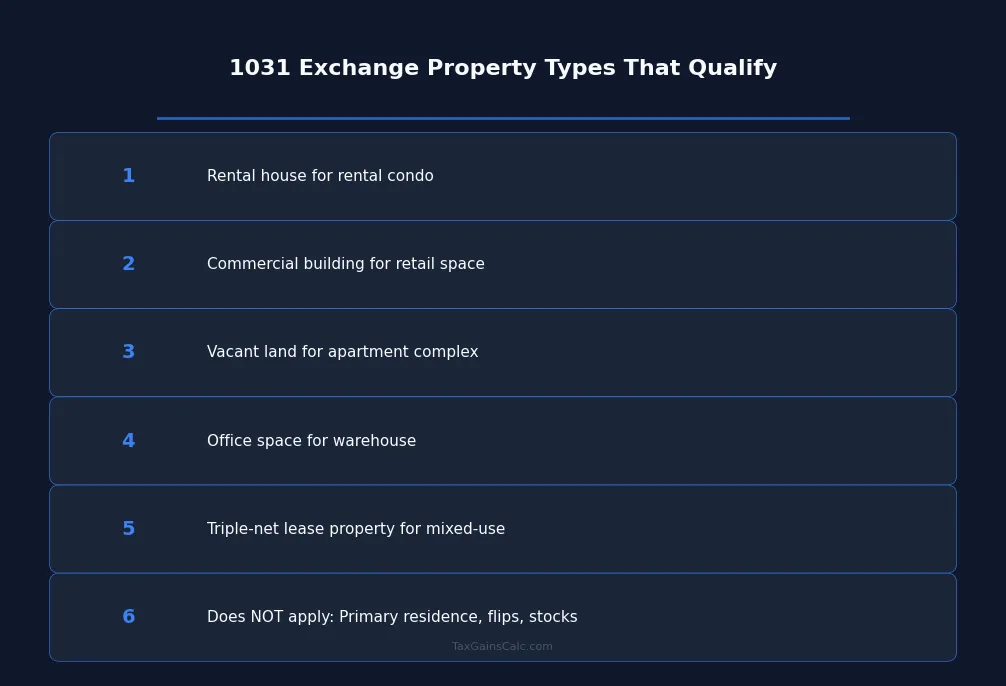
Properties held primarily for sale, such as house flips, do not qualify for 1031 exchange treatment. The IRS looks at your intent when you acquired the property. If you bought a property with the primary intention of renovating and selling it quickly for a profit, the IRS considers it inventory rather than investment property, and the gain is taxed as ordinary income.
Understanding Like-Kind
The like-kind requirement is surprisingly broad. Virtually any type of real property held for investment or business use can be exchanged for any other type of real property held for investment or business use. You can exchange a single-family rental in California for a commercial building in Florida, or a vacant lot in Texas for a triple-net lease property in New York. The properties do not need to be similar in type, quality, or location.
The only restriction is that both properties must be real property held for investment or business use. You cannot exchange real property for personal property, and you cannot exchange a property held for personal use, such as your primary residence, for an investment property. If you are selling your primary residence, you should look into the Section 121 exclusion instead.
The 1031 Exchange Timeline
The 1031 exchange process is governed by strict deadlines that you must follow precisely. Missing either deadline by even one day can disqualify your entire exchange, resulting in the full capital gains tax being due immediately.
The 45-Day Identification Period
From the date you close on the sale of your relinquished property, you have exactly 45 calendar days to identify potential replacement properties in writing. This identification must be delivered to your qualified intermediary, and it must be specific enough to unambiguously identify the property. A street address, legal description, or other unique identifier is required.
You can identify up to three replacement properties without regard to their fair market value, which is known as the three-property rule. Alternatively, you can identify more than three properties, but their combined value cannot exceed 200 percent of the value of the relinquished property. This is called the 200 percent rule. A third option, the 95 percent rule, allows you to identify any number of properties, but you must acquire properties worth at least 95 percent of the total value of all identified properties.
The 180-Day Exchange Period
From the date you close on the sale of your relinquished property, you have exactly 180 calendar days to close on the purchase of your replacement property. This period includes the 45-day identification period, so you effectively have 135 additional days after identification to complete the purchase. The 180-day period is also shortened to the due date of your tax return (including extensions) for the year of the sale, if that date comes first.
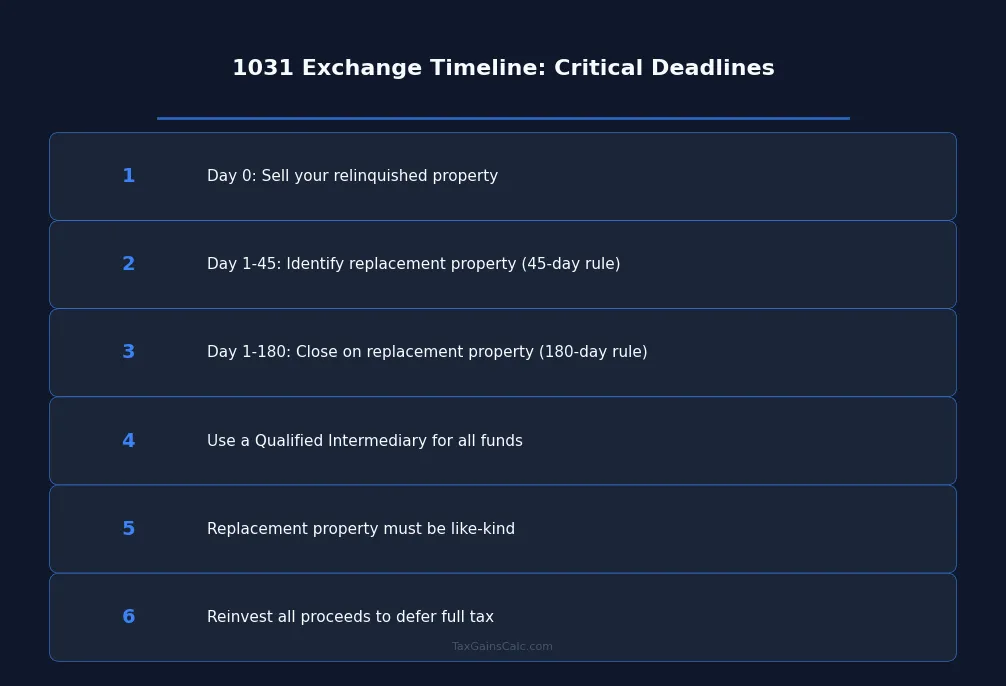
These deadlines are absolute and cannot be extended for any reason, including weekends, holidays, or natural disasters. The only exception is if the President declares a disaster in your area, which may extend certain tax deadlines. Plan your exchange carefully and work with experienced professionals to ensure you meet both deadlines.
The Role of a Qualified Intermediary
A qualified intermediary, sometimes called an exchange accommodator, is a third party who facilitates the 1031 exchange by holding the proceeds from the sale of your relinquished property and using them to acquire the replacement property. You cannot take constructive receipt of the funds at any point during the exchange. If you receive the money directly, the exchange is invalid and the entire gain is taxable.
The qualified intermediary must be an independent party who is not your agent, attorney, accountant, or anyone who has acted as your agent in the past two years. This independence requirement is strictly enforced, and using a disqualified person as your intermediary will invalidate the exchange. Many companies specialize in serving as qualified intermediaries, and they typically charge fees ranging from $500 to $2,000 for a standard exchange.
How the Process Works
The 1031 exchange process typically follows these steps. First, you engage a qualified intermediary before you close on the sale of your relinquished property. The intermediary prepares an exchange agreement and assignment documents. When you close on the sale, the proceeds are transferred directly to the intermediary, who holds them in a segregated account.
Within 45 days, you identify replacement properties in writing to the intermediary. When you are ready to close on a replacement property, the intermediary uses the held funds to purchase the property on your behalf, and then transfers the property to you. The intermediary handles all the paperwork and ensures that the funds flow correctly to maintain the exchange qualification.
Common 1031 Exchange Structures
There are several different structures for a 1031 exchange, each suited to different circumstances. The most common is the delayed exchange, where you sell the relinquished property first and then acquire the replacement property within the 180-day period. This is the standard structure used by most investors.
A reverse exchange is the opposite: you acquire the replacement property first, and then sell the relinquished property within 180 days. Reverse exchanges are more complex and expensive because the qualified intermediary must hold title to one of the properties during the exchange period. They are typically used when you find an ideal replacement property before you have sold your current property.
A construction exchange, also known as a build-to-suit exchange, allows you to use exchange proceeds to improve a replacement property. The qualified intermediary holds title to the property while improvements are made, and the improved property is then transferred to you. This is useful when you want to acquire a property that needs significant work before it can generate rental income.
Tax Implications of a 1031 Exchange
A properly executed 1031 exchange defers both federal and state capital gains tax on the sale of your relinquished property. The deferred gain reduces your basis in the replacement property, which means your depreciation deductions on the new property will be lower and your future gain will be higher. This is the trade-off: you get a tax deferral now, but you will owe more tax when you eventually sell the replacement property.
Depreciation Recapture in a 1031 Exchange
Depreciation recapture is a critical consideration in any 1031 exchange. When you sell a property on which you have claimed depreciation, the IRS requires you to pay tax on that depreciation at a maximum rate of 25 percent. In a 1031 exchange, the depreciation recapture is deferred along with the capital gain. This is different from the depreciation recapture on rental property rules that apply in a taxable sale.
However, the deferred depreciation recapture carries over to the replacement property. When you eventually sell the replacement property in a taxable transaction, the accumulated depreciation from both properties will be subject to recapture. This means that the total tax bill when you eventually cash out can be significantly higher than if you had paid the tax on each property separately.
Boot and Partial Exchanges
If you receive cash or other non-like-kind property in a 1031 exchange, it is called "boot" and is taxable. Boot can arise when the replacement property costs less than the relinquished property, when you receive cash back at closing, or when the mortgage on the replacement property is less than the mortgage on the relinquished property. Any boot received is taxed in the year of the exchange, while the remaining gain is deferred.
To maximize the tax deferral, you should try to reinvest all of the proceeds from the sale and acquire a replacement property of equal or greater value. If the replacement property costs less, the difference is treated as cash boot and is taxable. Similarly, if you reduce your debt, the debt reduction is treated as mortgage boot and is also taxable.
Mistakes That Can Ruin Your 1031 Exchange
The most common mistake is missing the 45-day or 180-day deadlines. These deadlines are absolute, and the IRS has consistently refused to grant extensions. Even if you have a valid reason for the delay, such as a delayed closing through no fault of your own, the exchange will be disqualified. Build extra time into your schedule and identify backup replacement properties in case your first choice falls through.
Another frequent error is failing to use a qualified intermediary. Some investors attempt to handle the exchange themselves, which is not allowed. The IRS requires a qualified intermediary to hold the proceeds and facilitate the exchange. If you take constructive receipt of the funds at any point, the exchange is invalid.
Some investors also fail to consider the state capital gains tax implications. While most states conform to the federal 1031 exchange rules, some states have different requirements or additional taxes. For example, California imposes a withholding tax on the sale of real property by non-residents, which can affect the amount of cash available for reinvestment.
How to Report a 1031 Exchange
You must report a 1031 exchange on your tax return for the year in which the exchange occurs. File Form 8824, Like-Kind Exchanges, with your individual income tax return. This form requires you to describe both properties, the date the relinquished property was transferred, the date the replacement property was received, and the gain deferred. You must also report any boot received and the basis of the replacement property.
Proper reporting is essential because the IRS uses Form 8824 to track your deferred gain. If you fail to file this form, the IRS may assume the entire gain is taxable and send you a bill. Even if no tax is due because the entire gain was deferred, the reporting requirement still applies. Make sure your tax preparer is familiar with 1031 exchange reporting to avoid errors.
1031 Exchange vs Other Tax Strategies
The 1031 exchange is not the only strategy for deferring capital gains tax on real estate. A deferral strategy using opportunity zones can also defer gains, and it offers the additional benefit of excluding gain on the opportunity zone investment if held for at least ten years. However, opportunity zone investments carry more risk and are limited to designated areas.
If you are selling your primary residence rather than an investment property, the capital gains tax exclusion for home sales may be more appropriate. This exclusion allows you to exclude up to $250,000 or $500,000 of gain, and it is a true exclusion rather than a deferral. For many homeowners, the Section 121 exclusion is simpler and more beneficial than a 1031 exchange.
Key Takeaways
A 1031 exchange allows real estate investors to defer capital gains tax by reinvesting proceeds into a like-kind replacement property. The exchange must be completed within strict timelines: 45 days to identify replacement properties and 180 days to close. A qualified intermediary is required to hold the proceeds and facilitate the exchange. The deferred gain carries over to the replacement property, reducing your basis and increasing your future tax liability. Proper planning and professional guidance are essential for executing a successful 1031 exchange.
If you are considering a 1031 exchange, start planning early and work with experienced professionals. The rules are strict, but the tax savings can be substantial. By understanding the process and avoiding common mistakes, you can defer significant capital gains tax and keep more of your investment capital working for you.
Fact-Checked & Reviewed
This article was written by David Chen (JD, LLM in Taxation (New York University)) and reviewed for accuracy by David Chen (JD, LLM (Taxation), EA). Published by Wasim Akram, Founder & Lead Researcher at TaxGainsCalc. All tax rates, thresholds, and rules referenced are based on IRS publications and current tax law as of the date published. Tax laws change frequently — always consult a qualified tax professional for advice specific to your situation.
Tax Attorney & Legal Editor
David Chen is a tax attorney with a Juris Doctor and a Master of Laws in Taxation from New York University School of Law. With over 10 years of legal practice, he specializes in 1031 exchanges, capital gains tax law, and IRS dispute resolution....
Tax Attorney & Enrolled Agent
David Chen is a tax attorney and Enrolled Agent with over 20 years of experience in tax law and IRS dispute resolution. He holds a Juris Doctor from Columbia Law School and a Master of Laws in Taxation from NYU School of Law....

Founder & Lead Researcher, TaxGainsCalc
Wasim Akram is an independent web publisher and digital entrepreneur based in India. Since 2018, he has been building custom CMS platforms, WordPress plugins, niche websites, and AI-powered digital products with over 8 years of real-world experience....
Disclaimer: This article is for informational purposes only and does not constitute tax, legal, or financial advice. Tax laws and regulations change frequently, and the information presented here may not reflect the most current updates. You should consult with a qualified CPA, tax attorney, or financial advisor before making any tax-related decisions. TaxGainsCalc is not responsible for any actions taken based on the information provided in this article.