Capital Gains Tax Thresholds 2026: Income Limits That Decide Your Rate
Complete breakdown of 2026 capital gains tax thresholds by filing status. Learn the 0%, 15%, and 20% bracket income limits, how the stacking mechanism works, and strategies to stay in the lowest possible bracket.
Capital gains tax thresholds determine the rate you pay on your investment profits, and understanding these income limits is one of the most important things you can do to minimize your tax bill. Unlike ordinary income tax brackets, which top out at 37 percent, long-term capital gains tax rates are significantly lower, with three distinct brackets: 0 percent, 15 percent, and 20 percent. The bracket you fall into depends entirely on your taxable income, and the difference between the 0 percent and 15 percent brackets can save you thousands of dollars.
For the 2026 tax year, the income thresholds that determine your capital gains tax rate have been adjusted for inflation. These thresholds vary by filing status, and they can change significantly from year to year. Understanding where you fall relative to these thresholds allows you to plan your investment sales strategically, potentially qualifying for a lower rate by timing your gains and losses appropriately.
This guide provides a comprehensive breakdown of the 2026 capital gains tax thresholds, explains how the brackets work for each filing status, and offers strategies for managing your income to stay in the lowest possible bracket. Whether you are a casual investor selling a few shares or a sophisticated trader managing a large portfolio, knowing these thresholds is essential for tax planning.
How Capital Gains Tax Brackets Work
Capital gains tax brackets operate differently from ordinary income tax brackets. For ordinary income, you have seven federal tax brackets ranging from 10 percent to 37 percent. For long-term capital gains, there are only three brackets: 0 percent, 15 percent, and 20 percent. Your capital gains are stacked on top of your ordinary income to determine which bracket applies.
This stacking mechanism means that your ordinary income fills up the lower brackets first, and your capital gains are then added on top. If your ordinary income already exceeds the 0 percent threshold, all of your capital gains will be taxed at 15 percent or 20 percent. However, if you have room below the 0 percent threshold, some or all of your capital gains could be taxed at 0 percent.
Short-Term vs Long-Term Capital Gains
The distinction between short-term and long-term capital gains is critical. Short-term gains, from assets held for one year or less, are taxed at your ordinary income rate, which can be as high as 37 percent. Long-term gains, from assets held for more than one year, are taxed at the preferential rates of 0 percent, 15 percent, or 20 percent. This is why the short-term vs long-term capital gains tax distinction is so important for tax planning.
If you are considering selling an investment that you have held for eleven months, waiting just one more month could reduce your tax rate from your ordinary income rate to the long-term capital gains rate. For a $50,000 gain, this could mean the difference between paying $18,500 in tax at the 37 percent rate and paying $7,500 at the 15 percent rate, a savings of $11,000.
2026 Capital Gains Tax Thresholds by Filing Status
The income thresholds for the 2026 tax year are adjusted annually for inflation. The IRS publishes these thresholds each year, and they apply to your taxable income, which includes both ordinary income and capital gains. Here are the specific thresholds for each filing status.
Single Filers
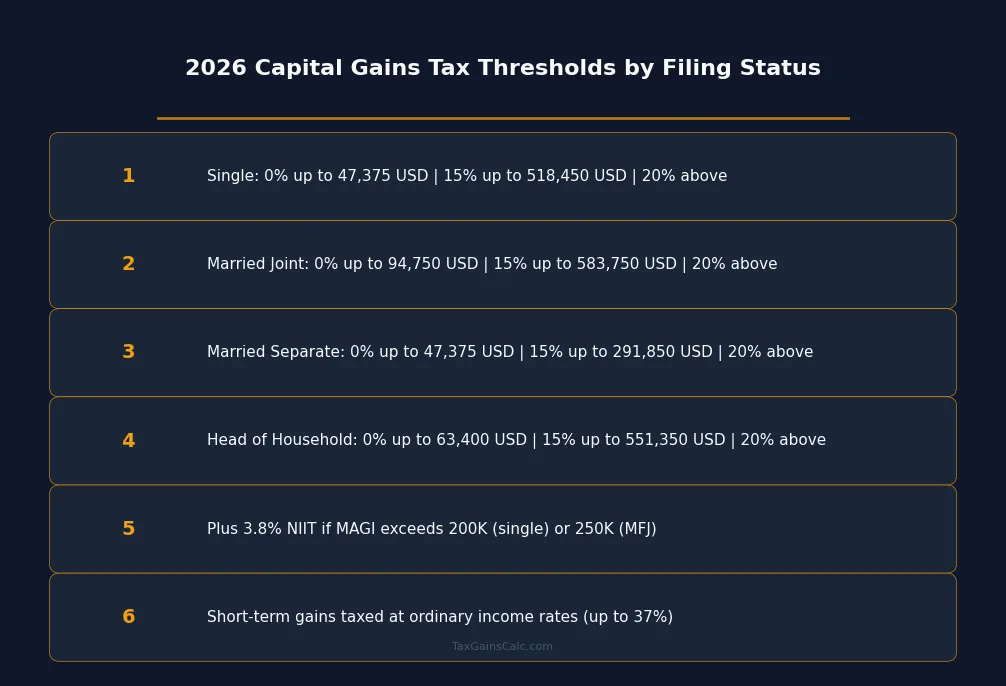
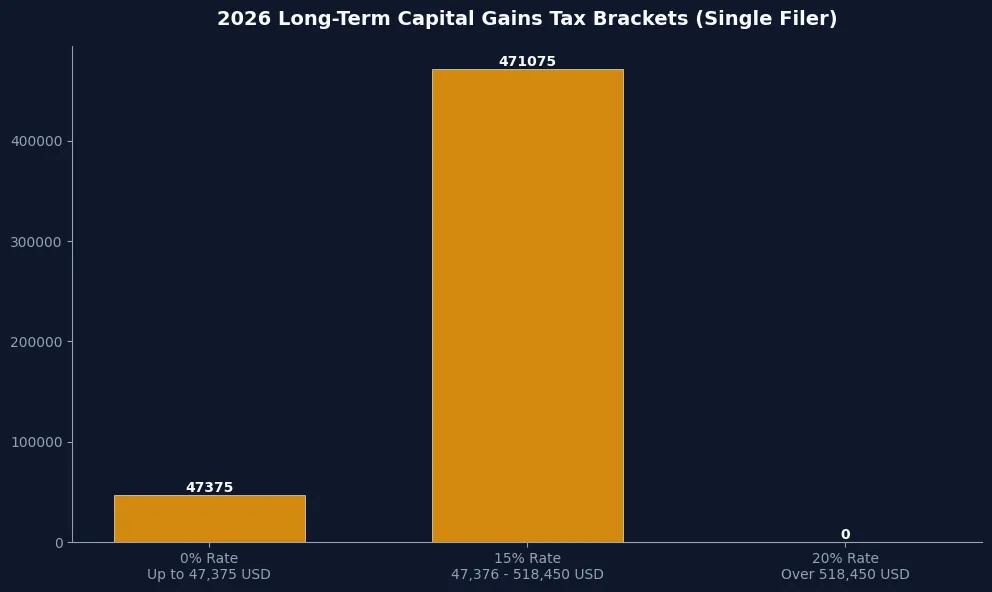
For single filers, the 0 percent rate applies to long-term capital gains that fall within the first $47,375 of taxable income. The 15 percent rate applies to gains between $47,376 and $518,450. The 20 percent rate applies to gains above $518,450. If your total taxable income, including ordinary income and capital gains, is $47,375 or less, all of your long-term capital gains are taxed at 0 percent.
Married Filing Jointly
For married couples filing jointly, the 0 percent rate applies to taxable income up to $94,750. The 15 percent rate applies to income between $94,751 and $583,750. The 20 percent rate applies to income above $583,750. These thresholds are exactly double the single thresholds for the 0 percent and 15 percent brackets, which provides a significant advantage for married couples.
Married Filing Separately
For married individuals filing separately, the 0 percent rate applies to taxable income up to $47,375. The 15 percent rate applies to income between $47,376 and $291,850. The 20 percent rate applies to income above $291,850. These thresholds are generally half of the married filing jointly thresholds, which means filing separately can result in a higher tax bill for couples with similar incomes.
Head of Household
For head of household filers, the 0 percent rate applies to taxable income up to $63,400. The 15 percent rate applies to income between $63,401 and $551,350. The 20 percent rate applies to income above $551,350. These thresholds are higher than the single thresholds, reflecting the additional financial responsibility of supporting a household.
The 0 Percent Capital Gains Rate
The 0 percent capital gains rate is one of the most overlooked tax benefits in the entire tax code. If your taxable income, including your capital gains, falls below the 0 percent threshold, you pay absolutely no federal tax on those gains. This creates a powerful opportunity for tax planning, particularly for retirees, low-income taxpayers, and anyone who can strategically manage their income.
For example, a married couple filing jointly with $70,000 in ordinary income and $20,000 in long-term capital gains would have a total taxable income of $90,000. Since the 0 percent threshold for married filing jointly is $94,750, the entire $20,000 of capital gains would be taxed at 0 percent. This couple would pay no federal tax on their investment gains, saving them $3,000 compared to the 15 percent rate.
Strategies for Qualifying for the 0 Percent Rate
If you are near the 0 percent threshold, there are several strategies you can use to qualify. The most common is to realize capital gains in a year when your ordinary income is lower than usual. This might mean selling appreciated investments in a year when you are between jobs, taking a sabbatical, or have significant business losses that offset your ordinary income.
Another strategy is to use tax-loss harvesting to offset ordinary income. If you have unrealized losses in your portfolio, selling those investments to realize the losses can reduce your ordinary income by up to $3,000 per year. This, combined with the standard deduction, can help you stay below the 0 percent threshold.
Retirees often benefit significantly from the 0 percent rate. If your primary sources of income are Social Security and retirement account distributions, your taxable income may be low enough to qualify for the 0 percent rate on capital gains. This is especially true for retirees who have not yet started taking required minimum distributions from their traditional IRAs.
The 15 Percent Capital Gains Rate
The 15 percent rate applies to most taxpayers with long-term capital gains. If your taxable income exceeds the 0 percent threshold but falls below the 20 percent threshold, your capital gains are taxed at 15 percent. This rate is significantly lower than the ordinary income rates that apply to most other types of income, which makes long-term investing more tax-efficient than short-term trading.
For a single filer with $80,000 in ordinary income and $30,000 in long-term capital gains, the first $47,375 of total income is taxed at 0 percent, and the remaining income, including the capital gains, is taxed at 15 percent. The exact calculation depends on the stacking mechanism, where ordinary income fills the lower brackets first and capital gains are added on top.
The 3.8 Percent Net Investment Income Tax
In addition to the 15 percent or 20 percent capital gains rate, you may also owe the 3.8 percent net investment income tax if your modified adjusted gross income exceeds $200,000 for single filers or $250,000 for married filing jointly. This additional tax applies to the lesser of your net investment income or the amount by which your MAGI exceeds the threshold.
For a single filer with $250,000 in MAGI and $50,000 in long-term capital gains, the 3.8 percent NIIT would apply to the $50,000 of investment income because MAGI exceeds the $200,000 threshold by $50,000. The NIIT would add $1,900 to the tax bill, bringing the effective rate on the capital gains to 18.8 percent (15 percent plus 3.8 percent).
The 20 Percent Capital Gains Rate
The 20 percent rate is the highest long-term capital gains rate, and it applies only to taxpayers with very high taxable income. For single filers, the 20 percent rate kicks in at $518,450. For married filing jointly, it applies above $583,750. Relatively few taxpayers have enough income to reach this bracket, but for those who do, the additional 5 percent over the 15 percent rate can add significant tax liability.
For a single filer with $600,000 in taxable income including $100,000 in long-term capital gains, the first $47,375 of gains is taxed at 0 percent, the next $471,075 is taxed at 15 percent, and the remaining $81,550 is taxed at 20 percent. This graduated rate structure means that even high-income taxpayers benefit from the lower rates on the first portions of their capital gains.
How to Calculate Your Capital Gains Tax
Calculating your capital gains tax requires you to determine your total taxable income, including both ordinary income and capital gains. The capital gains tax calculator can help you estimate your liability, but understanding the calculation manually is valuable for planning purposes.
First, calculate your ordinary income, which includes wages, salaries, interest, and short-term capital gains. Then, add your long-term capital gains on top of your ordinary income. The long-term gains fill the brackets from the bottom up, starting with whatever room remains in the 0 percent bracket after ordinary income has been accounted for.
Example Calculation
Consider a single filer with $40,000 in ordinary income and $30,000 in long-term capital gains. Total taxable income is $70,000. The 0 percent threshold for single filers is $47,375. Since ordinary income of $40,000 leaves $7,375 of room in the 0 percent bracket, $7,375 of the capital gains is taxed at 0 percent. The remaining $22,625 of capital gains is taxed at 15 percent, resulting in a tax of $3,394 on the capital gains. Without the 0 percent bracket, the tax would have been $4,500, so the threshold saves $1,106.
Strategies for Managing Your Capital Gains Tax Bracket
Effective tax planning involves managing your income to stay in the lowest possible capital gains bracket. There are several strategies that can help you achieve this goal.
Timing Your Sales
The most straightforward strategy is to time your investment sales to minimize your taxable income in any given year. If you have a large capital gain, consider spreading the sale across multiple tax years. For example, if you plan to sell a stock position worth $100,000 with a $40,000 gain, you might sell half in December and half in January, splitting the gain across two tax years.
Offset Gains with Losses
Tax-loss harvesting allows you to offset capital gains with capital losses. If you have investments with unrealized losses, selling them before the end of the year can reduce your taxable capital gains. Any losses that exceed your gains can offset up to $3,000 of ordinary income, with the remainder carried forward to future years.
Maximize Retirement Contributions
Contributing to retirement accounts such as 401(k) plans and traditional IRAs reduces your taxable income, which can help you stay below the 0 percent threshold or reduce the amount of capital gains taxed at 15 percent. For 2026, the 401(k) contribution limit is $23,000, and the IRA limit is $7,000. These contributions directly reduce your adjusted gross income, which can have a significant impact on your capital gains tax bracket.
Consider Roth Conversions
If you expect to be in a low tax bracket this year, consider converting some of your traditional IRA funds to a Roth IRA. The conversion increases your ordinary income, but if you stay below the 0 percent capital gains threshold, you can realize capital gains tax-free while paying ordinary income tax on the conversion at a lower rate. This is a sophisticated strategy that requires careful calculation, but it can be very effective for taxpayers in the right circumstances.
Common Mistakes with Capital Gains Thresholds
One of the most common mistakes is assuming that the capital gains tax thresholds are the same as the ordinary income tax brackets. They are not. The capital gains brackets are separate and have different income thresholds. Another mistake is failing to account for the net investment income tax when calculating your total tax liability. The 3.8 percent NIIT can add a significant amount to your bill, especially for higher-income taxpayers.
Some taxpayers also fail to consider the impact of state capital gains taxes. While the federal thresholds are the same across the country, state tax rates vary widely. Some states tax capital gains at the same rate as ordinary income, while others have preferential rates. Understanding your state capital gains tax rates is essential for accurately estimating your total tax liability.
Key Takeaways
The 2026 capital gains tax thresholds determine whether you pay 0 percent, 15 percent, or 20 percent on your long-term capital gains. The 0 percent rate applies to taxpayers with taxable income below $47,375 for single filers and $94,750 for married filing jointly. Strategic planning, including timing your sales, harvesting losses, and maximizing retirement contributions, can help you stay in the lowest bracket possible. The 3.8 percent NIIT adds an additional layer of tax for higher-income taxpayers. Understanding these thresholds and planning around them is one of the most effective ways to reduce your tax bill.
Take the time to calculate where you stand relative to the 2026 capital gains tax thresholds before making any investment decisions. A few thousand dollars of additional income can push you into a higher bracket, while a few thousand dollars of deductions or losses can keep you in a lower one. With careful planning, you can minimize your capital gains tax and keep more of your investment returns.
Fact-Checked & Reviewed
This article was written by Sarah Mitchell (CPA, MST (Master of Science in Taxation)) and reviewed for accuracy by David Chen (JD, LLM (Taxation), EA). Published by Wasim Akram, Founder & Lead Researcher at TaxGainsCalc. All tax rates, thresholds, and rules referenced are based on IRS publications and current tax law as of the date published. Tax laws change frequently — always consult a qualified tax professional for advice specific to your situation.
Certified Public Accountant (CPA)
Sarah Mitchell is a Certified Public Accountant with over 15 years of experience in individual and business taxation. She holds a Master of Science in Taxation from Golden Gate University and specializes in capital gains tax planning, investment tax ...
Tax Attorney & Enrolled Agent
David Chen is a tax attorney and Enrolled Agent with over 20 years of experience in tax law and IRS dispute resolution. He holds a Juris Doctor from Columbia Law School and a Master of Laws in Taxation from NYU School of Law....

Founder & Lead Researcher, TaxGainsCalc
Wasim Akram is an independent web publisher and digital entrepreneur based in India. Since 2018, he has been building custom CMS platforms, WordPress plugins, niche websites, and AI-powered digital products with over 8 years of real-world experience....
Disclaimer: This article is for informational purposes only and does not constitute tax, legal, or financial advice. Tax laws and regulations change frequently, and the information presented here may not reflect the most current updates. You should consult with a qualified CPA, tax attorney, or financial advisor before making any tax-related decisions. TaxGainsCalc is not responsible for any actions taken based on the information provided in this article.