Long-Term Capital Gains Tax: The Smart Investor Guide to Lower Rates
Long-term capital gains tax rates of 0%, 15%, and 20% reward patient investors. Learn exactly how to qualify, which bracket you fall into, how the holding period works, and how to calculate your tax — with real examples for every income level.
Why Long-Term Capital Gains Tax Rates Are Your Best Friend as an Investor
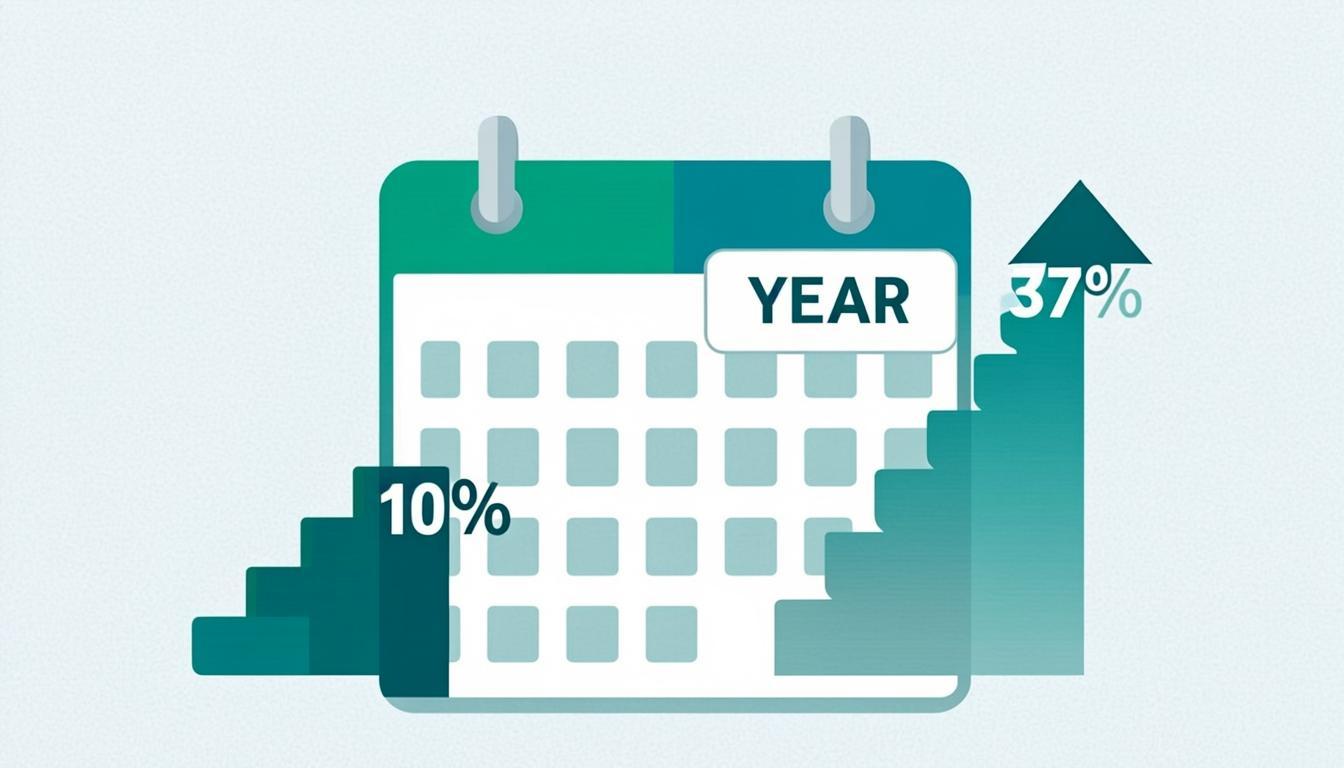
The IRS rewards patience. When you hold an investment for more than one year before selling, your profit qualifies for the long-term capital gains tax rates of 0%, 15%, or 20% — compared to the ordinary income rates of up to 37% that apply to short-term gains.
This rate reduction is not a small perk. For a single investor earning $95,000 in wages who sells stock for a $50,000 profit, waiting to qualify for long-term treatment drops the federal tax on that gain from approximately $11,735 down to roughly $7,500. That is a savings of over $4,200 on one transaction — simply from holding a few extra weeks.
For taxpayers in lower income brackets, the savings can be even more dramatic. If your total taxable income falls below the threshold for the 0% long-term rate, your entire long-term gain is taxed at zero percent. You pay literally nothing in federal capital gains tax on those profits. Understanding these brackets and how they interact with your other income is the key to minimizing your tax bill legally and effectively.
The Three Long-Term Capital Gains Tax Brackets for 2026
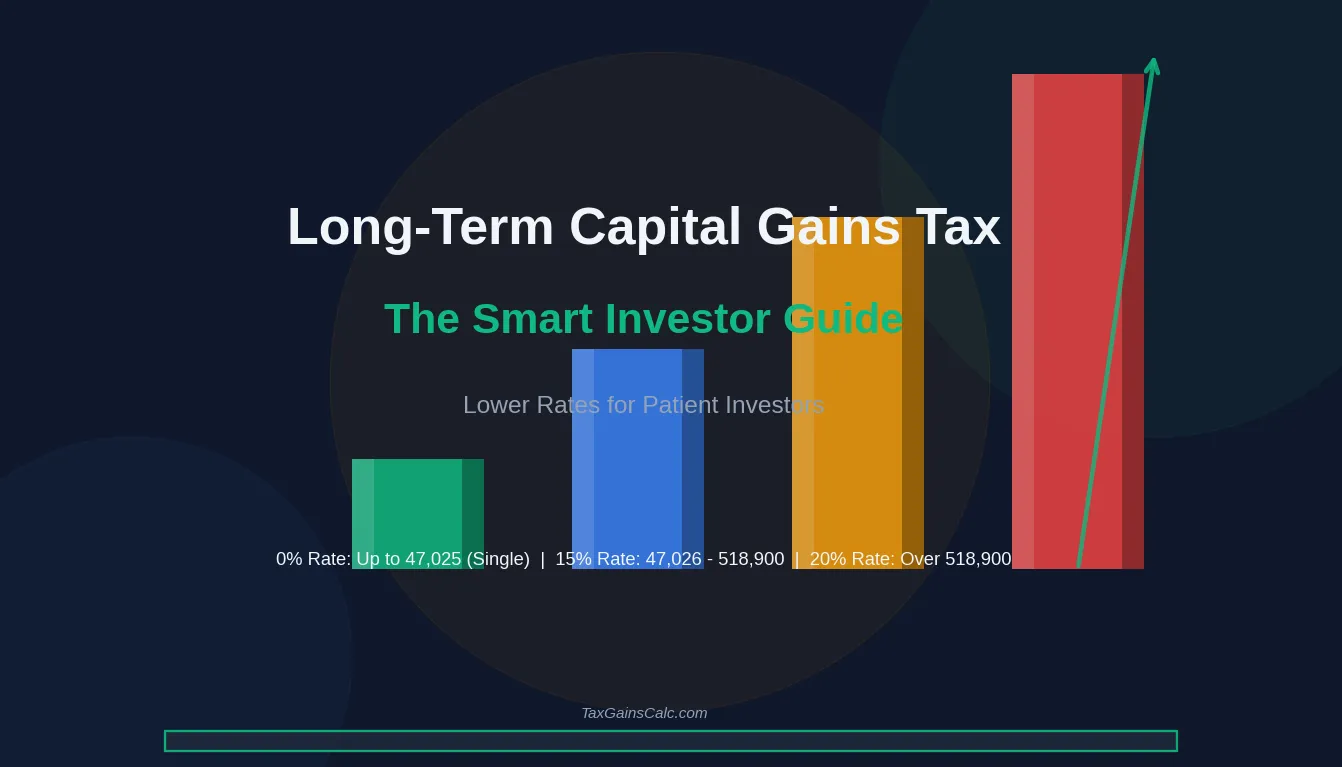
Long-term capital gains have their own separate bracket structure that sits apart from the ordinary income brackets. For the 2026 tax year, the three rates and their thresholds are:
| Filing Status | 0% Rate Threshold | 15% Rate Threshold | 20% Rate Threshold |
|---|---|---|---|
| Single | Up to $47,150 | $47,151 – $518,900 | $518,901+ |
| Married Filing Jointly | Up to $94,300 | $94,301 – $583,750 | $583,751+ |
| Married Filing Separately | Up to $47,150 | $47,151 – $291,850 | $291,851+ |
| Head of Household | Up to $63,100 | $63,101 – $551,350 | $551,351+ |
These thresholds apply to your taxable income — which includes both your ordinary income and your long-term gains combined. The key mechanism is that long-term gains stack on top of ordinary income, filling up the brackets in order.
This means your ordinary income fills the lower portions of the brackets first, and the long-term gains fill whatever space remains. A single taxpayer with $40,000 in wages and a $15,000 long-term gain has $55,000 in taxable income. The first $47,150 is covered by the 0% bracket, and the remaining $7,850 falls into the 15% bracket — so only that portion of the gain gets taxed at 15%, and the rest is tax-free.
Our complete breakdown of capital gains tax rates provides detailed examples across every filing status and income level.
How the Holding Period Determines Your Rate
The holding period is the single factor that decides whether your gain gets the preferential long-term rates or the higher ordinary income rates. The rule is straightforward: you must hold the asset for more than one year from the acquisition date to the sale date.
When the Clock Starts
The acquisition date for stocks is the trade settlement date — typically one to two business days after you place the buy order. For real estate, it is the closing date recorded on the deed. The holding period begins on the day after the acquisition date.
When the Clock Ends
The sale date is when the transaction is completed — the settlement date for stocks and the closing date for real estate. To qualify for long-term treatment, the sale date must be at least one year and one day after the acquisition date.
Special Situations That Affect the Holding Period
Several scenarios can change how the holding period is calculated:
- Inherited property is automatically treated as long-term regardless of how long you hold it after inheriting. The holding period is considered to have started on the date of the decedent's death. Our guide on capital gains tax on inherited property covers the step-up in basis and other rules that apply.
- Gifted property carries over the donor's holding period. If your parent gives you shares they held for 18 months, you continue that 18-month clock — you only need six more months to qualify for long-term treatment.
- Wash sale adjustments add the disallowed holding period to your replacement shares. If you sell at a loss and buy back within 30 days, the new shares inherit the old holding period, potentially extending the time you need to wait for long-term treatment. See our wash sale rule guide for details.
- Stock splits, mergers, and spin-offs generally preserve the original holding period. New shares from a split carry the same acquisition date as the original position.
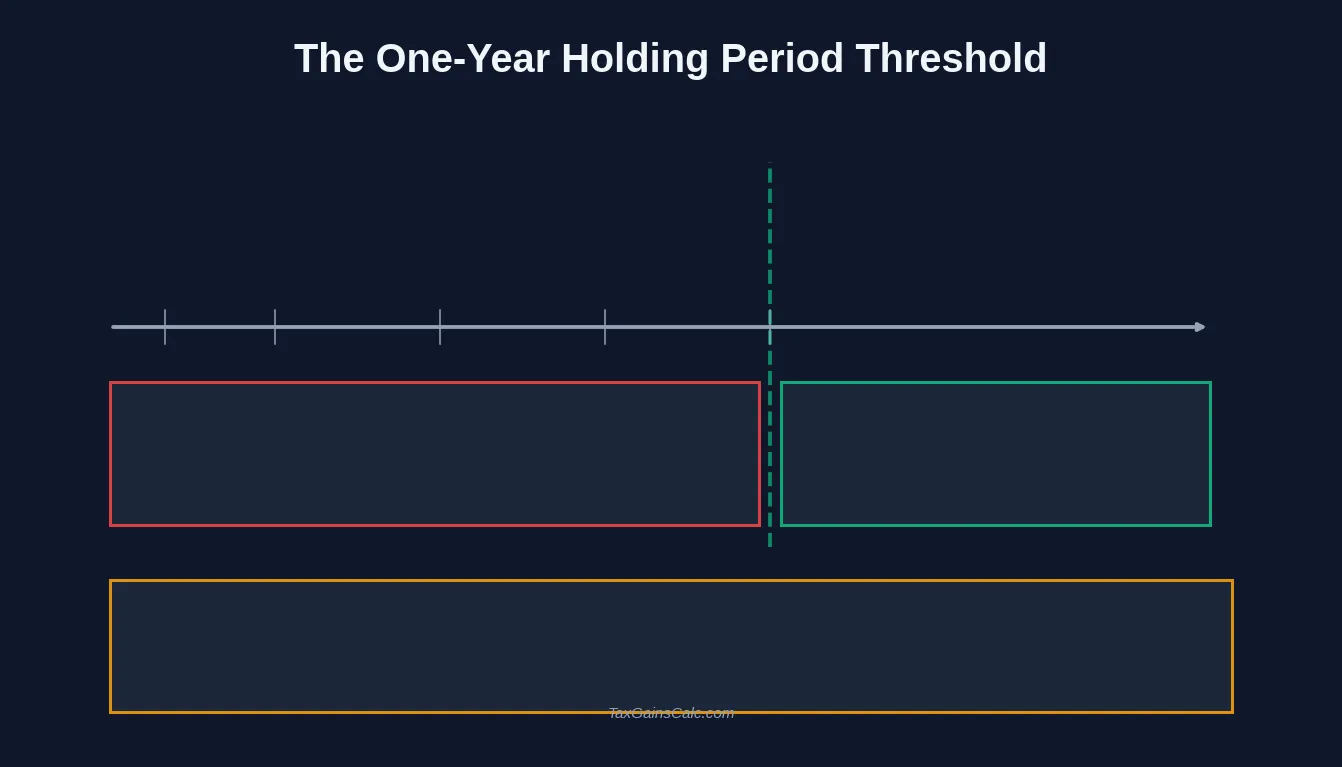
Missing the one-year threshold by even one day means your entire gain is taxed at ordinary income rates. Always verify your exact acquisition date before selling.
Who Qualifies for the 0% Long-Term Rate
The 0% rate is the most powerful tax break available to investors with moderate incomes. If your taxable income — ordinary income plus long-term gains — falls below the threshold, you pay zero federal tax on those gains.
For 2026, the 0% bracket covers taxable income up to:
- $47,150 for single filers
- $94,300 for married filing jointly
- $63,100 for head of household
This means a married couple with $70,000 in wages could realize up to $24,300 in long-term gains and pay $0 in federal capital gains tax on those gains. The first $94,300 of their combined income is covered by the 0% bracket, and since their wages fill only $70,000 of that space, the remaining $24,300 is available for tax-free gains.
Retirees and part-time workers often qualify for the 0% rate without even realizing it. If your income comes primarily from Social Security, pension distributions, or part-time work, you may have substantial room in the 0% bracket to realize gains tax-free. Our capital gains tax guide for seniors explains how this works in detail for retirees.
How to strategically use the 0% bracket
If you are near the threshold, you can intentionally realize just enough long-term gains each year to fill up the 0% bracket without crossing into the 15% bracket. This is sometimes called gain harvesting and it works like this:
- 1Calculate your projected taxable income for the year (wages, interest, other ordinary income).
- 2Subtract that from the 0% bracket threshold for your filing status.
- 3The difference is the amount of long-term gains you can realize at 0% federal tax.
- 4Sell investments with long-term gains up to that amount.
- 5If you want to keep the same portfolio, you can immediately repurchase similar (but not identical) investments to reset your cost basis higher — avoiding wash sale problems by buying a different but comparable fund.
This strategy effectively "locks in" your gains at a zero rate and raises your cost basis, reducing future tax liability. It only works for long-term holdings, and it requires careful income planning.
Real Examples: Calculating Long-Term Capital Gains Tax
Example 1: Single Filer, Moderate Income, 0% + 15% Split
Sarah is single with $42,000 in wages. She sells stock held for three years with a $20,000 long-term gain. Her taxable income is $62,000.
- The 0% bracket covers up to $47,150
- Her wages use $42,000 of that space
- $5,150 of her gain falls in the 0% bracket — tax-free
- The remaining $14,850 of her gain falls in the 15% bracket
- Tax on the gain: $5,150 × 0% + $14,850 × 15% = $2,227.50
If she had sold those shares as a short-term gain, the entire $20,000 would have been taxed at her ordinary income rate of roughly 22%, costing about $4,400 — nearly double the long-term tax.
Example 2: Married Couple, Higher Income, 15% Rate Only
Mark and Lisa file jointly with $200,000 in wages. They sell investment property held for five years with a $80,000 long-term gain. Their taxable income is $280,000.
- Their wages fill the 0% bracket ($94,300) and extend well into the 15% bracket
- The entire $80,000 gain falls in the 15% bracket
- Tax on the gain: $80,000 × 15% = $12,000
At ordinary income rates, that same $80,000 would have been taxed at approximately 24-32%, costing between $19,200 and $25,600.
Example 3: High Earner, 20% Rate
James is single with $400,000 in wages and a $200,000 long-term gain from selling a business asset held for two years. His taxable income is $600,000.
- The gain exceeds the 15% bracket threshold ($518,900)
- Most of the gain falls in the 20% bracket
- Tax on the gain: approximately $36,220 (with portions at 15% and 20%)
Without long-term treatment, at the 35-37% ordinary rates, the tax would have been approximately $70,000 to $74,000 — nearly double.
The Net Investment Income Tax Surtax on Long-Term Gains
Even with the preferential long-term rates, taxpayers with high income face an additional surtax. The 3.8% Net Investment Income Tax (NIIT) applies when your modified adjusted gross income exceeds:
- $200,000 for single filers
- $250,000 for married filing jointly
The NIIT applies to your net investment income — including long-term gains — or the amount by which your MAGI exceeds the threshold, whichever is less.
For a married couple with $300,000 MAGI and $80,000 in long-term gains, the NIIT adds an extra $3,040 (3.8% of $80,000). This pushes their effective rate on those gains from 15% to 18.8%.
Our NIIT complete guide explains the calculation in full and covers strategies for minimizing this extra tax.
Strategies to Maximize Long-Term Rate Benefits
Track Acquisition Dates Religiously
The difference between short-term and long-term treatment is entirely determined by your holding period. Before selling any investment, check the exact acquisition date. If you are close to the one-year mark, wait. The rate difference can save you thousands.
Harvest Gains in the 0% Bracket
If your income leaves room in the 0% bracket, intentionally realize long-term gains to fill that space. You pay zero federal tax on those gains, and you reset your cost basis higher — which reduces future tax when you eventually sell at a higher price.
Pair Gains with Losses
If you have long-term gains that fall in the 15% or 20% bracket, you can offset them with long-term losses from other positions. This reduces the amount of gain subject to tax. The tax loss harvesting strategy is especially valuable because the loss offsets gain at the same preferential rate — you save 15% or 20% on every dollar of loss you realize.
Use Retirement Accounts for Active Trading
If you trade frequently and generate short-term gains by habit, move that activity into a Roth IRA or traditional IRA. Inside these accounts, there is no capital gains tax on any trade — short or long. The gains grow tax-free in a Roth, or are deferred in a traditional account. This eliminates the rate penalty entirely for active strategies.
Consider Charitable Giving of Appreciated Assets
Donating long-term appreciated stock directly to a qualified charity lets you deduct the full fair market value and skip the capital gains tax entirely. You never pay tax on the gain, and you get a charitable deduction for the full value. This works only for assets held more than one year — donated short-term gains are deductible only at cost basis, not market value. Our guide on how to avoid capital gains tax legally covers this and other avoidance strategies.
Plan Around the NIIT Threshold
If your income is near the NIIT trigger point, reducing your MAGI by even a few thousand dollars can eliminate the 3.8% surtax on all your investment income. Strategies include increasing retirement contributions, timing income recognition, and using estimated payments strategically.
How to Report Long-Term Capital Gains on Your Tax Return
Long-term transactions go on Part II of Form 8949, then flow to Schedule D, Part II. Here is the reporting path:
- Form 8949, Part II: List each long-term transaction with acquisition date, sale date, proceeds, cost basis, and gain or loss. Check box D, E, or F based on your 1099-B reporting.
- Schedule D, Part II: Sum your long-term totals and calculate your net long-term gain or loss.
- Schedule D, Part III: Combine short-term and long-term results to find your total capital gain or loss.
- Qualified Dividends and Capital Gain Tax Worksheet: This worksheet in the Form 1040 instructions calculates your actual tax on long-term gains using the 0%/15%/20% brackets — ensuring you get the preferential rates rather than ordinary rates.
- Form 1040: The final amount flows into your total tax calculation.
If you have both qualified dividends and long-term gains, they are taxed together at the same preferential rates. For detailed filing instructions, see our guide on how to report capital gains.
State Tax on Long-Term Gains
State tax treatment of long-term gains varies widely. Some states offer their own preferential rates for long-term gains, while others tax them at the same rate as ordinary income:
- No state income tax: Alaska, Florida, Nevada, Texas, Washington, Wyoming — long-term gains face zero state tax
- Preferential state rates: Some states, like Arizona and Montana, offer reduced rates for long-term gains
- Full ordinary rate: California (up to 13.3%), New York (up to 10.9%), and most others tax long-term gains at the same rate as wages
Our state capital gains tax comparison provides a complete breakdown for every state.
Final Takeaway: Patience Pays
The long-term capital gains tax system exists to reward patient investors. Every holding period threshold you cross, every bracket you strategically manage, and every loss you pair with a gain reduces what you owe. The math is unambiguous: for most investors, the difference between selling today and selling after the one-year mark is the single largest tax savings available.
Before you sell any appreciated asset, ask yourself one question: Am I past the one-year holding period? If the answer is no, and the gain is substantial, waiting a few extra weeks could save you thousands. The IRS built this system to encourage long-term investment — use it to your advantage.
Fact-Checked & Reviewed
This article was written by Sarah Mitchell (CPA, MST (Master of Science in Taxation)) and reviewed for accuracy by David Chen (JD, LLM in Taxation (New York University)). Published by Wasim Akram, Founder & Lead Researcher at TaxGainsCalc. All tax rates, thresholds, and rules referenced are based on IRS publications and current tax law as of the date published. Tax laws change frequently — always consult a qualified tax professional for advice specific to your situation.
Certified Public Accountant (CPA)
Sarah Mitchell is a Certified Public Accountant with over 15 years of experience in individual and business taxation. She holds a Master of Science in Taxation from Golden Gate University and specializes in capital gains tax planning, investment tax ...
Tax Attorney & Legal Editor
David Chen is a tax attorney with a Juris Doctor and a Master of Laws in Taxation from New York University School of Law. With over 10 years of legal practice, he specializes in 1031 exchanges, capital gains tax law, and IRS dispute resolution. David...

Founder & Lead Researcher, TaxGainsCalc
Wasim Akram is an independent web publisher and digital entrepreneur based in India. Since 2018, he has been building custom CMS platforms, WordPress plugins, niche websites, and AI-powered digital products with over 8 years of real-world experience....
Disclaimer: This article is for informational purposes only and does not constitute tax, legal, or financial advice. Tax laws and regulations change frequently, and the information presented here may not reflect the most current updates. You should consult with a qualified CPA, tax attorney, or financial advisor before making any tax-related decisions. TaxGainsCalc is not responsible for any actions taken based on the information provided in this article.