Capital Gains Tax Exemption: Who Qualifies for the 0% Rate in 2026
The 0% capital gains tax rate can eliminate your federal tax bill entirely on long-term gains. Learn the income thresholds, which filing statuses qualify, how the 0% bracket works with your other income, and strategies to maximize tax-free gains.
The 0% Capital Gains Tax Rate: How Some Investors Pay Nothing at All
The IRS has a capital gains tax bracket that charges 0% — meaning you pay literally zero federal tax on qualifying investment profits. This is not a loophole, a deduction, or a credit. It is a statutory rate written into the tax code that applies to long-term gains for taxpayers whose income falls below specific thresholds.
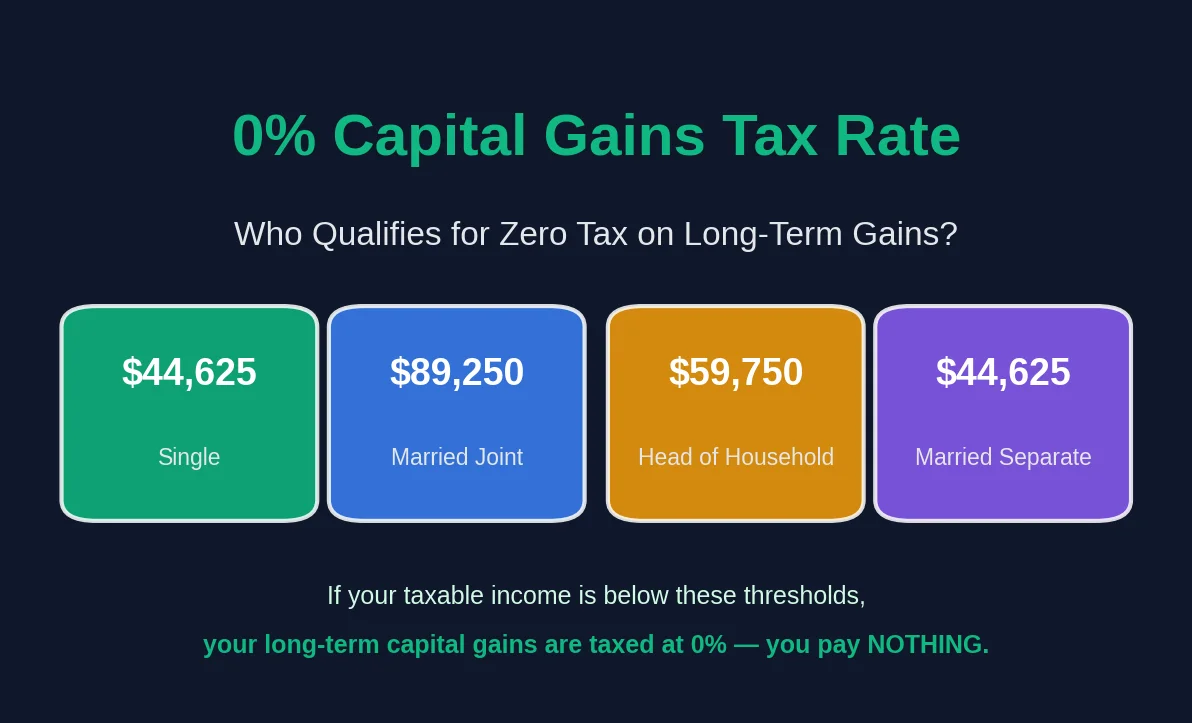
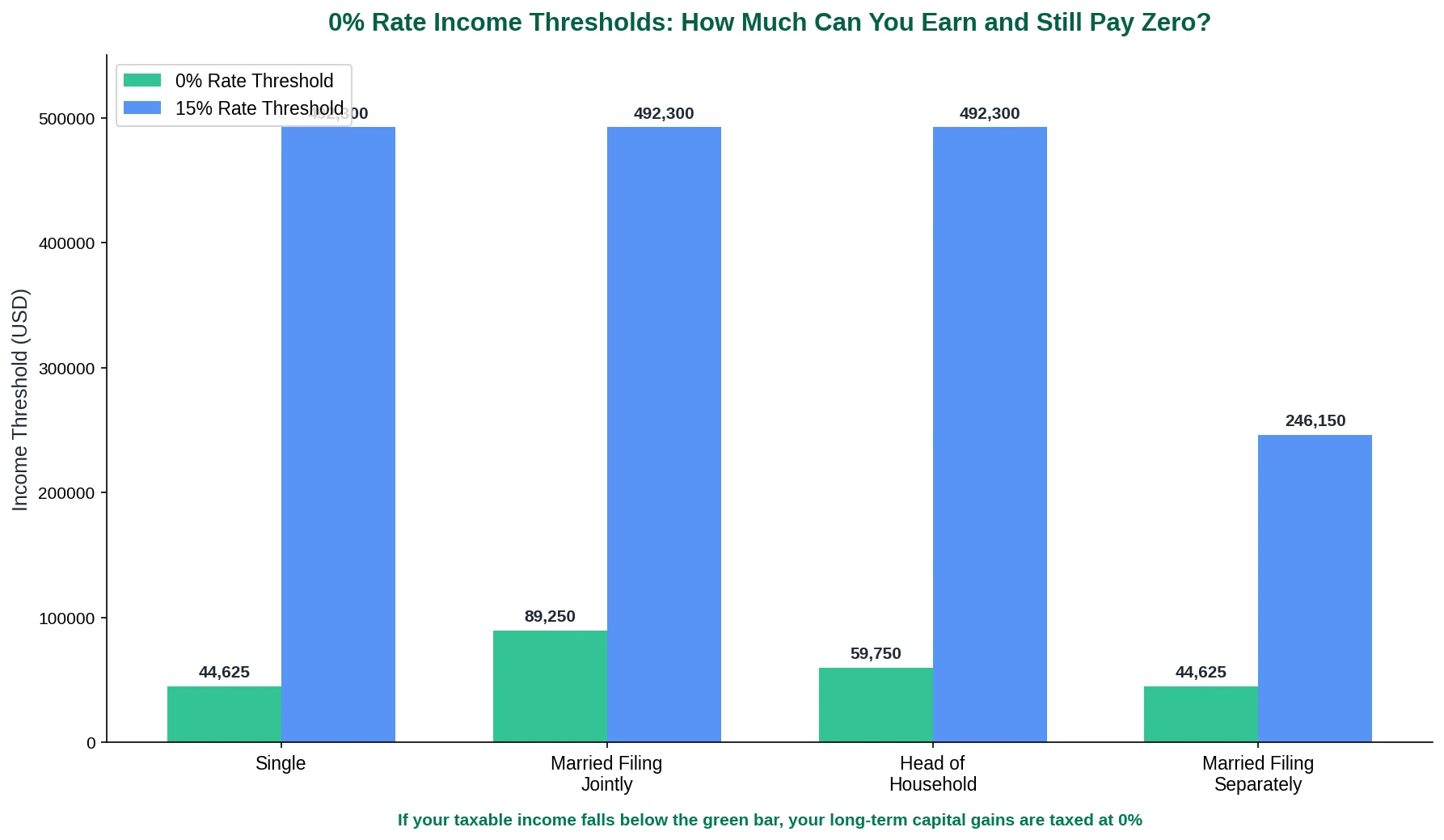
For the 2026 tax year, the 0% rate applies to taxable income up to:
- $47,150 for single filers
- $94,300 for married couples filing jointly
- $63,100 for head of household filers
- $47,150 for married filing separately
If your total taxable income — including wages, interest, dividends, and long-term capital gains — stays below these numbers, every dollar of long-term gain is taxed at zero percent. You keep 100% of your investment profit after federal taxes.
This rate only applies to long-term capital gains from assets held more than one year. Short-term gains are always taxed as ordinary income and never qualify for the 0% rate — they start at 10% and go up to 37%.
How the 0% Bracket Actually Works with Your Income
The 0% bracket is not a separate calculation — it is part of the long-term capital gains bracket structure that stacks on top of your ordinary income. The way it works is critical to understand:
Your ordinary income fills the bracket first, then long-term gains fill whatever space remains.
This means the 0% bracket is not a fixed amount of gains you can realize tax-free. It is the amount of total taxable income that is taxed at 0%, and your ordinary income eats into that space before your gains get their turn.
Example: Single Filer with Room in the 0% Bracket
Maria is single and earns $35,000 in wages. She sells stock held for three years with a $12,000 long-term gain. Her taxable income is $47,000.
- The 0% bracket covers up to $47,150
- Her wages use $35,000 of that space
- Only $12,150 of the 0% bracket remains
- Her entire $12,000 gain fits inside that remaining space
- Tax on the gain: $0 — she pays zero federal capital gains tax
Example: Single Filer Who Partially Exceeds the 0% Bracket
Carlos is single with $40,000 in wages. He sells stock held for two years with a $20,000 long-term gain. His taxable income is $60,000.
- The 0% bracket covers up to $47,150
- His wages use $40,000 of that space
- Only $7,150 of the 0% bracket remains
- $7,150 of his gain is taxed at 0% — tax-free
- The remaining $12,850 spills into the 15% bracket
- Tax on the gain: $7,150 × 0% + $12,850 × 15% = $1,927.50
Carlos still saves significantly compared to selling as a short-term gain, which would have taxed the entire $20,000 at his ordinary rate of approximately 22%, costing about $4,400.
Example: Married Couple with Full 0% Bracket Room
Kevin and Lisa file jointly with $65,000 in combined wages. Lisa sells a long-held investment with a $29,300 long-term gain. Their taxable income is $94,300.
- The 0% bracket covers up to $94,300 for joint filers
- Their wages use $65,000 of that space
- $29,300 of the 0% bracket remains
- The entire $29,300 gain fills that space at 0%
- Tax on the gain: $0 — completely tax-free at the federal level
If they had earned just $1 more in ordinary income, $1 of the gain would spill into the 15% bracket. Precision matters.
Our complete rate breakdown guide provides detailed bracket calculations for every filing status and income scenario.
Who Most Commonly Qualifies for the 0% Rate
Several groups of taxpayers frequently qualify for the 0% long-term rate without even knowing it:
Retirees and Seniors
Retirees drawing Social Security and modest pension income often have total taxable income well below the thresholds. A married couple receiving $40,000 in Social Security (with only half taxable) and $20,000 in pension income may have only $40,000 in taxable income — leaving $54,300 of room in the 0% bracket for tax-free long-term gains. Our seniors and retirees capital gains guide explains this in detail.
Part-Time Workers and Students
Workers earning less than $47,150 in annual wages automatically have room in the 0% bracket for at least some long-term gains. A graduate student earning $25,000 from a research stipend could realize up to $22,150 in long-term gains tax-free.
Low-Income Households
Families with income from part-time work, disability benefits, or other modest sources often fall well below the thresholds. The 0% rate gives them a powerful incentive to invest long-term and reap tax-free profits.
Strategic Income Planners
Even higher-income taxpayers can qualify for the 0% rate through careful planning — by timing income recognition, maximizing deductions, and using retirement account distributions strategically. The key is reducing your taxable income below the threshold in a specific year, then harvesting gains during that low-income window.
Strategies to Maximize Tax-Free Gains Under the 0% Rate
Gain Harvesting: Intentionally Realizing Gains at 0%
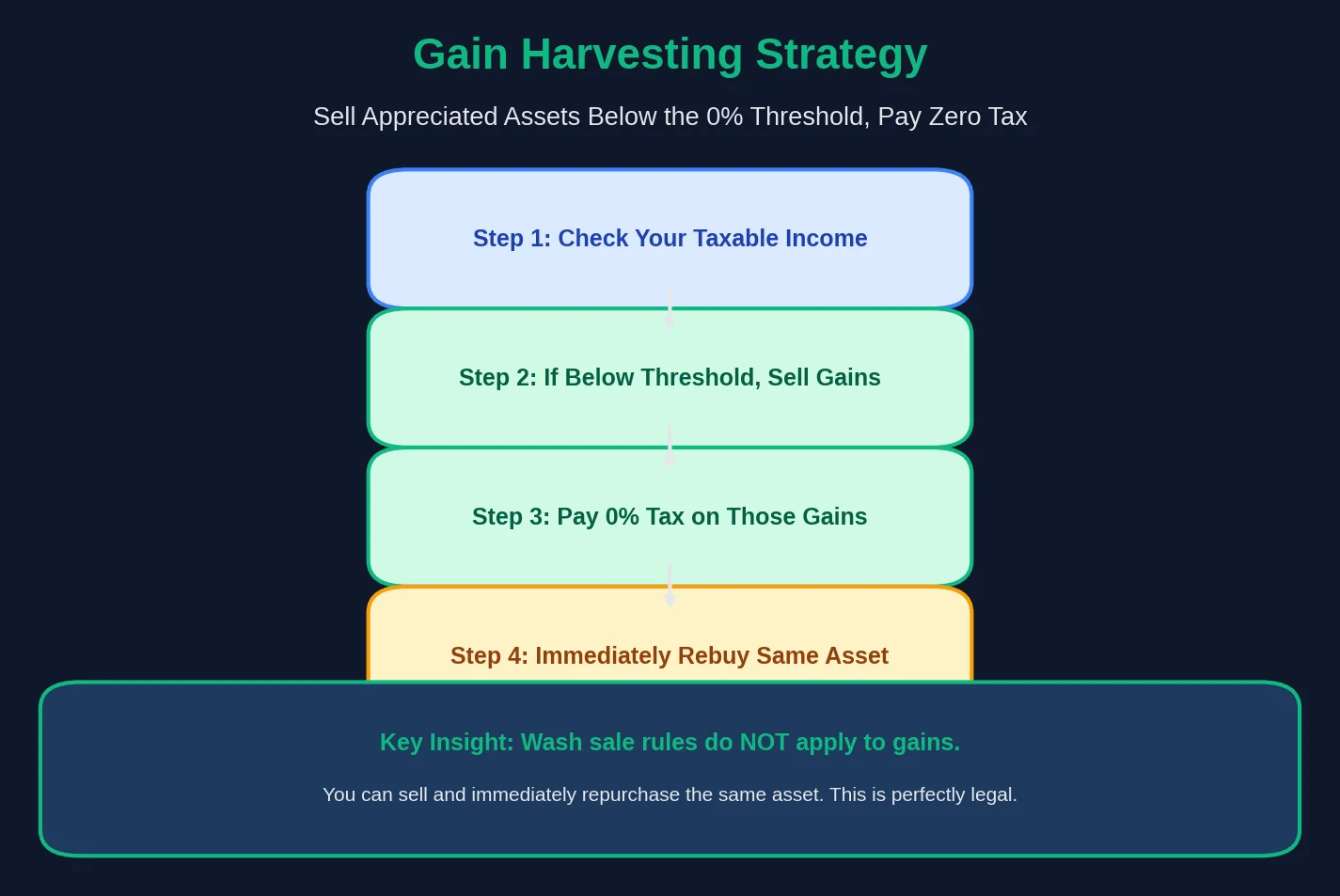
If you have room in the 0% bracket, you should consider intentionally selling appreciated long-term investments to realize gains that fill that space. This strategy, called gain harvesting, works as follows:
- 1Calculate your projected taxable income for the year (wages, interest, deductions).
- 2Determine the remaining space in the 0% bracket by subtracting your projected income from the threshold.
- 3Sell investments with long-term gains up to that amount — the gains are taxed at 0%.
- 4Immediately repurchase similar investments to maintain your portfolio allocation, but choose different funds or stocks to avoid wash sale rule complications.
- 5Your new cost basis is now higher, which reduces future tax liability when you eventually sell at an even higher price.
This is especially powerful in years when your income is unusually low — such as a gap year between jobs, a year with large deductions, or a year when you are taking a sabbatical.
Managing Income to Stay Below the Threshold
If you are near the 0% bracket threshold, reducing your taxable income by even a few hundred dollars can save you 15% on a significant amount of gains. Strategies include:
- Increase retirement contributions: 401(k) and IRA contributions reduce your taxable income directly. Every dollar you contribute saves you 15 cents on a long-term gain that stays in the 0% bracket.
- Time income recognition: If you have control over when you receive bonuses or freelance income, defer it to a year when you do not plan to harvest gains.
- Maximize deductions: Itemizing deductions — including mortgage interest, charitable contributions, and state taxes — can reduce your taxable income below the threshold.
- Take business losses: If you have self-employment income, business losses reduce your overall taxable income and can open space in the 0% bracket.
Using the 0% Rate with Capital Loss Carryovers
If you have capital loss carryovers from previous years — from tax loss harvesting or other loss realization — they offset your gains first before the bracket calculation. This means losses can push more of your gains into the 0% bracket by reducing your net gain amount.
Our capital gains tax loss carryover guide explains how carryovers interact with the bracket structure and how to time loss usage for maximum benefit.
Pairing Gain Harvesting with Roth IRA Conversions
A powerful combination strategy: in a year when your income is low enough to qualify for the 0% rate, harvest long-term gains at 0% and also convert some Traditional IRA funds to a Roth IRA. The Roth conversion generates ordinary income, but if you manage the total amount carefully, you can:
- Fill the 0% bracket with long-term gains
- Fill the lower ordinary income brackets with Roth conversion income
- End up with a Roth account that grows tax-free forever
- Reset your investment cost basis higher for future tax savings
This requires precise income calculation, but for taxpayers in the right situation, it can save tens of thousands over a lifetime.
What the 0% Rate Does NOT Cover
The 0% rate has important limitations:
Only Long-Term Gains Qualify
Assets held less than one year generate short-term gains taxed at ordinary rates starting at 10%. There is no 0% rate for short-term gains regardless of your income level.
Collectibles Get a Minimum 28% Rate
Even if your income qualifies for the 0% bracket, gains from collectibles — coins, art, antiques, precious metals — are taxed at a minimum 28% rate. The 0% rate does not apply to collectible gains. See our collectibles tax guide for the complete rules.
Section 1250 Unrecaptured Gain Gets 25%
Depreciation recapture on real estate — called unrecaptured Section 1250 gain — is taxed at a flat 25% rate, not the 0% rate. If you sell investment property with depreciation recapture, that portion is taxed at 25% even if your other long-term gains qualify for 0%.
Qualified Small Business Stock Has Its Own Rules
Section 1202 provides a potential 50%, 75%, or 100% exclusion for gains from qualified small business stock held more than five years. This is separate from the 0% bracket and applies regardless of your income level.
State Tax Considerations
Even if your federal tax on long-term gains is 0%, your state may still tax those gains. Most states that have an income tax do not offer a 0% capital gains rate — they treat long-term gains as ordinary income at the state level.
For example, a California resident in the federal 0% bracket would still pay up to 13.3% state tax on their long-term gains. A New York resident would pay up to 10.9%. Only residents of states with no income tax — Alaska, Florida, Nevada, Texas, Washington, and Wyoming — truly pay 0% total tax on their gains.
Our state capital gains tax comparison provides a complete state-by-state breakdown so you can calculate your true total rate.
The Net Investment Income Tax and the 0% Rate
The 3.8% NIIT applies to net investment income when your modified adjusted gross income exceeds $200,000 (single) or $250,000 (joint). Since the 0% bracket thresholds are well below these NIIT trigger points, taxpayers qualifying for the 0% rate are almost always below the NIIT threshold as well — meaning the NIIT does not add an extra layer of tax on their 0% gains.
However, if you harvest gains at 0% and simultaneously do a Roth conversion or receive a large bonus, your MAGI could cross the NIIT threshold even though your taxable income stays within the 0% bracket. This is an edge case that requires careful planning. Our NIIT guide covers the interaction between NIIT and capital gains brackets.
How to Calculate Whether You Qualify: A Step-by-Step Worksheet
Use this process to determine if your long-term gains will be taxed at 0%:
Step 1: Calculate Your Taxable Income Without Gains
Start with your projected gross income (wages, interest, dividends, other ordinary income). Subtract your deductions — standard deduction ($14,600 single, $29,200 joint for 2026) or itemized deductions, whichever is larger.
Step 2: Find the Remaining Space in the 0% Bracket
Subtract your Step 1 result from the 0% bracket threshold for your filing status. The remainder is the maximum amount of long-term gains you can realize at 0% federal tax.
Step 3: Add Your Projected Long-Term Gains
Add your expected long-term gains to your Step 1 income. If the total stays below the threshold, all gains are at 0%. If it exceeds the threshold, calculate how much of the gain falls in the 15% bracket.
Step 4: Factor in State Tax and NIIT
Add your state's capital gains rate and check whether your MAGI exceeds the NIIT threshold. Even with 0% federal tax, state tax can still apply.
For precise calculations with real numbers across different scenarios, our capital gains tax calculator guide provides tools and formulas you can apply directly to your situation.
Common Mistakes That Cost You the 0% Rate
Selling Too Early
The most common mistake is selling an investment just before the one-year holding period mark. A gain that would have been taxed at 0% gets hit with ordinary income rates of 10-37% instead. Always check your exact acquisition date before selling.
Ignoring the Bracket Stacking Effect
Some taxpayers assume the 0% bracket gives them a fixed amount of tax-free gains. But ordinary income fills the bracket first, reducing the space available for gains. A single filer earning $40,000 does not get $47,150 of tax-free gains — they get only $7,150.
Not Harvesting Gains Strategically
Many low-income investors hold appreciated positions indefinitely, missing years where they could have harvested gains at 0%. Every year you qualify but do not realize gains is a year you waste the 0% bracket space that cannot be recovered retroactively.
Overlooking State Tax
Celebrating a 0% federal rate while living in a high-tax state can be misleading. Your total tax burden may still be significant at the state level. Always calculate your combined federal-state rate before making decisions.
Triggering Unintended Income
A surprise bonus, an unexpected freelance payment, or a Roth IRA conversion can push your income above the 0% threshold, turning what should have been tax-free gains into 15%-rated gains. Plan your income carefully before harvesting.
Quick Reference: 0% Rate Eligibility Calculator
For a fast check, use this simple formula:
Space in the 0% bracket = Threshold for your filing status - Your taxable income (excluding long-term gains)
If this number is positive, you can realize up to that amount of long-term gains at 0% federal tax. If it is zero or negative, all your long-term gains fall in the 15% or 20% brackets.
| Filing Status | 2026 0% Threshold | Standard Deduction | Max Ordinary Income to Still Have 0% Gain Space |
|---|---|---|---|
| Single | $47,150 | $14,600 | $32,550 gross income |
| Married Joint | $94,300 | $29,200 | $65,100 gross income |
| Head of Household | $63,100 | $21,900 | $41,200 gross income |
These are the gross income levels (before deductions) that leave at least $1 of space in the 0% bracket. Below these levels, any long-term gain you realize is partially or fully taxed at 0%.
For help with the full calculation, see our beginners guide to capital gains tax which walks through the basics step by step.
Bottom Line: The 0% Rate Is Real and It Is Powerful
The 0% capital gains tax rate is not a myth or an obscure provision — it is a real, statutory rate that applies to millions of taxpayers every year. If your income falls below the thresholds, you can sell long-term investments and pay absolutely nothing in federal capital gains tax on those profits.
The key is awareness: know the thresholds, understand how your ordinary income interacts with the bracket, and plan your gains strategically. Every year you qualify for the 0% rate without using it is a missed opportunity that you cannot recover. Take the time to calculate your eligibility, and if you qualify, make the most of it.
Fact-Checked & Reviewed
This article was written by Wasim Akram (Independent Web Publisher & Digital Entrepreneur) and reviewed for accuracy by David Chen (JD, LLM in Taxation (New York University)). Published by Wasim Akram, Founder & Lead Researcher at TaxGainsCalc. All tax rates, thresholds, and rules referenced are based on IRS publications and current tax law as of the date published. Tax laws change frequently — always consult a qualified tax professional for advice specific to your situation.

Founder & Lead Researcher, TaxGainsCalc
Wasim Akram is an independent web publisher and digital entrepreneur based in India. Since 2018, he has been building custom CMS platforms, WordPress plugins, niche websites, and AI-powered digital products with over 8 years of real-world experience....
Tax Attorney & Legal Editor
David Chen is a tax attorney with a Juris Doctor and a Master of Laws in Taxation from New York University School of Law. With over 10 years of legal practice, he specializes in 1031 exchanges, capital gains tax law, and IRS dispute resolution. David...
Founder & Lead Researcher, TaxGainsCalc
Wasim Akram is an independent web publisher and digital entrepreneur based in India. Since 2018, he has been building custom CMS platforms, WordPress plugins, niche websites, and AI-powered digital products with over 8 years of real-world experience....
Disclaimer: This article is for informational purposes only and does not constitute tax, legal, or financial advice. Tax laws and regulations change frequently, and the information presented here may not reflect the most current updates. You should consult with a qualified CPA, tax attorney, or financial advisor before making any tax-related decisions. TaxGainsCalc is not responsible for any actions taken based on the information provided in this article.