Capital Gains Tax on Art and NFTs: How Digital and Physical Assets Are Taxed
Understand how capital gains tax applies to art, NFTs, and collectibles. Learn the 28% collectibles rate, digital asset reporting rules, and tax planning strategies.
Why Art and NFTs Have Different Tax Rules
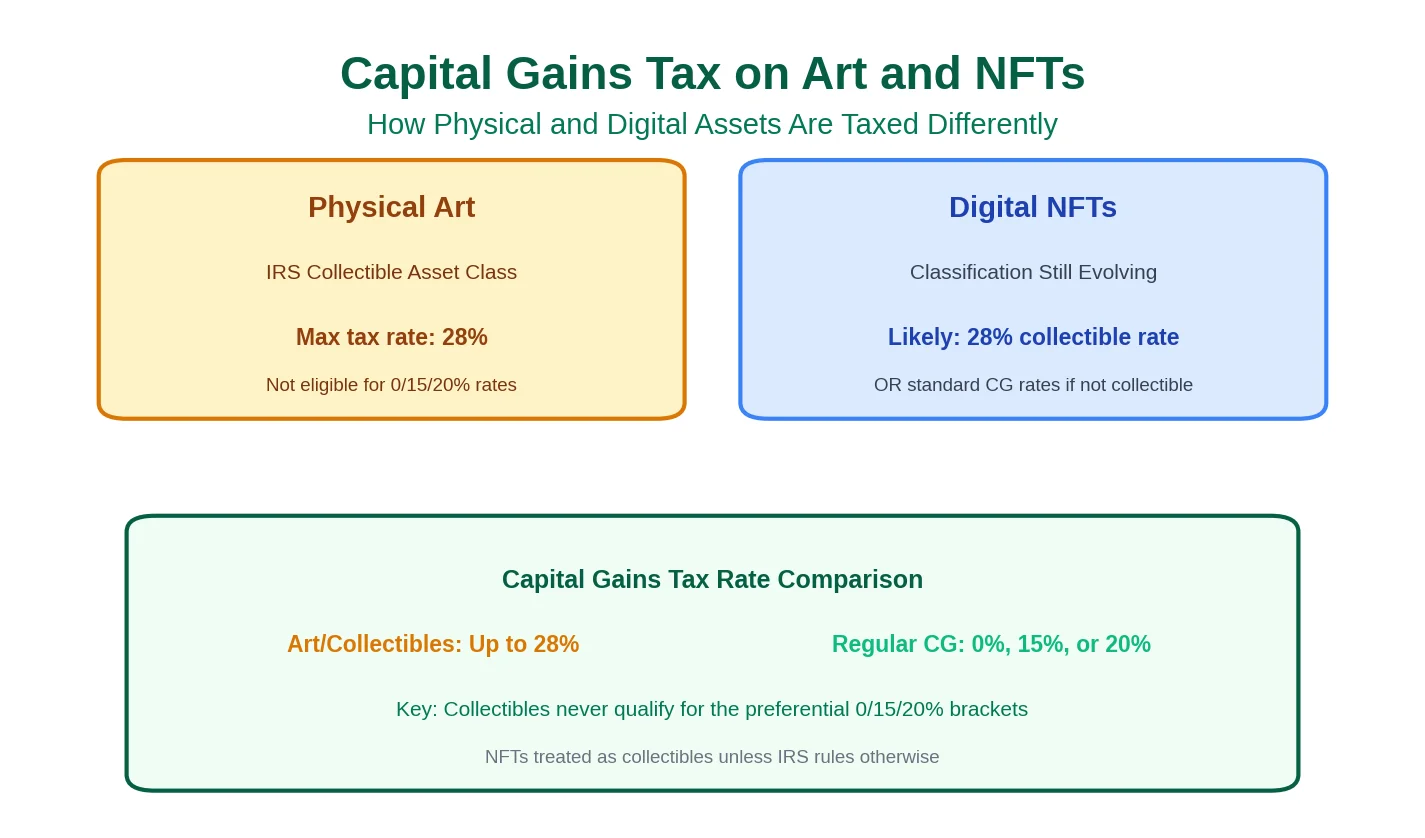
Most investors know that long-term capital gains on stocks are taxed at a maximum rate of 20 percent. But when you sell a painting, a sculpture, or a digital artwork in the form of an NFT, the rules change dramatically. The IRS classifies these assets as collectibles, and collectibles are subject to a maximum capital gains rate of 28 percent — significantly higher than the rate that applies to most other investments.
This higher rate catches many people off guard, especially those who entered the NFT market during the 2021 boom and are now facing substantial gains on their digital assets. The tax treatment of art and NFTs is complex, evolving, and sometimes unclear, but the basic principles are well-established. Understanding them before you sell can save you from a nasty surprise at tax time.
The foundational concept here is that the IRS treats collectibles differently from other capital assets. This distinction has been part of the tax code since the Revenue Act of 1938, and it has been updated over the decades to include new categories of collectible assets. The capital gains tax rules for collectibles are some of the most nuanced in the entire Internal Revenue Code, and they deserve a careful read if you own any type of collectible asset.
✅ Key Takeaway: Art and NFTs are classified as collectibles by the IRS, which means the maximum long-term capital gains rate is 28 percent — not the 20 percent rate that applies to stocks and other capital assets. This 8-point difference can cost you thousands of dollars on a large sale.
How the IRS Defines Collectibles
The Internal Revenue Code Section 408(m) defines collectibles to include a specific list of asset categories. The statute explicitly names works of art, rugs, antiques, metals (with some exceptions for certain coins), gems, stamps, coins, and alcoholic beverages. If you are holding any of these assets as an investment, the gains are taxed at the collectibles rate.
It is important to note that the classification depends on how you hold the asset, not just what the asset is. If you buy a painting for personal enjoyment in your home, it is still a collectible for tax purposes, but the gain is only recognized when you sell it. If you buy a painting as a dealer — someone who buys and sells art in the ordinary course of business — the gains are treated as ordinary income, not capital gains at all. The distinction between an investor and a dealer can be blurry, and the IRS looks at factors like the frequency of transactions, the holding period, and your intent at the time of purchase.
There is also a special rule for gold and other precious metals. Physical gold bullion, gold coins, and certain other metals are classified as collectibles, even though they might seem like ordinary investments. The exception is that certain coins minted by the U.S. Treasury and certain bullion that meets specific purity standards are treated as capital assets rather than collectibles. This is a narrow exception, and most gold investments held in physical form are still subject to the 28 percent rate.
⚠️ Common Misconception: Many people assume that because NFTs are digital, they are taxed like cryptocurrency. This is not correct. While the IRS has not issued specific guidance on every type of NFT, the general consensus among tax professionals is that most NFTs — especially digital art and collectibles — are classified as collectibles, not as regular capital assets. This means the 28 percent rate likely applies.
Capital Gains Tax Rates for Collectibles vs. Regular Assets
The tax rate on collectibles is fundamentally different from the rate on regular capital assets. For regular long-term capital gains — such as gains on stocks, bonds, and real estate — the rates are 0 percent, 15 percent, or 20 percent, depending on your taxable income. For collectibles, the long-term capital gains rate is a flat 28 percent, regardless of your income bracket.
However, there is a nuance that many people miss. The 28 percent rate is a maximum, not a flat rate. If your ordinary income tax bracket is lower than 28 percent, you pay the lower rate. The collectibles rate is effectively the lesser of your ordinary income rate or 28 percent. So if you are in the 12 percent bracket, your collectibles gain is taxed at 12 percent, not 28 percent. This is an important distinction that can work in your favor if your income is relatively low.
To understand the full picture, review the complete breakdown of capital gains tax rates and see how the collectibles rate fits into the overall rate structure. The key takeaway is that the collectibles rate is always at least as high as the regular capital gains rate, and often significantly higher.
| Asset Type | Max Long-Term Rate | Short-Term Rate | Classification |
|---|---|---|---|
| Stocks and Bonds | 20% | Ordinary income | Capital asset |
| Real Estate | 20% (25% unrecaptured) | Ordinary income | Capital asset |
| Physical Art | 28% | Ordinary income | Collectible |
| NFTs (Digital Art) | 28% | Ordinary income | Collectible (likely) |
| Gold and Precious Metals | 28% | Ordinary income | Collectible |
| Cryptocurrency | 20% | Ordinary income | Capital asset |
How NFTs Are Taxed: Current IRS Guidance
The tax treatment of NFTs is one of the most actively debated topics in the tax community. The IRS has not issued specific guidance that addresses NFTs by name, but the general principles are clear enough to provide a framework for tax planning. The key question is whether an NFT is classified as a collectible, a regular capital asset, or something else entirely.
Most tax professionals believe that NFTs representing digital art, collectible items, and similar assets are classified as collectibles under Section 408(m). The reasoning is straightforward: the statute includes "works of art" in its definition of collectibles, and digital art is a form of art. The IRS has informally indicated that it views NFTs as digital representations of collectibles, which would subject them to the 28 percent rate.
However, not all NFTs are necessarily collectibles. An NFT that represents a functional utility — such as access to a platform, a membership token, or a gaming item with functional use — might be classified differently. The tax treatment depends on the nature of the underlying asset, not the fact that it is tokenized on a blockchain. This is a gray area, and the IRS may issue more specific guidance in the future.
What is clear is that the purchase and sale of NFTs creates taxable events. When you buy an NFT using cryptocurrency, you are disposing of the crypto, which triggers a capital gain or loss on the crypto itself. When you sell the NFT, you recognize a gain or loss on the NFT. And when you trade one NFT for another, you are treated as selling one asset and buying another, which triggers two taxable events. This creates a cascade of tax obligations that many NFT traders overlook.
For more on how digital currencies are taxed, read our article on capital gains tax on cryptocurrency, which covers the foundational rules that apply to all crypto transactions, including those used to purchase NFTs.
NFT Transaction Tax Flowchart
Every NFT transaction has tax implications. Here is a breakdown of the most common scenarios and their tax consequences:
📊 Buying an NFT with crypto: You must calculate and report the gain or loss on the cryptocurrency you used to make the purchase. If you bought Ethereum at 200 dollars and it was worth 3,000 dollars when you used it to buy an NFT, you have a 2,800 dollar gain on the Ethereum.
📊 Selling an NFT for crypto: You recognize a gain or loss on the NFT based on the difference between your basis (what you paid for it) and the fair market value of the crypto you received. The gain is likely taxed at the 28 percent collectibles rate if held long-term.
📊 Trading one NFT for another: This is treated as a sale of the first NFT and a purchase of the second. You must recognize gain or loss on the NFT you gave up, and your basis in the new NFT is the fair market value at the time of the trade.
📊 Minting an NFT: The minting process itself is not a taxable event, but the gas fees you pay in crypto are. You must calculate the gain or loss on the crypto used to pay gas fees at the time of the transaction.
📊 Earning royalties from NFTs: Royalties from NFT sales are treated as ordinary income, not capital gains. This is true whether you are the original creator or you hold a royalty-bearing NFT.
Calculating Your Basis in Art and NFTs
Your basis in an asset is the starting point for calculating your gain or loss when you sell. For art and NFTs, determining your basis can be more complicated than you might expect. The general rule is that your basis is the amount you paid for the asset, including any commissions, fees, and transaction costs. But there are several nuances that can affect your basis calculation.
If you purchased an NFT with cryptocurrency, your basis is the fair market value of the crypto at the time of the purchase, not the amount you originally paid for the crypto. This is an important distinction. If you bought Ethereum at 500 dollars and used it to purchase an NFT when Ethereum was worth 3,000 dollars, your basis in the NFT is 3,000 dollars — not 500 dollars. The 2,500 dollar gain on the Ethereum is a separate taxable event that must be reported.
If you created the art or NFT yourself, your basis is generally the cost of materials and any direct expenses related to creating the work. This does not include the value of your time or labor — the IRS does not allow you to assign a value to your own creative effort for basis purposes. If you are a professional artist, the income from selling your work is treated as ordinary income, not capital gain, which is a critical distinction.
For inherited art and collectibles, the basis is generally stepped up to the fair market value at the date of the decedent's death. This is a significant benefit for heirs, because it eliminates all the unrealized appreciation that occurred during the original owner's lifetime. If your grandmother bought a painting for 5,000 dollars and it was worth 500,000 dollars when she died, your basis is 500,000 dollars, and you only owe tax on appreciation above that amount.
For more on the mechanics of calculating gains and losses, see our guide on how to calculate capital gains tax, which walks through the entire process step by step.
Short-Term vs. Long-Term Holding Periods for Art and NFTs
The holding period for art and NFTs works the same way as for other capital assets. If you hold the asset for one year or less before selling, the gain is short-term and taxed at your ordinary income rate. If you hold it for more than one year, the gain is long-term and taxed at the collectibles rate of up to 28 percent.
This creates an interesting dynamic. For short-term gains on collectibles, the rate is the same as your ordinary income rate — up to 37 percent. For long-term gains, the rate is capped at 28 percent. This means the benefit of holding for more than one year is even more significant for collectibles than for regular capital assets. On a 100,000 dollar gain, the difference between a 37 percent short-term rate and a 28 percent long-term rate is 9,000 dollars. That is a meaningful savings for simply waiting a few extra days to sell.
The holding period starts on the day after you acquire the asset and ends on the day you sell it. For NFTs, the acquisition date is the date the transaction was recorded on the blockchain, not the date you placed the order or the date the funds left your wallet. This distinction matters when you are trying to determine whether you have crossed the one-year threshold.
Understanding the difference between short-term and long-term capital gains tax is essential for timing your art and NFT sales effectively. The tax savings from holding an extra few weeks can be substantial, especially for high-value collectibles.
Art Appraisal and Valuation Challenges
One of the biggest challenges with art and collectibles is determining fair market value. Unlike stocks, which have a publicly traded price that is easy to verify, art is inherently subjective. Two identical paintings by the same artist might sell for very different prices depending on the venue, the buyer, and the market conditions at the time of sale.
The IRS requires that art valued above 5,000 dollars be appraised by a qualified appraiser for charitable contribution deductions. For estate tax purposes, art valued above 3,000 dollars must be appraised. While there is no specific appraisal requirement for reporting capital gains on a sale, having a professional appraisal can protect you in an audit by establishing a defensible basis for the asset's value.
If you are claiming a large loss on a sale of art, the IRS may scrutinize the transaction more closely. The agency is aware that the art market has been used for tax evasion schemes, including inflated appraisals, wash sales, and strategic donations of overvalued art. Legitimate collectors and investors should maintain thorough records of their purchase prices, appraisals, and sale transactions to support their tax positions.
💡 Appraisal Tip: If you are donating art to a charity, the IRS requires a qualified appraisal for any item valued above 5,000 dollars, and you must attach Form 8283 to your tax return. For items valued above 20,000 dollars, the IRS may require a photograph of the artwork. For items above 50,000 dollars, the IRS Art Advisory Panel reviews the appraisal. Make sure your appraiser meets the qualifications outlined in IRS Publication 561.
Tax Strategies for Art and NFT Investors
While the 28 percent collectibles rate is higher than the standard capital gains rate, there are several strategies you can use to reduce your overall tax burden on art and NFT investments.
1. Tax Loss Harvesting on Crypto Used for NFT Purchases
When you buy an NFT with cryptocurrency, you trigger a taxable event on the crypto. If the crypto has declined in value since you purchased it, you can harvest that loss to offset other capital gains. This is a common strategy in the crypto space, but you need to be careful about the wash sale rule if you are trading securities. The wash sale rule does not currently apply to cryptocurrency, but the IRS has signaled that it may extend the rule to digital assets in the future.
For a deeper dive into this strategy, read our complete guide to tax loss harvesting, which covers the mechanics, timing, and limitations of this powerful tax reduction technique.
2. Charitable Donations of Appreciated Art
Donating appreciated art to a qualified charitable organization is one of the most tax-efficient ways to dispose of valuable collectibles. If you donate art that you have held for more than one year, you can deduct the full fair market value of the artwork — not just your basis — as a charitable contribution. This eliminates the capital gains tax entirely and provides a deduction at the full market value.
However, there are important limitations. The deduction is generally limited to 30 percent of your adjusted gross income for donations to public charities, and 20 percent for donations to private foundations. Any excess can be carried forward for up to five years. You also need a qualified appraisal for art valued above 5,000 dollars, and the charity must acknowledge the donation in writing.
3. Holding Period Management
As discussed earlier, the difference between short-term and long-term capital gains rates on collectibles can be significant. If you are close to the one-year holding period, it almost always makes sense to wait. The tax savings from qualifying for the 28 percent long-term rate instead of the 37 percent short-term rate can be substantial, especially for high-value pieces.
4. Using Installment Sales for Large Art Transactions
If you are selling a high-value piece of art, an installment sale can spread the gain over multiple years, potentially keeping you in a lower tax bracket. This works especially well for sales above 500,000 dollars, where the gain could push you into the highest tax brackets if recognized all at once. The installment sale rules under Section 453 allow you to recognize gain as you receive payments, which provides both tax savings and cash flow benefits.
🏆 Pro Tip: If you are a serious art collector, consider working with a tax advisor who specializes in art transactions. The intersection of collectibles tax, charitable giving, and estate planning is complex, and the right advisor can help you structure your collection for maximum tax efficiency across multiple strategies.
Reporting Requirements for Art and NFT Sales
Reporting art and NFT sales on your tax return requires attention to detail. The IRS has been increasing its focus on digital asset transactions, and the reporting requirements are becoming more stringent. Starting with the 2025 tax year, brokers facilitating digital asset transactions are required to report sales on Form 1099-DA, which will make it much harder for taxpayers to overlook their NFT gains.
For art sales, you report the gain or loss on Form 8949 and carry the totals to Schedule D. You must indicate whether the gain is short-term or long-term, and you must specify the correct category for the transaction. For collectibles, the long-term gain is reported in Part II of Form 8949, and the tax is calculated on the Schedule D worksheet using the 28 percent rate.
If you are subject to the Net Investment Income Tax of 3.8 percent, your effective rate on collectibles gains could be as high as 31.8 percent. This surtax applies to investment income for taxpayers with modified adjusted gross income above 200,000 dollars for single filers or 250,000 dollars for married filing jointly. It is an additional layer of tax that many art and NFT investors overlook.
Special Considerations for NFT Creators
If you are an NFT creator — someone who mints and sells original digital artwork — the tax treatment is different from that of an investor. Income from the sale of your own creations is treated as ordinary income, not capital gain. This is because you are considered the creator of the asset, not an investor in it. The IRS views this as similar to a painter selling their own paintings: the income is business income, subject to self-employment tax and ordinary income tax rates.
This means NFT creators cannot take advantage of the 28 percent collectibles rate or the lower capital gains rates. Instead, the income is taxed at ordinary income rates of up to 37 percent, plus an additional 15.3 percent in self-employment tax (13.3 percent for the Social Security portion up to the wage base, plus 2.9 percent for Medicare). The combined rate can exceed 50 percent for high-income creators, which is a significant burden.
Creators can offset this income with deductible business expenses, such as software subscriptions, marketplace fees, hardware costs, and a portion of their home office expenses. But the overall tax rate on NFT creation income is substantially higher than the rate on NFT investment gains, which is an important factor to consider when deciding whether to create or invest.
⚠️ Creator vs. Investor: If you both create and invest in NFTs, you must track these activities separately. Gains on NFTs you created are ordinary income, while gains on NFTs you purchased as investments are capital gains (likely at the collectibles rate). Mixing these up can lead to incorrect tax reporting and potential penalties.
Key Takeaways for Art and NFT Tax Planning
🎯 Collectibles are taxed at a maximum rate of 28 percent for long-term gains, which is higher than the 20 percent rate for regular capital assets. Short-term gains are taxed at ordinary income rates.
🎯 NFTs are likely classified as collectibles by the IRS, though the agency has not issued specific guidance. Most tax professionals treat NFT gains as collectible gains.
🎯 Every NFT transaction can trigger a taxable event — buying, selling, trading, and even paying gas fees with crypto. Keep detailed records of every transaction.
🎯 Your basis in an NFT is the fair market value of the crypto you used to purchase it, not the amount you originally paid for the crypto.
🎯 NFT creators face ordinary income tax rates plus self-employment tax on their sales, which can result in an effective rate above 50 percent. This is very different from the collectibles rate that applies to investors.
🎯 Charitable donations of appreciated art can eliminate capital gains tax and provide a deduction at full fair market value, but the appraisal and documentation requirements are strict.
Final Thoughts
The tax treatment of art and NFTs is one of the most complex and rapidly evolving areas of the tax code. The 28 percent collectibles rate creates a significant tax burden compared to other investments, and the lack of specific IRS guidance on NFTs adds uncertainty. But the fundamental principles are clear: if you hold art or NFTs as investments, the gains are likely taxed as collectibles, and you need to plan accordingly.
The best approach is to keep meticulous records of every transaction, understand the holding period requirements, and consider the tax implications before you buy or sell. Whether you are a casual collector, a serious art investor, or an NFT creator, the tax consequences of your transactions can be significant. By understanding the rules and planning ahead, you can minimize your tax burden and keep more of the returns on your creative investments.
For additional strategies on reducing your tax liability, explore our guide on capital gains tax deferral strategies to learn about installment sales, opportunity zones, and other techniques that can help you manage the tax impact of your art and NFT transactions.
Fact-Checked & Reviewed
This article was written by Wasim Akram (Independent Web Publisher & Digital Entrepreneur) and reviewed for accuracy by David Chen (JD, LLM in Taxation (New York University)). Published by Wasim Akram, Founder & Lead Researcher at TaxGainsCalc. All tax rates, thresholds, and rules referenced are based on IRS publications and current tax law as of the date published. Tax laws change frequently — always consult a qualified tax professional for advice specific to your situation.

Founder & Lead Researcher, TaxGainsCalc
Wasim Akram is an independent web publisher and digital entrepreneur based in India. Since 2018, he has been building custom CMS platforms, WordPress plugins, niche websites, and AI-powered digital products with over 8 years of real-world experience....
Tax Attorney & Legal Editor
David Chen is a tax attorney with a Juris Doctor and a Master of Laws in Taxation from New York University School of Law. With over 10 years of legal practice, he specializes in 1031 exchanges, capital gains tax law, and IRS dispute resolution. David...
Founder & Lead Researcher, TaxGainsCalc
Wasim Akram is an independent web publisher and digital entrepreneur based in India. Since 2018, he has been building custom CMS platforms, WordPress plugins, niche websites, and AI-powered digital products with over 8 years of real-world experience....
Disclaimer: This article is for informational purposes only and does not constitute tax, legal, or financial advice. Tax laws and regulations change frequently, and the information presented here may not reflect the most current updates. You should consult with a qualified CPA, tax attorney, or financial advisor before making any tax-related decisions. TaxGainsCalc is not responsible for any actions taken based on the information provided in this article.