Qualified Small Business Stock Exclusion: Section 1202 Tax Exemption Explained
Section 1202 allows you to exclude up to $10 million in capital gains from qualified small business stock. Learn the eligibility requirements, holding period rules, and how this powerful tax exemption can save you hundreds of thousands of dollars.
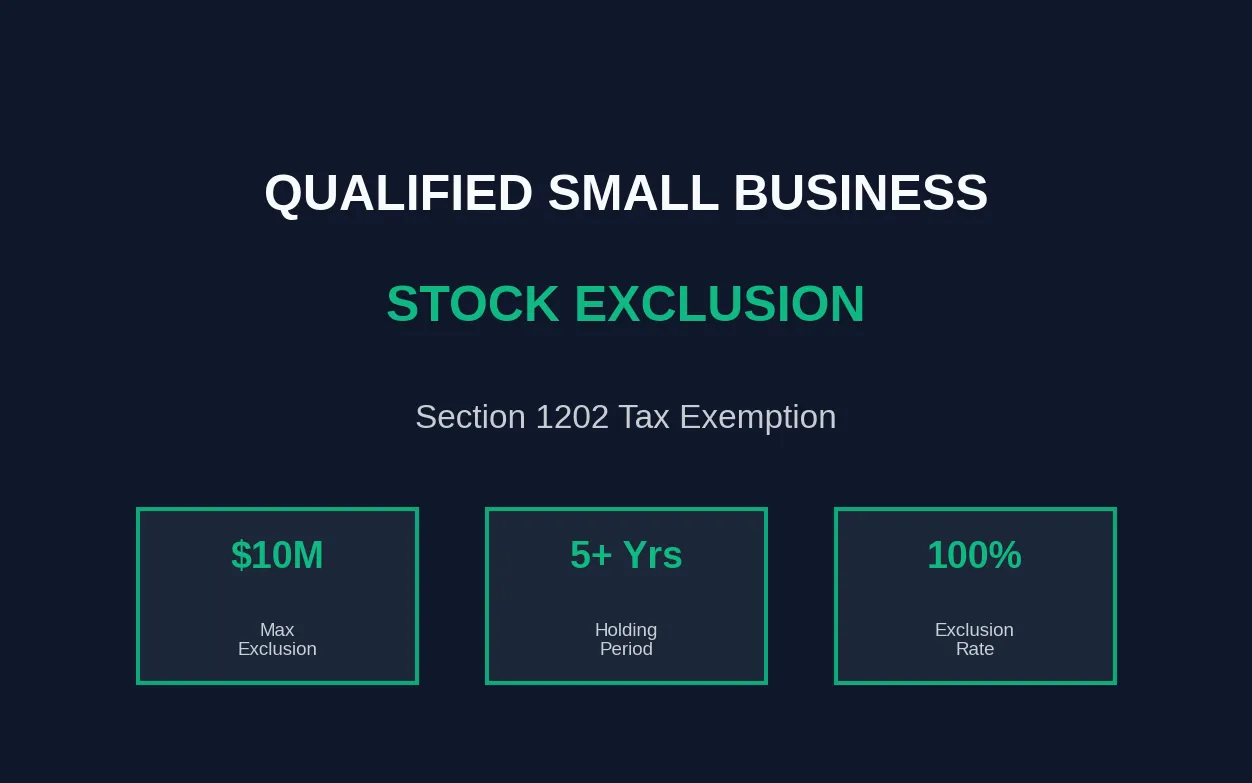
Section 1202 of the Internal Revenue Code provides one of the most generous tax benefits available to investors and entrepreneurs in the United States. If you hold qualified small business stock (QSBS) for more than five years, you can exclude up to 100 percent of your capital gains from federal income tax, subject to a maximum exclusion of $10 million or ten times your basis in the stock, whichever is greater.
This exclusion is extraordinarily powerful. For a founder or early investor who holds QSBS for the required period, the tax savings can reach millions of dollars. A $10 million gain that would normally incur a $2 million federal capital gains tax bill could be completely tax-free under Section 1202. This makes QSBS one of the most valuable tax planning tools available for startup founders and angel investors.
What Is Qualified Small Business Stock?
Qualified small business stock is stock in a domestic C corporation that meets specific requirements at the time of issuance and throughout the holding period. The corporation must have gross assets of $50 million or less at the time the stock is issued, and the stock must be originally issued to the taxpayer, not purchased from another shareholder.
The $50 million asset test is based on the aggregate gross assets of the corporation and its affiliates. Gross assets include cash, accounts receivable, inventory, and the adjusted basis of other property. The corporation must also be an active trade or business, meaning it cannot be a holding company, investment vehicle, or passive business.
Eligibility Requirements
For stock to qualify as QSBS, several requirements must be met. The issuing corporation must be a domestic C corporation. S corporations, partnerships, and LLCs taxed as partnerships do not qualify. The corporation must have aggregate gross assets of $50 million or less immediately after the issuance of the stock.
The stock must be acquired by the taxpayer at its original issuance in exchange for money, other property, or as compensation for services. Stock purchased on the secondary market does not qualify. Stock received as a gift or through inheritance may qualify if the original acquisition met the requirements.
The corporation must use at least 80 percent of its assets in the active conduct of a qualified trade or business during substantially all of the taxpayer holding period. Certain businesses are excluded from qualification, including personal services businesses like law firms and medical practices, banking, insurance, financing, farming, and hotels and restaurants.
The Section 1202 Exclusion Amount
The exclusion percentage depends on when the QSBS was acquired. For stock acquired after September 27, 2010, the exclusion is 100 percent of the gain. For stock acquired between February 18, 2009 and September 27, 2010, the exclusion is 75 percent. For stock acquired before February 18, 2009, the exclusion is 50 percent.
The maximum exclusion is the greater of $10 million or ten times the taxpayer basis in the QSBS. This is a per-issuer limit, meaning if you hold QSBS in multiple qualifying corporations, you can exclude up to $10 million per corporation. For founders who invest small amounts that grow into large gains, the ten times basis rule can significantly increase the exclusion.
Example of the Exclusion
Suppose you invested $500,000 in a qualified small business in 2018 and sold the stock in 2024 for $12 million after holding it for more than five years. Your gain is $11.5 million. The maximum exclusion is the greater of $10 million or ten times your $500,000 basis, which is $5 million. Since $10 million is greater, your exclusion limit is $10 million.
Under the 100 percent exclusion, you can exclude $10 million of the $11.5 million gain. The remaining $1.5 million is subject to the 28 percent maximum capital gains rate for QSBS gains that exceed the exclusion, resulting in approximately $420,000 in federal tax. Your total tax savings compared to a regular capital gains sale would be approximately $1.5 million.
The Five-Year Holding Period
The five-year holding period is one of the most critical requirements for the Section 1202 exclusion. You must hold the QSBS for more than five years from the date of acquisition to qualify for the exclusion. The holding period begins on the date the stock is issued, not the date you agree to purchase it.
For founders who receive stock as compensation, the holding period begins on the date the stock is substantially vested. Stock that is subject to a substantial risk of forfeiture does not begin the holding period until the risk lapses. This is an important consideration for founders with vesting schedules.
Early Disposition Strategies
If you need to sell QSBS before the five-year holding period is satisfied, you may be able to defer the gain by rolling the proceeds into new QSBS within 60 days under Section 1045. This rollover provision allows you to maintain the original holding period for the portion of gain that is reinvested, which can be valuable if you are close to the five-year mark.
The Section 1045 rollover requires you to purchase new QSBS within the 60-day window beginning on the date of the sale. The amount of gain that can be deferred is limited to the amount reinvested in new QSBS. This is a powerful tool for investors who need liquidity before the five-year period is up but want to preserve the Section 1202 benefit.
Common Disqualifications
Many potential QSBS holders are disqualified because their corporation does not meet the active business requirement. If the corporation uses more than 20 percent of its assets for non-qualifying purposes, the stock may lose its QSBS status. This can happen if the company accumulates significant cash reserves that are not used in the active business.
Another common disqualification is the corporate structure. S corporations, partnerships, and LLCs do not issue QSBS. Only C corporations can issue qualified small business stock. Many startups initially form as LLCs for tax flexibility and later convert to C corporations, but the conversion must be handled carefully to ensure the QSBS status is preserved.
The Redemption Trap
Section 1202 contains a redemption rule that can disqualify stock if the corporation redeems significant amounts of stock within a four-year period surrounding the issuance of the QSBS. If the corporation redeems stock with a value exceeding 5 percent of the total value of its stock within the period beginning two years before and ending two years after the QSBS issuance, the QSBS may be disqualified.
This rule is designed to prevent taxpayers from engineering redemptions that effectively create a sale while maintaining the QSBS exclusion. It is particularly important for closely held corporations where shareholders may arrange redemptions as part of buy-sell agreements or ownership transitions.
QSBS and Startups
For startup founders, Section 1202 is one of the most valuable tax benefits available. Founders typically receive stock at very low cost, which means their basis is minimal. When the company is sold or goes public after five years, the gain can be enormous, and the $10 million exclusion can save millions in taxes.
The key for founders is to ensure the company remains a qualified small business throughout the holding period. This means monitoring the $50 million gross asset test, maintaining the active business requirement, and avoiding redemptions that could trigger the disqualification rules. Working with a tax advisor who understands QSBS is essential for maximizing this benefit.
Convertible Notes and SAFEs
Many startups raise initial capital through convertible notes or Simple Agreements for Future Equity (SAFEs). These instruments convert to equity in a later financing round, and the question is whether the QSBS holding period begins when the note or SAFE is issued or when it converts to stock.
The IRS has not issued definitive guidance on this issue, but most practitioners believe the holding period begins when the stock is actually issued upon conversion. This means the five-year period starts from the conversion date, not the original investment date. This is an important consideration for angel investors who invest through convertible instruments.
QSBS for Investors
Angel investors and venture capitalists who invest in early-stage companies can benefit significantly from the Section 1202 exclusion. By investing in qualifying small businesses and holding the stock for more than five years, investors can exclude up to $10 million in gains per investment from federal income tax.
This makes QSBS-eligible investments particularly attractive compared to other investment types. The tax-free nature of the gain effectively increases the after-tax return by 20 to 28 percent compared to a regular capital gain. For investors in high-tax states, the benefit is even greater since many states conform to the federal QSBS exclusion.
Interaction with Other Tax Provisions
The QSBS exclusion interacts with other tax provisions in important ways. The excluded gain is not subject to the net investment income tax of 3.8 percent, which provides additional savings. The excluded gain is also not included in the calculation of adjusted gross income for purposes of determining other tax benefits.
However, the excluded gain is included in the calculation of alternative minimum tax (AMT) preferences for stock acquired before 2009. For stock acquired after 2009, the excluded gain is not an AMT preference, which makes the exclusion even more valuable for recent investments.
State Tax Treatment
Not all states conform to the federal QSBS exclusion. California, for example, does not conform to Section 1202 and taxes the full gain at the state level. Other states like New York partially conform, while states with no income tax like Florida and Texas do not impose any additional tax on the gain.
Understanding your state treatment of QSBS is essential for accurate tax planning. In California, a $10 million excluded gain at the federal level would still be subject to the 13.3 percent state income tax, resulting in a state tax bill of approximately $1.33 million. This significantly reduces the benefit of the exclusion for California residents.
Planning Strategies
The most important planning strategy is to ensure the stock qualifies as QSBS from the beginning. This means investing in C corporations that meet the $50 million gross asset test, using the active business requirement, and avoiding redemptions. Working with a tax advisor before making the investment can save millions in taxes later.
Another strategy is to maximize the exclusion limit by making multiple investments in different qualifying corporations. Since the $10 million limit is per issuer, investors who diversify their QSBS investments across multiple companies can potentially exclude far more than $10 million in total gains.
Consider also the timing of your sale. If you are close to the five-year holding period, it may be worth waiting to qualify for the exclusion rather than selling early and paying full capital gains tax. The tax savings from the exclusion can easily exceed the opportunity cost of holding the investment for a few additional months.
Common Mistakes
The most common mistake is failing to verify that the stock qualifies as QSBS before the sale. Many investors assume their stock qualifies without checking the gross asset test, active business requirement, or redemption rules. This can result in a surprise tax bill when the exclusion is denied.
Another mistake is not tracking the holding period properly. The five-year period must be strictly satisfied, and selling even one day early disqualifies the exclusion. Investors should maintain clear records of when the stock was issued and when the five-year period is satisfied.
Finally, some investors fail to consider the QSBS exclusion when planning their overall tax strategy. The capital gains tax rates for QSBS gains that exceed the exclusion are 28 percent, which is higher than the regular 20 percent long-term rate. This means you need to plan for the tax on the non-excluded portion carefully.
Section 1202 is one of the most powerful tax provisions in the Internal Revenue Code, but it is also one of the most complex. Working with a qualified tax professional who understands QSBS is essential for maximizing this benefit and avoiding costly mistakes that could disqualify your exclusion.
Fact-Checked & Reviewed
This article was written by David Chen (JD, LLM in Taxation (New York University)) and reviewed for accuracy by Sarah Mitchell (CPA, MST (Master of Science in Taxation)). Published by Wasim Akram, Founder & Lead Researcher at TaxGainsCalc. All tax rates, thresholds, and rules referenced are based on IRS publications and current tax law as of the date published. Tax laws change frequently — always consult a qualified tax professional for advice specific to your situation.
Tax Attorney & Legal Editor
David Chen is a tax attorney with a Juris Doctor and a Master of Laws in Taxation from New York University School of Law. With over 10 years of legal practice, he specializes in 1031 exchanges, capital gains tax law, and IRS dispute resolution. David...
Certified Public Accountant (CPA)
Sarah Mitchell is a Certified Public Accountant with over 15 years of experience in individual and business taxation. She holds a Master of Science in Taxation from Golden Gate University and specializes in capital gains tax planning, investment tax ...

Founder & Lead Researcher, TaxGainsCalc
Wasim Akram is an independent web publisher and digital entrepreneur based in India. Since 2018, he has been building custom CMS platforms, WordPress plugins, niche websites, and AI-powered digital products with over 8 years of real-world experience....
Disclaimer: This article is for informational purposes only and does not constitute tax, legal, or financial advice. Tax laws and regulations change frequently, and the information presented here may not reflect the most current updates. You should consult with a qualified CPA, tax attorney, or financial advisor before making any tax-related decisions. TaxGainsCalc is not responsible for any actions taken based on the information provided in this article.